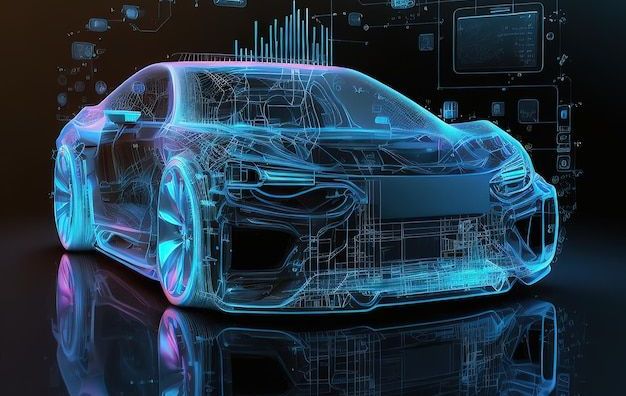
A recent study by the University of Michigan Transportation Research Institute found that the average driver understands only about 30% of the technology in their vehicle. That means 70% of the car's capabilities are essentially a black box. We trust it, but we don't truly know it.
I see this every day. A customer will bring in a car with a complaint, and when I explain that a specific sensor or system is the likely culprit, they give me a blank look. They might say, "I thought it was just a computer thing," or "It's never made that noise before." The truth is, modern cars are packed with hidden tech that works tirelessly in the background. It's designed to be seamless, so you don't notice it until it needs your attention. Understanding a few key systems can transform you from a passive driver into an informed owner.
Let's pull back the curtain on two of the most critical, yet misunderstood, pieces of technology in your car today.
The Guardian You Never See Electronic Stability Control
Most drivers have heard of ESC or seen the little skidding car icon on their dash. Many think it's just a fancy version of anti-lock brakes. That's a dangerous underestimation. ESC is a proactive guardian angel that intervenes before you even realize you're in trouble.
Here's how it works. A network of sensors monitors your steering wheel angle, the rotation of each wheel, and the car's lateral movement dozens of times per second. When the system detects a mismatch between where you're steering and where the car is actually going, it intervenes in milliseconds. It can apply brake pressure to individual wheels and even reduce engine power to help steer the vehicle back on your intended path. The National Highway Traffic Safety Administration credits ESC with reducing single-vehicle crash fatalities by 49% for cars and a staggering 80% for SUVs. NHTSA research shows it's one of the most significant safety advances since the seatbelt.
You'll feel it as a subtle pulsing in the brake pedal or a momentary drop in power, often accompanied by a flashing light on the dash. The mistake is thinking, "I lost power for a second." What actually happened was the system preventing a skid or a spin. If that light flashes, it's not a problem with the car. It's the car telling you it just helped you avoid one.
The Silent Efficiency Manager The Electric Power Steering Rack
Gone are the days of heavy, fluid-filled power steering pumps. Your car almost certainly uses an Electric Power Steering (EPS) system. It's lighter, more efficient, and completely silent. But its hidden intelligence is what's truly impressive.
The EPS module is constantly communicating with other vehicle computers. It doesn't just make steering easier. It adapts. At highway speeds, it firms up the steering feel for stability. At low speeds, like when parking, it becomes incredibly light. Some systems can even provide subtle steering inputs to help correct for crosswinds or a sloped road crown. When a fault occurs, it's rarely a total loss of steering. You'll get a warning light and the steering will become very heavy, a condition often described as "manual steering."
This is where I hear the common phrase, "The wheel feels stiff, but I can still drive it." You can, but you shouldn't for long. Forcing a faulty EPS system can damage the electric motor. The fix isn't always replacing the entire rack. Often, it's a sensor or a connection. A proper diagnosis is key, as highlighted by repair guides from sources like AutoZone that stress checking torque sensors and module communication first.
The Network You're Riding On The Controller Area Network (CAN Bus)
This is the central nervous system. Your car isn't a collection of separate devices. It's a network. The CAN Bus is a robust, two-wire communication system that allows every module from the engine computer to the radio to talk to each other. When you press the unlock button on your fob, it's the CAN Bus that tells the doors to unlock and the interior lights to turn on.
Its genius is in its simplicity and redundancy. This network architecture is why your car can display engine temperature on the dashboard and why a single faulty sensor can sometimes cause seemingly unrelated warnings. The system is so integrated that a problem in one area can send confusing signals to another. I've had customers baffled by a stability control light that was triggered by a faulty wheel speed sensor, a critical data point for the ESC we discussed earlier. Resources like Popular Mechanics often explain how these systems are interlinked, emphasizing that modern diagnostics require understanding this network, not just individual parts.
The takeaway is this. When your car shows multiple warning lights or exhibits strange behavior, it's not necessarily several things breaking at once. It's often one fault on the CAN Bus causing a cascade of confusion for other modules. The solution is rarely to start replacing expensive parts. It's to find the communication error.
You don't need to be an engineer. But recognizing that your car is an integrated network of intelligent systems changes how you interact with it. Listen to the subtle feedback. Understand what the warning lights are truly indicating. That hidden technology isn't there to confuse you. It's there to protect you, improve your drive, and communicate with you. Start listening.
Comments (0)
Please login to join the discussion
Be the first to comment on this article!
Share your thoughts and start the discussion