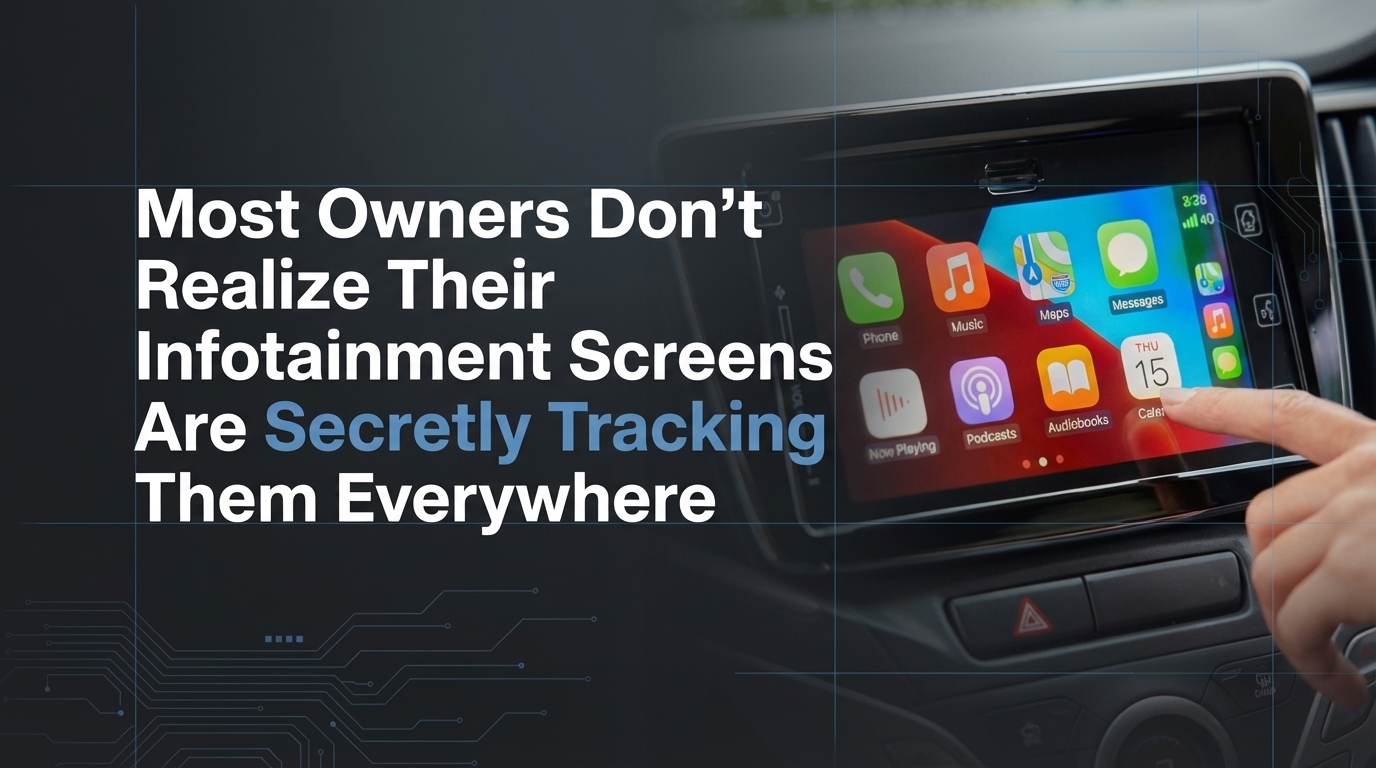
A recent report from the Mozilla Foundation found that 84% of the car brands they reviewed share personal data with third parties, and 76% say they can sell it. That is not about your phone. That is about your car. The infotainment system you use for maps and music is often the primary data collection hub, and most of us have no idea what it is really doing.
I hear the same thing from drivers all the time. "It's just a screen. It's not connected to anything important." That assumption is the problem. Modern infotainment systems are deeply integrated with your vehicle's network. They log far more than your destination. They are watching, listening, and remembering, often without clear consent or a simple way to opt out.
This is not science fiction. It is the standard business model for most connected vehicles today. The data is valuable. Your privacy is often the trade-off for convenience. Understanding what is being collected and how to limit it is the only way to take back some control.
What Your Car Is Actually Collecting
Think beyond your search history. When you pair your phone, the system can access your contact list, call logs, and text messages. Many privacy policies, like those referenced by Consumer Reports, grant permission for this data to be shared. Your driving behaviour is a goldmine. Hard braking, rapid acceleration, speeding events, and even seatbelt use are logged. This "telematics" data can be packaged and sold to data brokers, insurers, or marketing firms.
The microphone and cameras add another layer. Voice commands are processed, and recordings may be retained to "improve services." Interior cameras, increasingly common for driver monitoring, can capture video and biometric data. A driver might think, "I only use it for navigation," but the system's default settings often allow for much broader collection. The line between vehicle function and surveillance is blurrier than most owners realize.
How This Data Leaves Your Car
Your car does not need your phone's hotspot to transmit data. It has its own built in cellular connection, often through an embedded SIM card. This is how you get real time traffic, remote start from an app, and over the air software updates. It is also the pipeline for your personal data.
This transmission happens automatically and continuously. Trip details, diagnostic information, and location pings are sent to the manufacturer's servers. From there, as highlighted by research from Mozilla, it can be shared with a wide network of "service providers" and "business partners." You might see a vague mention of this in the lengthy terms and conditions you clicked through at the dealership. People say, "I had to accept it to use the features." Exactly. That is the choice presented, and it is rarely an informed one.
Practical Steps to Limit Tracking
You cannot stop all data collection if you want to use connected features. But you can significantly reduce your digital footprint. This is not about paranoia. It is about practical privacy.
First, dig into your infotainment settings. Look for menus named "Privacy," "Data Sharing," or "Connectivity Services." Disable everything you do not explicitly need. Turn off "Share Driving Data" or "Improve Product Experience" options. These are usually opt out. Review your connected services account online through the manufacturer's portal and adjust your preferences there too.
Second, be selective with connections. Do not pair your phone if you only need audio. Use an auxiliary cable or a standalone Bluetooth receiver instead. If you do pair, limit the permissions on your phone when the prompt appears. Deny access to contacts and messages. Regularly delete your trip history and destination memory from the navigation system. A common habit is to think, "It's fine, it's only for me." The system is not designed to keep it that way.
Third, consider the nuclear option for the truly concerned. You can often disable the embedded modem by pulling its fuse. This will break all remote and connected features. It is a trade off. For a detailed, vehicle specific guide on what this entails, resources like Car and Driver have explored the technical and legal landscape. This step is not for everyone, but it is the most effective way to shut the data pipeline down completely.
Your car's screen is more than an entertainment center. It is a window into your life that companies are keen to look through. The next time you get in and see that familiar home screen, remember it is a two way street. Data flows out as easily as music flows in. Taking twenty minutes to adjust your settings is not about hiding. It is about deciding for yourself what you are willing to share.
Comments (0)
Please login to join the discussion
Be the first to comment on this article!
Share your thoughts and start the discussion