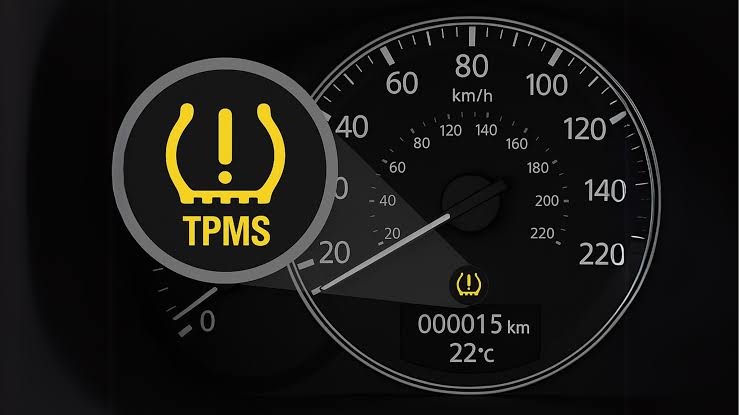
That little yellow horseshoe on your dashboard is a master of psychological warfare. You see it, you pull over, you get out, and you stare at your tires. They look fine. You give them a firm kick. They feel fine. You get back in, the light is still on. The National Highway Traffic Safety Administration (NHTSA) estimates that one in four cars on the road is driving with at least one underinflated tire. The scary part? Most of those drivers have no idea. Your tire pressure monitoring system (TPMS) is trying to tell you something your eyes can't see. When a customer tells me, "The light is on, bu
Your TPMS is smarter than your foot
First, let's clear something up. The system is not measuring the physical shape of your tire. It's measuring the air pressure inside it, typically via a sensor inside each wheel. Modern tires are designed with stiff sidewalls. A tire can be 10, even 15 PSI under its recommended pressure and still appear fully inflated to a casual glance. That "kick test" is completely useless. The threshold for triggering the warning light is usually a drop of about 25% below the vehicle's recommended pressure, as noted in many owner's manuals. So if your car calls for 35 PSI, the light might come on around 26 PSI. At that point, you're losing fuel economy, increasing tire wear, and compromising handling. The tire looks fine. It is not fine.
The temperature is playing tricks on you
This is the most common reason for an intermittent light, especially as seasons change. The air inside your tires is subject to the laws of physics. For every 10°F drop in ambient temperature, tire pressure can decrease by about 1 PSI. You park your car overnight in a 40°F garage after driving all day in 70°F weather. You start it up the next morning, and bam, the TPMS light is on. Drive for 20 minutes, and the light goes off as the tires warm up and pressure increases. People say, "It comes on when it's cold, then goes away." That's not the system being faulty. That's it doing its job, reporting the actual cold pressure. The fix is simple: always check and adjust tire pressures when the tires are cold, meaning the car has been parked for at least three hours. Refer to the placard on your driver's door jamb, not the number on the tire sidewall.
A slow leak is hiding in plain sight
Your tire holds air. Until it doesn't. A tiny nail, a poor seal between the tire and wheel rim, or a failing valve stem can cause a leak so slow you'd never notice it day-to-day. The pressure drops gradually over a week. The light comes on. You add air, the light resets, and the cycle repeats. This is the system's most valuable function: catching a problem before you're stranded with a flat. If you're constantly topping up one specific tire, you have a leak. Submerging the tire in water to find bubbles is the old-school method, but any shop can perform a leak detection test quickly. Ignoring this and simply resetting the light is a gamble. That slow leak can suddenly become a rapid one.
When the problem isn't the tire at all
Sometimes, the message is correct, but the source of the problem is unexpected. The TPMS is an electronic system, and like any other, it can have faults.
A failing sensor battery
Each wheel sensor has a small, non-replaceable battery with a lifespan of 5 to 10 years. When it dies, the sensor stops transmitting. Your car's computer interprets this as "no data" and will often illuminate the TPMS warning light steadily, and sometimes a separate system fault light. The car might display a warning message like "TPMS Fault" or show dashes instead of pressures on the display. This is different from the low-pressure warning. The diagnosis here requires a TPMS scan tool to communicate with each sensor. Replacing the sensor is the only fix.
System interference or reset error
After a tire rotation or replacement, the system needs to be recalibrated so it knows which sensor is at which corner of the vehicle. If this isn't done, the car might tell you your right-rear tire is low when the problem is actually at the left-front. The procedure varies by manufacturer; some require a manual reset with a button, others auto-learn as you drive. Furthermore, electronic interference, though rare, can disrupt the radio frequency signals from the sensors. This is why a proper diagnostic scan is crucial when the cause isn't obvious. Don't assume the computer is always wrong. It's usually following its programming exactly.
Indirect TPMS systems
Some vehicles, particularly older models, use an indirect TPMS. This system has no physical pressure sensors in the wheels. Instead, it uses the wheel speed sensors of the anti-lock brake system to detect if one wheel is rotating faster than the others, which an underinflated tire will do. These systems are more prone to false alarms. A sharp turn, aggressive acceleration, or even a change in tire tread depth can trick it into thinking there's a pressure loss. The light comes on, you check, and pressures are spot-on. Resetting the system according to your owner's manual is the solution. Understanding which type of system your car has is the first step to diagnosing the light.
The practical response when the light illuminates
Don't panic. Don't ignore it. Have a plan. First, find a safe place to stop and visually inspect all four tires for obvious damage or severe deflation. If nothing is apparent, use a reliable tire pressure gauge to check all four tires, including the spare if it has a sensor, against the cold pressure specification on your door jab. Inflate any that are low. The light should go off after a few minutes of driving. If it doesn't, or if it returns quickly, you have a leak or a system fault. Continuing to drive on a significantly underinflated tire generates excessive heat, which can lead to a catastrophic tire failure. The TPMS is a safety system. Treat its warning with the same seriousness as your check engine light. It's providing data your senses cannot. Trust the data, not your gut feeling. Because "they look fine" is never a valid diagnostic procedure.
Comments (0)
Please login to join the discussion
Be the first to comment on this article!
Share your thoughts and start the discussion