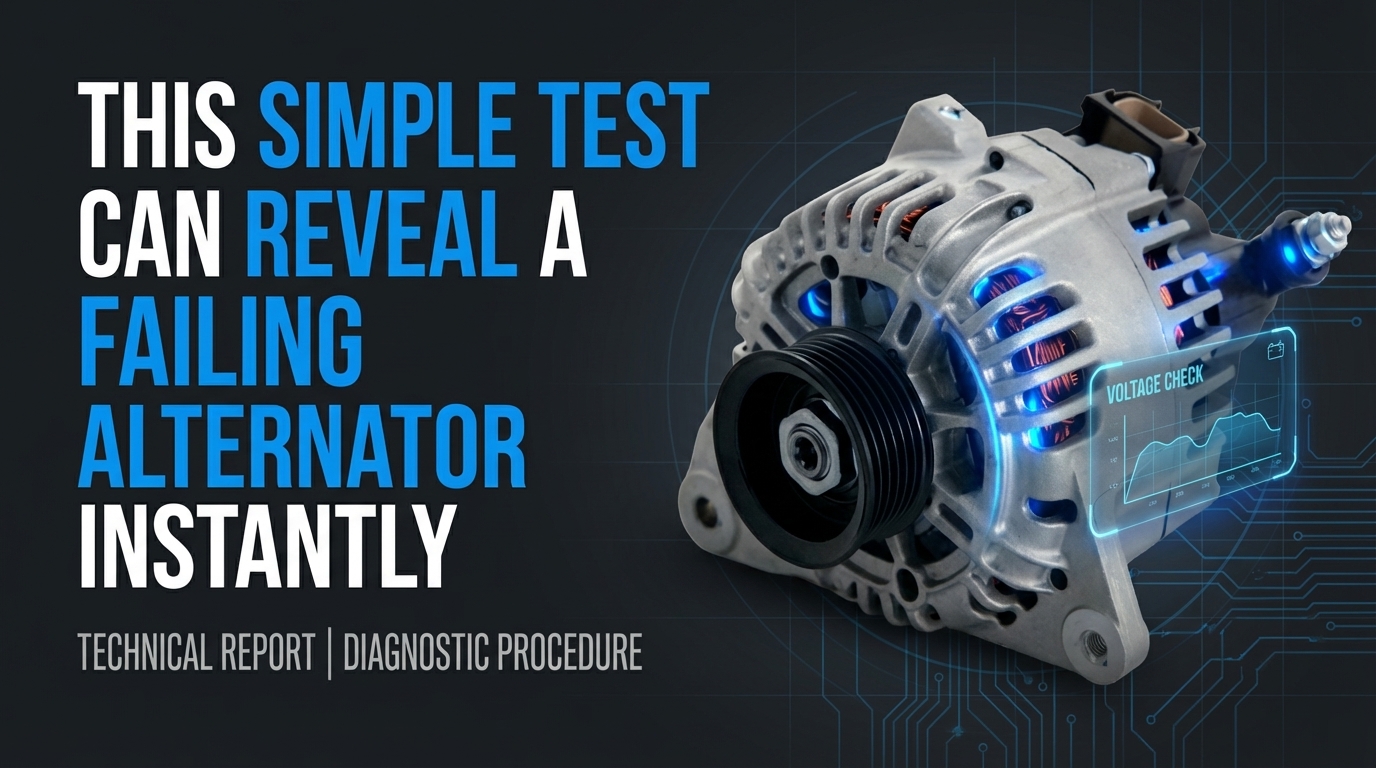
A failing alternator is one of the most common causes of a dead battery and a stranded vehicle. According to data from the National Institute for Automotive Service Excellence (ASE), charging system problems are a leading contributor to roadside breakdowns. Yet, many drivers replace the battery only to find the problem returns in a week. They say, "I put a new battery in it," with a tone of pure frustration. The real culprit was hiding in plain sight the whole time.
I see this pattern constantly. The alternator is the heart of your car's electrical system while the engine runs. When it starts to fail, the symptoms can be subtle at first. You might notice the headlights pulsing at idle or the radio resetting. People often dismiss these signs, thinking, "It's probably nothing, it's always been fine." That assumption is expensive. There's one simple, definitive test you can do in your driveway in under two minutes that will tell you instantly if your alternator is the problem.
The Dashboard Voltage Test
Forget the old-school method of disconnecting the battery while the car is running. That test is dangerous and can fry your vehicle's sensitive electronics. The modern, safe, and accurate method uses a feature already built into most cars made in the last 20 years.
Start your engine and let it idle. Navigate through your instrument cluster's digital display using the buttons on your steering wheel or dash. You are looking for the voltage readout. It's often buried in a "vehicle information" or "status" menu. If your car has this feature, you'll see a number, typically between 12 and 15, followed by a "V."
This is your charging system's output in real time. A healthy alternator should produce between 13.5 and 14.8 volts with the engine running. If your display shows a steady reading in that range, your alternator is likely working. If the number is below 13 volts, or worse, hovering around 12 to 12.5 volts, your alternator is not charging. It's merely matching the battery's voltage, which means it's failing. If the number is above 15 volts, the alternator is overcharging, which will cook your battery and damage electronics. Both extremes mean the same thing: the alternator's internal voltage regulator has failed.
Read Also: Never Test an Alternator by Disconnecting The Battery. Here is Why
The Multimeter Confirmation
Not every car has a dashboard voltage display. If yours doesn't, or if you want to confirm what you're seeing, a basic multimeter is your best friend. You can find one for a very reasonable price, and it's a tool every car owner should have.
Set the multimeter to DC voltage (the "V" with a straight line). With the engine off, touch the red probe to the positive battery terminal and the black probe to the negative terminal. A healthy, fully charged battery should read between 12.4 and 12.6 volts. Now, start the engine. Watch the multimeter display. The voltage should immediately jump up to that target range of 13.5 to 14.8 volts and hold steady. This is the proof your alternator is working.
If the voltage stays at or below 12.6 volts, the alternator isn't producing charge. If the voltage is erratic, jumping around wildly, the alternator is failing intermittently. This test removes all doubt. It gives you a hard number to work with, not a guess based on a dim light. For a deeper dive into using this essential tool, our guide on how to test car sensors and actuators using a multimeter covers the fundamentals.
Listen and Look for Supporting Evidence
The voltage test is definitive, but your senses often pick up the early warnings. A failing alternator frequently makes noise. Listen for a whining, grinding, or growling sound from the front of the engine that increases with engine speed. This often points to worn bearings inside the alternator.
Visually, check the alternator itself. Look for signs of physical damage, a cracked casing, or a seized or wobbly pulley. A loose or glazed serpentine belt can also cause charging issues, so inspect the belt for cracks and proper tension. Sometimes the issue isn't the alternator unit itself but the wiring. Corroded or loose connections at the alternator's output post can prevent charge from reaching the battery. If you suspect a wiring gremlin, our article on how to troubleshoot car wiring problems can help you track it down.
Essential Guide: Unlock the Mysteries of Your Vehicle's Alternator: A Guide to Troubleshooting and Beyond
What to Do After a Failed Test
So your test confirms a bad alternator. Driving the car will drain the battery until it dies, leaving you stranded. The immediate action is to get the vehicle to a repair shop. You can often drive it a short distance on battery power alone if necessary, but avoid using any electrical accessories like headlights, the fan, or the radio.
Replacing an alternator is a standard repair. While it's a doable DIY job for some, it often requires maneuvering in a tight engine bay and dealing with a tightly tensioned serpentine belt. If you're not comfortable, call a professional. Remember, a new alternator won't fix a battery that's been deeply drained multiple times. After replacement, have your battery tested. A weak battery will overwork the new alternator and shorten its life. Understanding the relationship between the two is key, which is why we break it down in alternator versus battery which one actually keeps your car alive on the road.
Don't wait for a total failure. If your lights dim at a stoplight or your battery seems weak, take two minutes and run the voltage test. It's the fastest way to move from guessing to knowing, and it could save you from a very long walk.
Comments (0)
Please login to join the discussion
Be the first to comment on this article!
Share your thoughts and start the discussion