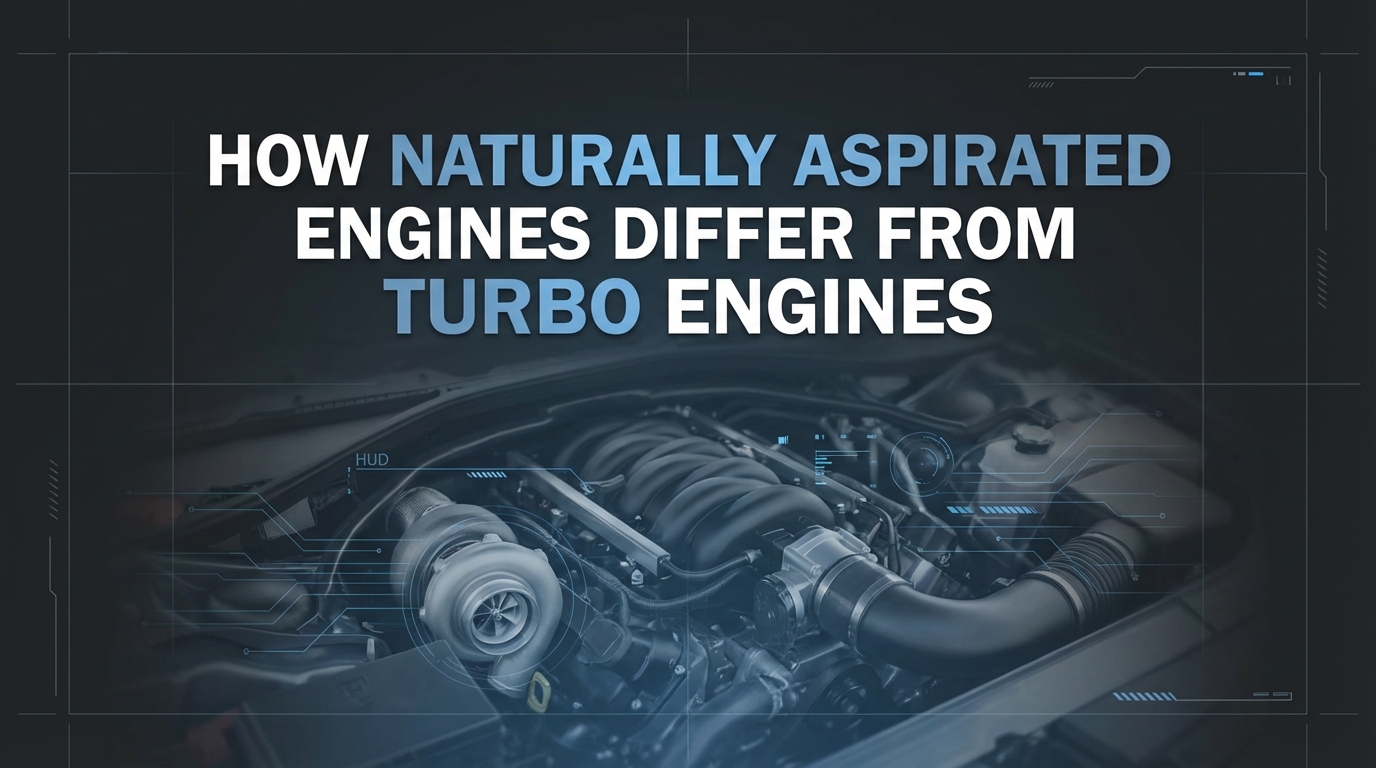
Walk into any dealership today and you will likely hear the same pitch. "This engine has a turbo for more power from a smaller size." It is presented as an obvious upgrade, a universal step forward. But that is a marketing oversimplification. The choice between a naturally aspirated engine and a turbocharged one is not about good versus bad. It is about two fundamentally different philosophies for making power, and each comes with its own set of trade-offs that affect how you drive, maintain, and pay for your car.
I have worked on both types for years, and the difference is not only under the bonnet. It is in the driving experience, the maintenance schedule, and the long-term costs. A driver might say, "It feels quick enough for me," without understanding why one engine feels linear and the other feels urgent. Let us cut through the noise and look at what truly separates them.
The Core Difference How They Breathe
Every petrol engine is an air pump. Power comes from burning fuel, and to burn more fuel, you need more air. This is the fundamental split.
A naturally aspirated (NA) engine is a traditionalist. It breathes on its own. Air is drawn into the cylinders solely by the vacuum created as the pistons move down. Its capacity is limited by its physical size, or displacement. Think of it like breathing normally. You can only inhale as much as your lung capacity allows. For a deeper understanding of this foundational process, see our guide on how a car engine actually works from start to finish.
A turbocharged engine is a forced induction system. It uses a turbine, spun by hot exhaust gases, to drive a compressor that rams additional air into the cylinders under pressure. This lets a smaller engine ingest more air than its displacement would normally allow, like using a turbocharger to supercharge your breathing. This process creates significant heat and pressure, which is why turbocharged engine maintenance requires specific care.
Related Reading: How Does Nitrous, Superchargers, and Turbochargers Boost Your Engine’s Horsepower?
What You Feel Behind the Wheel
This mechanical difference creates two distinct personalities. The driving experience is where owners form their real opinions.
Naturally aspirated engines are praised for their linear power delivery. You press the throttle, and power builds smoothly and predictably in direct relation to engine speed (RPM). There is no waiting, no surge. The power is always accessible, which makes it intuitive and engaging, especially when you need precise control. Enthusiasts often seek ways to increase horsepower in a naturally aspirated engine precisely to preserve this linear character.
Turbocharged engines deliver power in a wave. There is a lag between pressing the throttle and the turbo spooling up to create boost. Once it does, you get a strong surge of torque. This can make a car feel very fast in short bursts, like overtaking. However, that lag can feel like hesitation. You might press the pedal thinking, "It should go now," and there is a brief pause before the acceleration hits. Modern turbos minimize this, but the fundamental characteristic remains.
The Practical Trade-offs You Live With
Beyond the feel, the choice impacts your wallet and your maintenance habits in real ways.
Turbo engines are more complex. They add an entire high-temperature, high-pressure system: the turbo unit itself, intercoolers, additional piping, and more sophisticated engine management. More parts mean more potential failure points. A common driver thought is, "The turbo should last the life of the car." While many do, they are wear items subject to extreme heat and stress. When they fail, it is rarely a cheap fix. For a realistic look at their lifespan, consider the truth about turbo longevity.
This complexity demands stricter maintenance. Turbochargers rely on a constant flow of clean, high-quality engine oil to lubricate and cool their incredibly fast-spinning bearings. Using the wrong oil or extending oil change intervals is a sure path to premature failure. The mantra here is not "I'll check it next service," but "stick to the schedule exactly." This makes synthetic oil virtually mandatory for modern turbo engines.
Naturally aspirated engines, by comparison, are simpler and generally more tolerant. Their thermal and pressure stresses are lower. While they are not immune to problems like engine knocking or overheating, the absence of a turbo system removes a major complex component. This often translates to lower long-term repair costs and a reputation for durability, as seen in engines known for their long life.
In the end, your priority decides. Do you value predictable response, mechanical simplicity, and potentially lower running costs? A naturally aspirated engine delivers that. Do you prioritize maximum power and torque from a small, efficient package and are willing to adhere to stricter maintenance for it? Then a turbo makes sense. Neither is inherently better. They are simply different tools, and the right one depends entirely on the job you need it to do.
Comments (0)
Please login to join the discussion
Be the first to comment on this article!
Share your thoughts and start the discussion