Think of your car's engine as a controlled explosion chamber. Pistons fire, valves open and close, and a whirlwind of motion happens inside. But all that raw, up-and-down energy is useless unless it can be turned into the rotation that spins your wheels. That conversion is the singular, critical job of one component. It's the engine's backbone, and its failure means instant, catastrophic engine death. I'm talking about the crankshaft.
I hear drivers talk about horsepower, turbochargers, and exhaust notes all the time. The crankshaft rarely gets a mention. It's the unsung hero working in the shadows. When someone says, "The engine feels strong," they're feeling the flawless work of a perfectly balanced crankshaft. When they complain, "There's a deep knock from down low," my mind goes straight to crankshaft bearings. This isn't a glamorous part, but it is the absolute linchpin of your engine's operation and longevity.
The Master Translator: From Linear Force to Rotary Motion
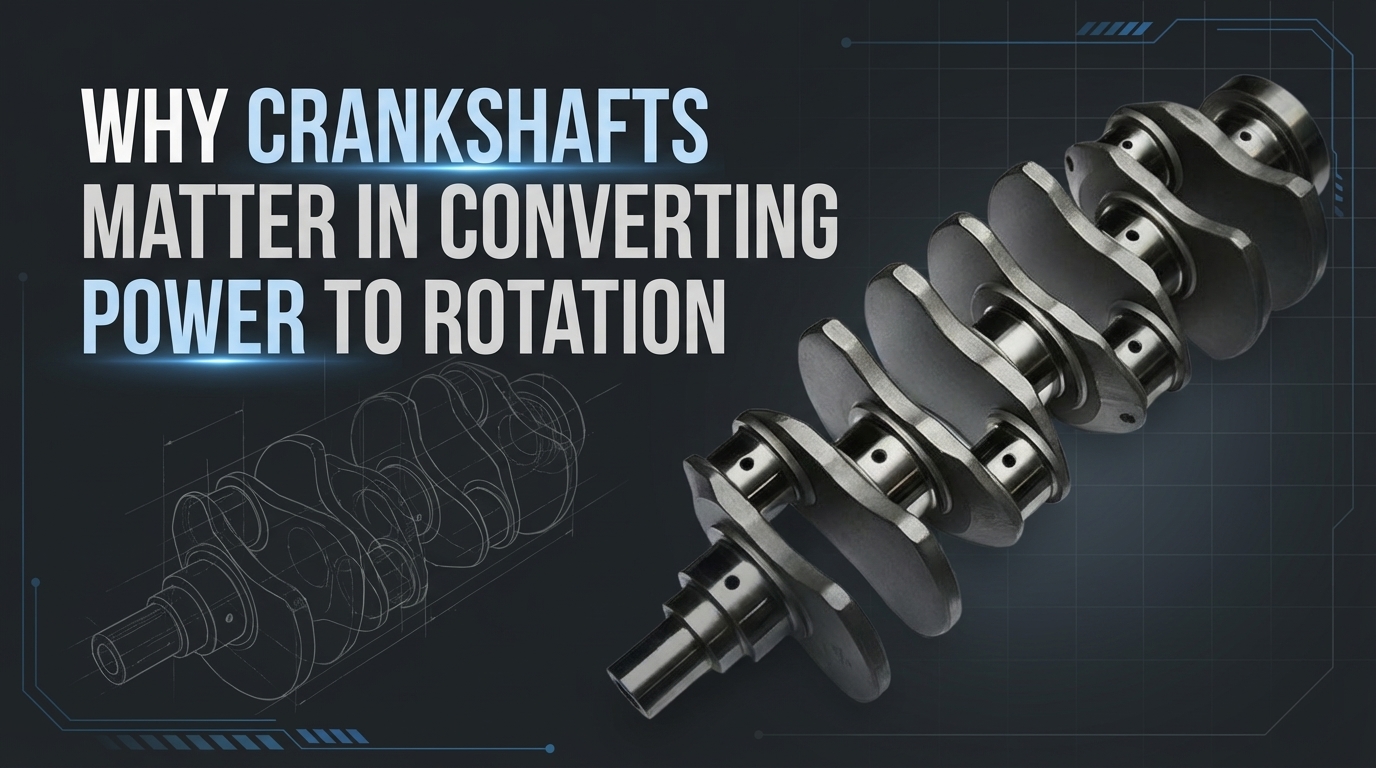
Every power stroke in your engine is a linear event. Fuel and air ignite, forcing the piston straight down its cylinder with tremendous force. On its own, that piston slamming down doesn't move your car an inch. The crankshaft is the ingenious mechanical translator. Its design features offset journals, which are essentially crankpins set away from the centerline of the main rotating shaft.
The connecting rod links the piston to this journal. As the piston is driven down, it pushes on the connecting rod, which in turn applies force to the offset journal. This force creates a turning effect, or torque, on the main shaft. The crankshaft converts that straight-line push into a smooth, continuous rotating motion. This is the fundamental principle that turns explosions into drivable power. Without this conversion, you'd have a very noisy, stationary machine. For a deeper look at the complete combustion process that creates this force, our article on how a car engine actually works from start to finish breaks it down step by step.
More Than a Spinning Bar: The Roles of Balance and Durability
A crankshaft doesn't just spin; it must do so smoothly under immense, constantly changing loads. At high RPM, the forces acting on it are colossal. This is where precision engineering becomes non-negotiable.
First, consider balance. Pistons and connecting rods are heavy. As they reciprocate at high speed, they create significant vibration. The crankshaft incorporates counterweights opposite the journals. These weights act like a counterbalance, offsetting the mass of the piston and rod assembly. A properly balanced crankshaft is what allows a modern engine to run silk-smooth at 3,000 RPM. When you feel a rough idle or a vibration that increases with engine speed, an issue with the crankshaft's balancing system, often the harmonic balancer at the front, can be a culprit.
Second, durability is built-in through material and lubrication. Crankshafts are forged from high-strength steel or cast from durable iron alloys. They rotate on main bearings, which are precision surfaces fed a constant stream of pressurized engine oil. This oil film prevents metal-to-metal contact. The phrase "it's got good oil pressure" is directly tied to crankshaft health. Low oil pressure or dirty oil destroys these bearings. Once a bearing spins, it scores the crankshaft journal. That's when you hear "the knock." It's a expensive sound that often leads to a complete engine teardown or replacement.
Related Reading: Lubrication Systems: Everything You Need to Know
Why Crankshaft Failure is a "Game Over" Scenario
In my years in the workshop, a confirmed crankshaft failure is one of the few diagnoses that makes me give the customer the "engine-out" talk. It's rarely a simple fix. The crankshaft is the central structural member of the engine block. The pistons, rods, timing system, and often the oil pump and transmission are all connected to it or timed to its rotation.
A failure typically happens in one of two ways. A spun main bearing seizes the crankshaft, causing it to stop rotating instantly. This often snaps connecting rods or punches holes in the engine block. Alternatively, a crack can develop in the crankshaft itself due to fatigue or a manufacturing flaw. This leads to catastrophic breakage. In either case, the repair involves removing the entire engine, disassembling it completely, and machining or replacing the block itself. The cost quickly surpasses the value of many older vehicles. This is why that deep, rhythmic knocking from the bottom end is the sound every mechanic and informed driver dreads. It's the opposite of a simple sensor code you can clear.
Keep Reading: The Mechanic Who Rebuilt 100 Engines Explains What Drivers Always Get Wrong
The Practical Takeaway for Every Driver
You don't need to become a crankshaft expert. Your job is to support the system that supports it. It all comes back to oil. Clean, adequate, high-quality oil at the correct pressure is the crankshaft's lifeblood. Stick to your manufacturer's severe service oil change intervals if you do short trips. Never ignore low oil pressure warnings. That light means stop driving, not "I'll check it later."
Listen to your engine. A new deep knock or a significant increase in vibration is a red flag. And while performance modifications can be fun, understand that significantly increasing engine power puts exponentially more stress on the crankshaft and its bearings. It's the foundation. You build a strong house on a strong foundation, not the other way around. The crankshaft is that foundation, silently and reliably turning thousands of tiny explosions into every mile you drive.
Essential Guide: Extend Your Car's Lifespan to 300000 Miles with These Powerful Maintenance Tips
Comments (0)
Please login to join the discussion
Be the first to comment on this article!
Share your thoughts and start the discussion