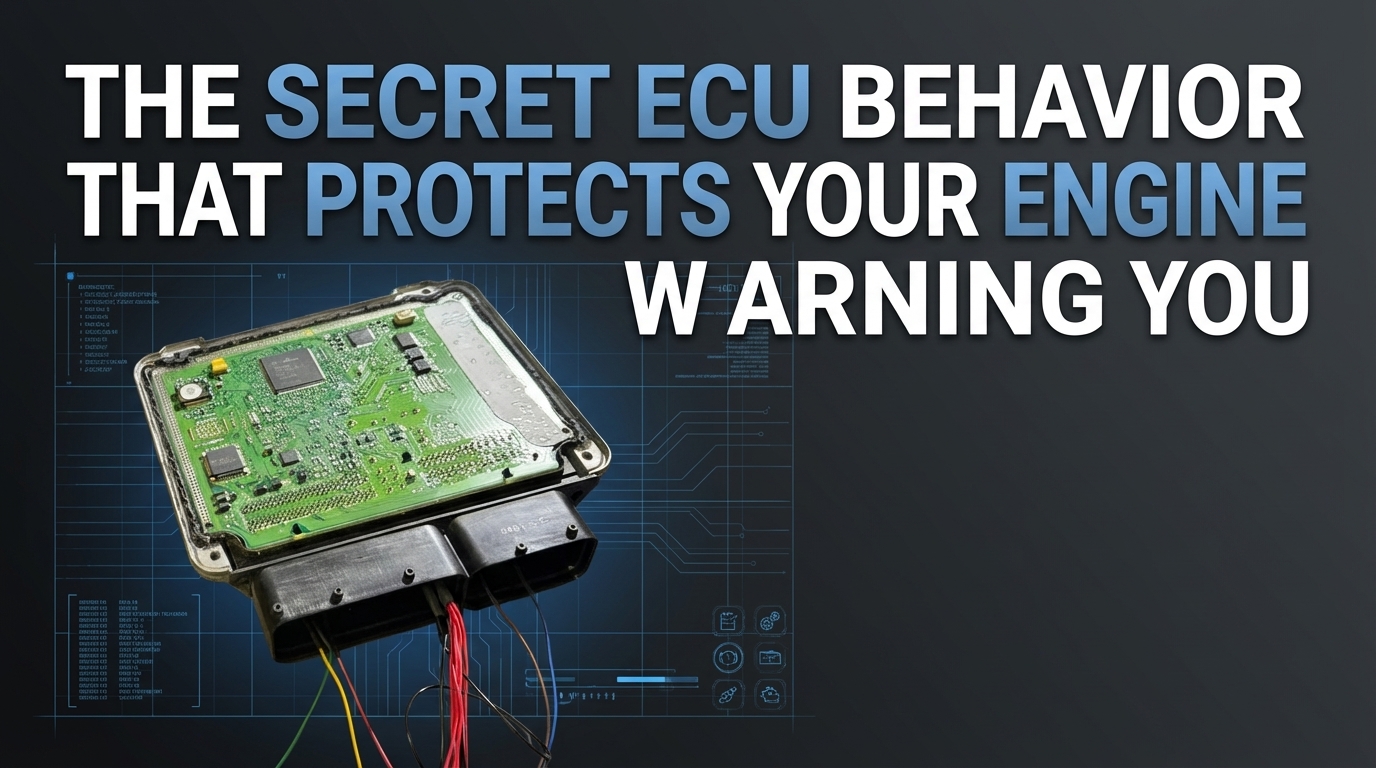
Your car's engine control unit is a silent guardian. It makes thousands of adjustments every second, and some of its most critical protective actions happen without a single dashboard light ever coming on. I hear the phrase all the time in the shop: "The car feels fine, no warnings." That's the point. The ECU's job is to keep it feeling fine, even when it's actively fighting a problem that could destroy the engine. It sacrifices performance and efficiency to keep the pistons moving and the block intact, all while letting you drive home.
This isn't a bug. It's a deeply engineered feature. Modern ECUs are programmed with multiple layers of failure management. The first layer tries to fix the issue internally, like adjusting fuel trims for a dirty sensor. The second layer, when a parameter goes too far out of spec, illuminates a check engine light. But there's a third, often hidden layer: the fail-safe or "limp-home" mode. This is the secret behavior. When the ECU detects a severe fault that could cause immediate mechanical damage, it overrides normal operation. It might cut power, limit RPM, disable cylinders, or lock the transmission in a single gear. And it does this to get you off the road safely, not to warn you of a minor issue. The goal is survival, not diagnosis.
How The ECU Makes The Silent Sacrifice
Think of the ECU as a pilot flying a damaged plane. Its first priority is to keep it in the air, not to explain the problem to the passengers. To do this, it has a set of pre-programmed contingency plans for specific sensor failures.
The Knock Sensor Lifesaver
This is one of the most dramatic examples. Engine knock, or detonation, is when fuel ignites uncontrollably, creating violent shockwaves inside the cylinder. It can shatter pistons and destroy bearings in minutes. The knock sensor listens for this specific high-frequency vibration. When it detects knock, the ECU doesn't wait. It doesn't store a pending code. It instantly retards ignition timing, often by several degrees, to stop the detonation. You might feel a slight loss of power or a dull response. The driver says, "It feels a bit sluggish today." The ECU saved the engine from self-destruction without turning on a light. Only if the knock is persistent and severe will it finally illuminate the check engine light.
Thermal Management Beyond The Gauge
Your coolant temperature gauge is a pacifier. It's heavily dampened to avoid alarming you with normal fluctuations. But the ECU knows the exact temperature, and it acts on it aggressively. If it sees coolant temp approaching a critical threshold, say 115°C, it will take drastic action long before the needle hits the red. It can command the cooling fans to maximum speed, enrich the fuel mixture to cool the combustion chambers, and even reduce engine power output to lower the thermal load. You might notice the fans roaring on a cold day or fuel economy dipping. This is the ECU managing a thermal crisis in real-time. It's trying to prevent the scenario detailed in overheating from driving habits, acting before you even know there's a stress.
Deep Dive: Decoding the Engine Control Unit (ECU): Inputs, Outputs, and Sensor Interactions
Recognizing The Silent Protection In Action
Since the car won't tell you, you need to read the subtle signs. These are not faults to ignore; they are the ECU's distress signals.
Unexplained Loss of Power
This is the big one. You press the accelerator, but the car refuses to rev past 3000 RPM or feels gutless. "It won't get out of its own way," they say. This is classic limp mode. The ECU has detected a catastrophic fault like a massive boost leak, a failed turbo actuator, or a critical sensor discrepancy and has severely limited engine output to prevent damage. It's protecting the turbo from overspeed or the engine from running dangerously lean. The critical engine elements are being safeguarded at the cost of performance.
Erratic Idle or Missing Cylinders
If the ECU detects a misfire severe enough to risk damaging the catalytic converter with unburned fuel, it may shut down fuel injectors to the affected cylinder. The engine will run rough, but it will run. It's sacrificing smoothness to save a very expensive component. This is different from a standard misfire code. The car feels lumpy and weak, but the check engine light might only flash, not stay solid, or it may not come on at all if the ECU believes it has the situation "under control." This is a precursor to issues explored in engine misfire diagnostics.
What To Do When You Suspect Silent Mode
Your response is critical. The ECU has given you a grace period, not a free pass.
First, reduce load immediately. Avoid hard acceleration, towing, or steep grades. Drive gently to your destination or a safe place to stop. The engine is operating in a protected, fragile state. Second, get a professional scan. A basic code reader won't cut it. You need a tool that can read manufacturer-specific codes and, more importantly, live data streams. A technician needs to see what the ECU is seeing: fuel trims, ignition timing adjustments, desired vs. actual boost, and component commands. This data reveals the silent battle happening under the hood.
Finally, understand the cause. The ECU is reacting to a problem. Putting it back into normal mode without fixing the root cause is asking for trouble. Whether it's a failing temperature sensor sending false data or a clogged fuel filter, the underlying fault must be addressed. The ECU's silent protection is a brilliant fail-safe, but it's the last line of defense before a warning light and, ultimately, a breakdown.
Related Reading: How to Read & Understand Live Data Streams from Your Car’s ECU
Trust the feel of the car over the silence of the dashboard. When performance changes dramatically for no apparent reason, your ECU is likely working overtime to protect a vital component. That quiet sacrifice is what keeps you from a catastrophic repair bill. Listen to it.
Comments (0)
Please login to join the discussion
Be the first to comment on this article!
Share your thoughts and start the discussion