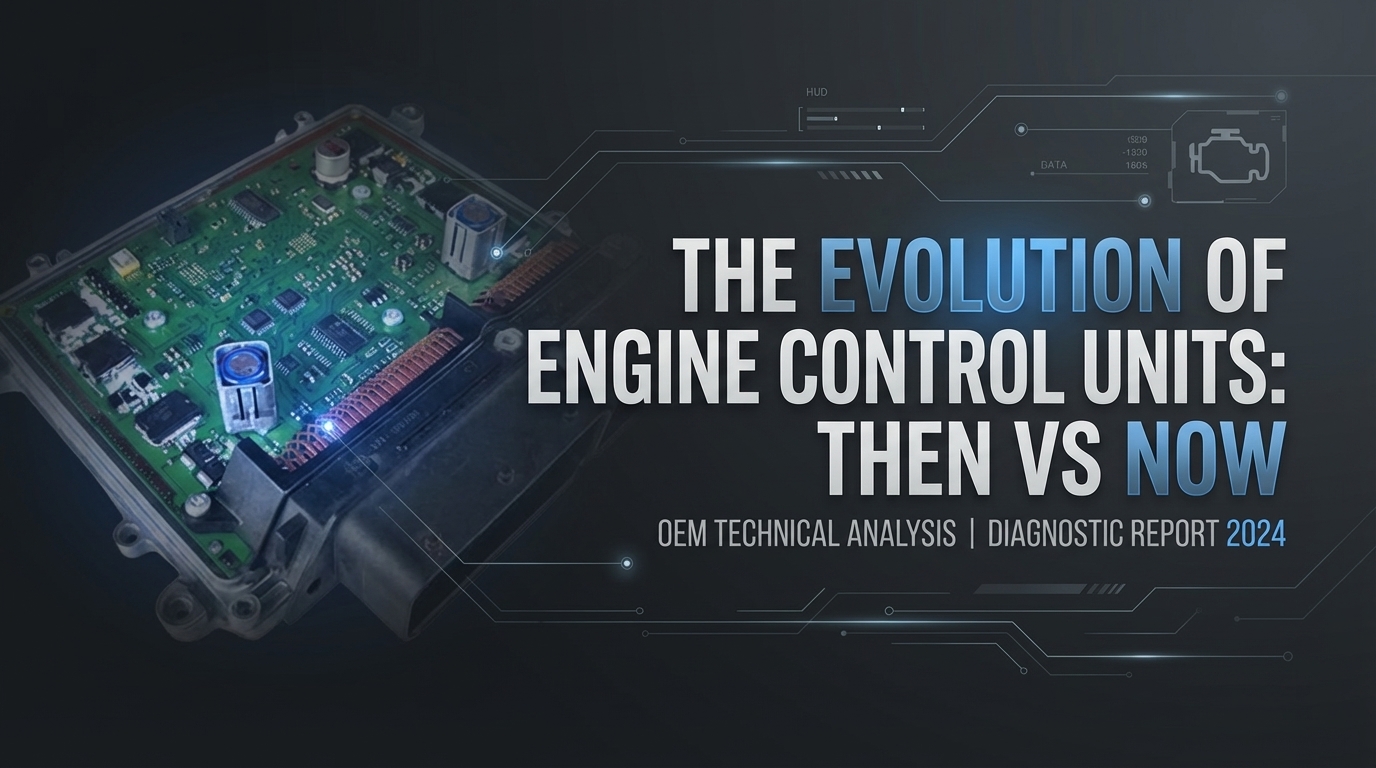
The first production car with a modern electronic engine control unit was the 1978 Cadillac Seville. It had a computer with 5 kilobytes of memory. Today, a single high performance ECU can process over 250 million instructions per second. That's not an upgrade. It's a revolution.
I've heard the old-timer's lament in shops for years. "They don't make 'em like they used to." They're right. They make them smarter, more efficient, and infinitely more complex. The journey from simple spark timing to managing every millisecond of combustion is the most significant leap in automotive history. It transformed the engine from a mechanical beast into a precisely tuned instrument. Let's talk about how.
The Analog Brain Mechanical and Early Electronic Control
Before computers, engines ran on physics, springs, and vacuum. The "control unit" was a collection of mechanical devices. The distributor handled spark timing via centrifugal weights and a vacuum advance diaphragm. The carburetor metered fuel using venturis, jets, and floats. It was elegant in its simplicity, but brutally imprecise.
Drivers from that era remember the rituals. "Choke out on a cold morning, pump the pedal twice." Performance and fuel economy were direct trade-offs. Emissions were an afterthought. These systems could not adapt. A worn carburetor diaphragm or a sticky advance mechanism meant poor running, and diagnosis was a hands-on art of adjustment and replacement.
The first electronic steps were tentative. Systems like GM's early "MISAR" (1977) or Ford's "EEC-I" (1978) were rudimentary. They often controlled only spark timing, relying on a few basic sensors like engine speed and vacuum. Their goal was not optimization, but meeting the new, stringent emissions standards that mechanical systems couldn't satisfy. They were the proof of concept that electronics could live under the hood.
The OBD-I Era The Rise of the True ECU
The 1980s marked the true birth of the Engine Control Unit as we know it. With the integration of fuel injection, the ECU's role exploded. Now it wasn't only about when to spark, but how much fuel to inject. This required more sensors: throttle position, coolant temperature, oxygen sensors in the exhaust.
This is when phrases like "It needs a computer scan" entered the lexicon. OBD-I (On-Board Diagnostics, first generation) gave technicians a flash code a series of check engine light pulses to identify faults. It was basic, but it was a start. The ECU had become the central nervous system, and for the first time, it could report on its own health. Understanding this shift is key, and our guide on decoding the Engine Control Unit breaks down these early input and output relationships perfectly.
Deep Dive: Understanding Engine Control Modules (ECMs) and Their Functions
The Digital Nervous System OBD-II and the Modern ECU
The 1996 model year mandate for OBD-II in the US was the big bang. This wasn't an incremental step. It was a new universe. The ECU was now a powerful, standardized computer required to monitor every component that affected emissions. It tracks catalyst efficiency, fuel trim, misfire counts, and evaporative system integrity.
Modern ECUs don't control. They manage. They make thousands of calculations per second, adjusting for altitude, air temperature, engine load, and even the quality of fuel. They learn your driving style. They can detect a single misfire in one cylinder out of thousands of cycles. This immense responsibility relies on a network of data from dozens of critical engine sensors.
The processing power is staggering. A modern ECU uses 32-bit or even 64-bit microprocessors. It stores multiple high-resolution fuel and timing maps. It can communicate over high-speed CAN (Controller Area Network) buses with the transmission, ABS, and stability control modules, creating a symphony of integrated vehicle control. When one part of this system fails, it can manifest in confusing ways, like a car that has reduced engine power to protect itself.
From Fixed Logic to Adaptive Learning
This is the most profound change. An old carburetor had a fixed jet size. A modern ECU has adaptive long-term and short-term fuel trims. It constantly compares the expected oxygen sensor reading to the actual reading and adjusts fuel delivery in real-time to compensate for wear, like a dirty air filter or a slightly clogged injector.
This is why "I cleaned the MAF sensor and now it runs worse" happens. The ECU had adapted to the dirty sensor's false reading. Correct the reading, and the ECU's learned adaptation is now wrong. It needs drive cycles to re-learn. The system is so sophisticated it can mask problems until they exceed its ability to compensate, which is why a check engine light is a final declaration of failure, not an early warning.
The Future Networked, Electrified, and Software-Defined
The evolution isn't slowing. It's accelerating. We're moving from the ECU to the VCU (Vehicle Control Unit) or domain controllers. In electric and hybrid vehicles, the powertrain controller manages not only motor output but also battery thermal management and regenerative braking, a complex dance detailed in our comparison of different engine architectures.
Connectivity is the next frontier. Over-the-air (OTA) software updates can now recalibrate your engine's performance or efficiency maps overnight, much like your phone updates. The ECU is no longer an isolated module. It's a node in a cloud-connected network. This brings immense capability and new challenges, including cybersecurity, as explored in articles on remote vehicle security.
The core philosophy has flipped. We've gone from a mechanical device with electronic assistance to a software platform that happens to control mechanical hardware. The "tune" is now software. The potential for optimization is nearly limitless, but so is the complexity of diagnosis. It demands a new kind of technician one who understands data networks as well as they understand wrench sizes.
The ECU's evolution is the story of the modern car. It took us from the audible knock of poor timing to the silent, real-time intervention of stability control. It turned brute force into refined efficiency. The next time your car seamlessly adjusts to a steep hill or a passing maneuver, remember the tiny, powerful computer making it happen. It's the difference between an engine that runs and an engine that thinks.
Because "it's got a computer" is no longer an excuse for complexity. It's the reason for capability.

Comments (0)
Please login to join the discussion
Be the first to comment on this article!
Share your thoughts and start the discussion