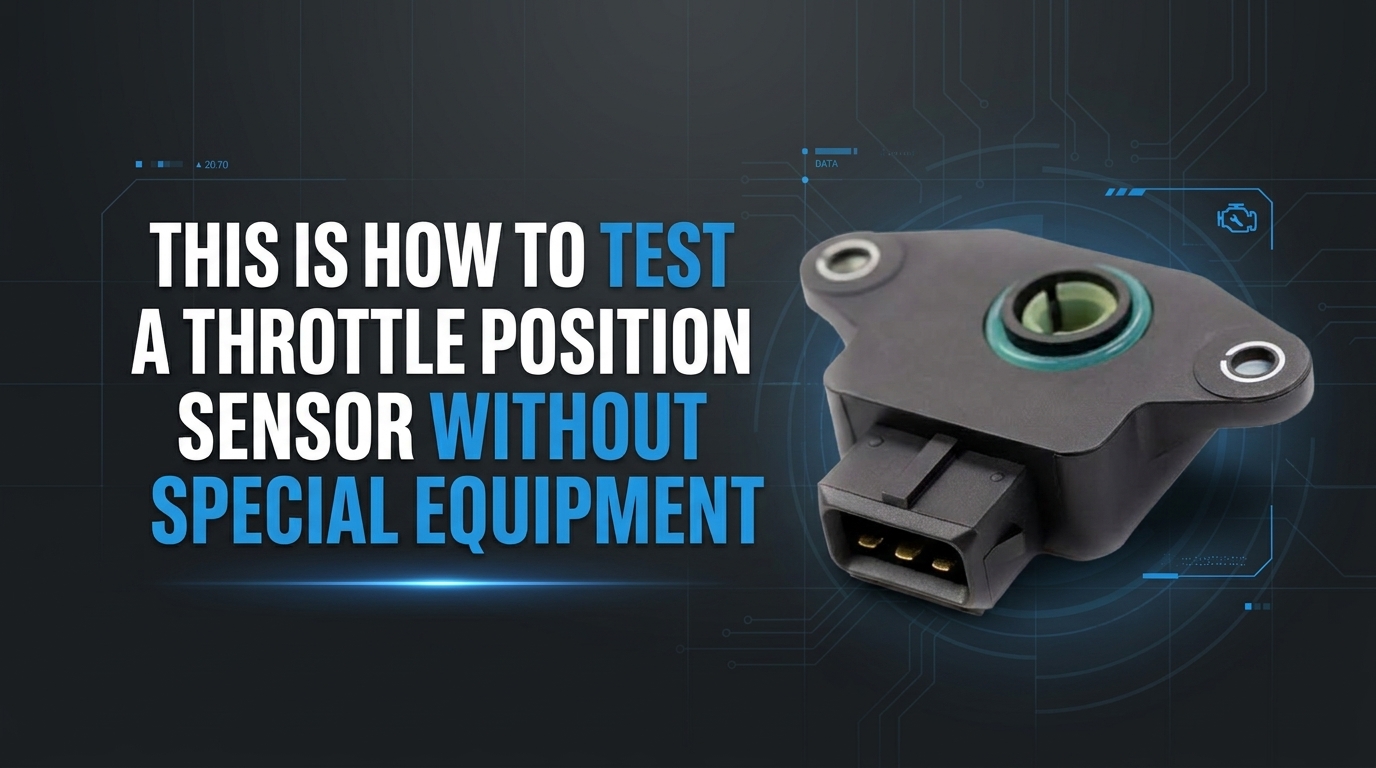
Modern engines rely on a network of sensors to run smoothly, but few are as critical and misunderstood as the throttle position sensor. I hear the same phrase in my shop all the time: "The car feels lazy, but there's no check engine light." That hesitation, that flat spot when you press the pedal, is often the TPS whispering a warning long before it shouts a fault code. You do not need a fancy scan tool to listen. With a simple multimeter, which you can find for under $20, you can diagnose this yourself in minutes. Let me show you how.
Read Also: Throttle Position Sensor (TPS): A Crucial Component for Engine Performance
Understanding What You Are Testing
The throttle position sensor is a simple potentiometer. It is mounted on the throttle body shaft and sends a variable voltage signal to your car's engine control unit (ECU). This signal tells the ECU exactly how far you have pressed the accelerator pedal. A good sensor provides a smooth, linear increase in voltage from idle to wide-open throttle. A bad one has dead spots, jumps, or flatlines, confusing the ECU and causing drivability issues. This is a common root of sensor-related fuel consumption problems you can often fix yourself.
The Symptoms That Point to a TPS Problem
Do not wait for a check engine light. The TPS can fail progressively. Watch for these signs: a sudden surge or hesitation during acceleration, a high or fluctuating idle, stalling when coming to a stop, or poor shifting in an automatic transmission. Drivers often describe it as, "It feels like it's searching for power" or "It bucks when I give it gas." These are classic TPS failure modes. Remember, similar symptoms can come from a dirty throttle body, so inspecting both is wise.
The Hands-On Voltage Test
This is the definitive test. You need a digital multimeter set to DC volts. Safety first: ensure the vehicle is in park with the parking brake on. Locate the TPS on the side of the throttle body. It will have an electrical connector with typically three wires: a 5-volt reference from the ECU, a signal return (ground), and the variable signal wire back to the ECU.
Finding the Signal Wire
With the key in the "ON" position but the engine off, carefully back-probe the connector pins. Do not pierce the wires. You are looking for the pin that shows around 0.5 to 1.0 volts at idle throttle. Gently open the throttle by hand while watching the meter. The voltage should rise smoothly to about 4.5 volts at wide-open throttle. Any sudden drops to zero, spikes, or flat spots where the voltage does not change indicate a faulty sensor. A jumpy needle on an analog meter is a dead giveaway. This process is very similar to testing other critical sensors like the crankshaft position sensor.
Checking for a Proper Ground and Reference Voltage
A bad reading might not be the sensor's fault. Next, check the 5-volt reference. One of the other pins should show a steady 5 volts with the key on. Another should show a good ground connection. You can test this by setting your multimeter to resistance (ohms) and checking continuity between that pin and the vehicle's chassis. No continuity means a broken ground wire, which will mimic a bad sensor. This is a fundamental step in tracking down electrical problems.
Pro Tip: How to Test Car Sensors and Actuators Using a Multimeter
The Audible "Click" Test for Worn Spots
Here is a clever trick that requires no meter at all, only your ears. With the key on and engine off, have an assistant slowly press the accelerator pedal all the way to the floor and then slowly release it. Meanwhile, listen closely at the TPS. You should hear a continuous, smooth, faint scratching or rubbing sound from inside the sensor as the wiper moves across the resistor track. If you hear any clicking, popping, or if the sound cuts in and out, the internal track is worn. This sensor is finished. This audible test is a fantastic quick-check before you even grab your tools.
What Your Results Mean and What to Do Next
If your tests point to a faulty TPS, replacement is the only fix. They are not serviceable. Before you install the new one, it is a perfect time to inspect the throttle plate for carbon buildup. A dirty throttle body can cause similar symptoms and put extra strain on the new sensor. If you proceed, most new TPS units require a calibration. This often involves a simple relearn procedure: with the engine fully warmed up, turn the key off for 10 seconds, then turn it on for 30 seconds without starting, and finally start the engine and let it idle for 2 minutes. Consult a service manual for your specific vehicle. After replacement, clear any stored fault codes with an OBD2 scanner or by disconnecting the battery for a few minutes.
Related Reading: How to Perform a Throttle Body Cleaning for Improved Performance
When the Tests Are Good But Problems Persist
If your TPS tests perfectly, the problem lies elsewhere. The issue could be a vacuum leak, a failing mass air flow sensor, or even a problem with the throttle actuator control motor in drive-by-wire systems. Do not overlook the wiring harness. A chafed wire or corroded connector can cause intermittent faults that are hard to catch. Wiggle the harness while the engine is idling roughly and see if the idle changes. This is a classic technique for finding gremlins in automotive electrical components.
Testing a throttle position sensor is straightforward. It demands patience, not expensive gear. A multimeter and your own senses are powerful diagnostic tools. When a driver tells me, "I know it's not getting the right signal," I know they have done the homework. That understanding turns a confusing drivability issue into a simple swap. You can do this. Trust the process, trust the voltage readings, and you will find the fault.
Comments (0)
Please login to join the discussion
Be the first to comment on this article!
Share your thoughts and start the discussion