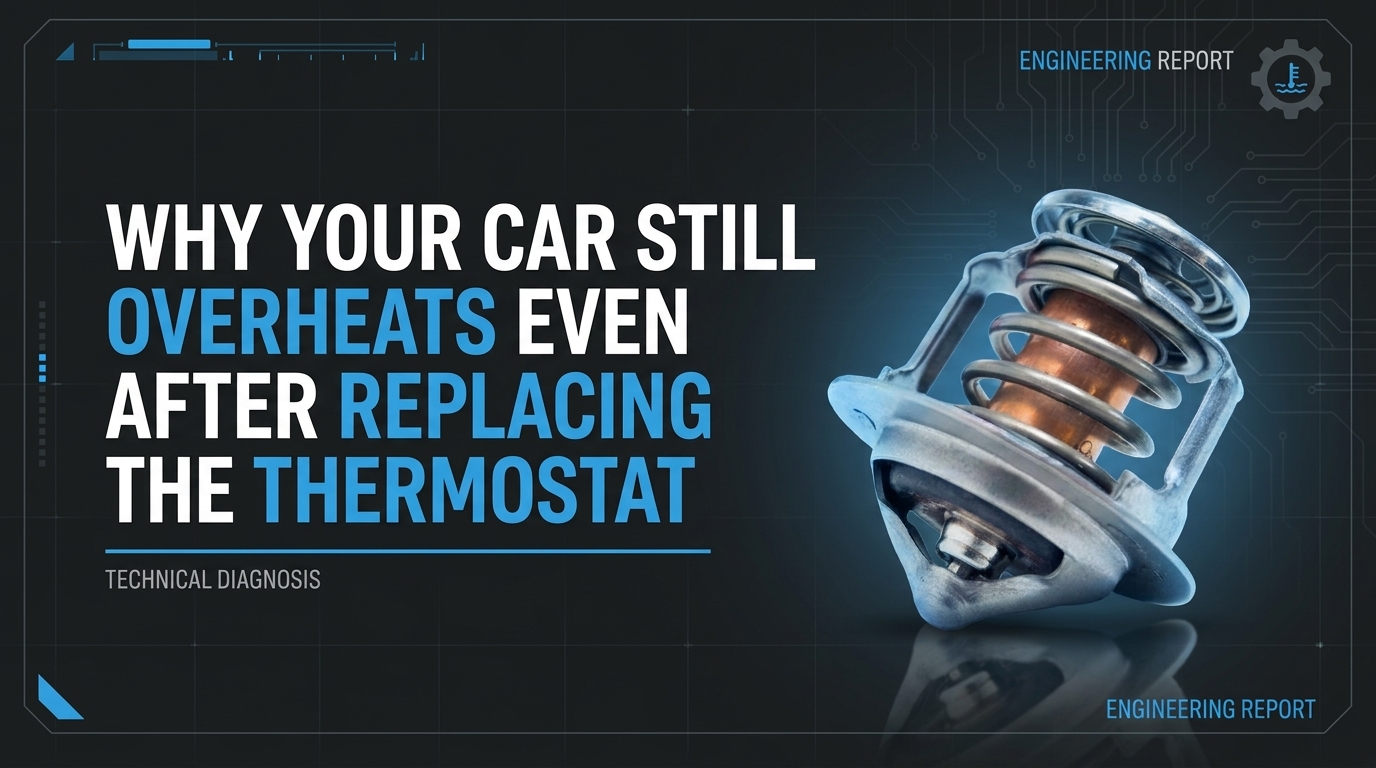
Here is the uncomfortable truth. The thermostat is often not the root cause. It is the part people blame first because it is cheap, easy to reach, and directly connected to temperature regulation in the driver's mind. A stuck closed thermostat can cause overheating. That is true. But a fully functional new thermostat cannot compensate for other failed components in the circuit.
You have replaced the thermostat. You spent the money. You did the work. And your temperature gauge still climbs toward the red zone like nothing changed. I hear this complaint more often than you would believe. According to breakdown data from AAA, cooling system failures account for 11% of all roadside breakdowns in the United States. That statistic tells me one thing. Most drivers fix the wrong part first. "I put a new thermostat in it. That should have solved it." I hear that line with confident certainty right before I point to the real problem. The thermostat is one piece of a larger system. Replacing it does not fix a blocked radiator, a failing water pump, or air trapped in the cooling system. Let me walk you through the real reasons your engine still runs hot.
The Thermostat Was Probably Fine To Begin With
Think of your cooling system like a loop of moving water. The thermostat simply opens and closes a door. If the water cannot flow because something else is blocking it, or if the water is not being pushed hard enough, the door position means nothing. Your engine still cooks.
Air Trapped In The System
This is the most common mistake I see after a thermostat replacement. Air pockets get trapped in the cooling system when coolant is drained and refilled. Air does not transfer heat like liquid does. An air pocket near the engine block or heater core can cause localized hot spots that spike your temperature reading even with a perfect thermostat.
The fix is straightforward. You need to bleed the cooling system properly. Most modern cars have a specific bleed procedure that involves running the engine with the radiator cap off and the heater set to maximum until bubbles stop rising from the filler neck. Check your vehicle repair manual for the exact steps.
If you skipped this step, go back and do it. That single action resolves a surprising number of "still overheating" complaints.
The Radiator Is Partially Blocked
A new thermostat does not fix a radiator that is clogged with debris, scale, or corrosion. Over years of service, the tiny coolant passages inside your radiator can become restricted. Less coolant flows through. Less heat gets transferred to the outside air. The engine temperature climbs steadily, especially under load or in stop and go traffic.
I had a customer once insist the new thermostat was defective. I measured the radiator surface temperature with an infrared gun. The top tank was hot. The bottom tank was cold. That is a classic sign of a blocked radiator core. The coolant could not circulate. The thermostat was fine. A radiator replacement solved the problem completely.
You can check this yourself. Let the engine reach operating temperature and carefully feel the radiator surface. It should be evenly warm across the entire core. Cold spots indicate blockage.
The Water Pump Is Failing
The water pump is the heart of your cooling system. It pushes coolant through the engine block, the thermostat, the radiator, and the heater core. If the pump impeller is corroded, broken, or slipping on its shaft, coolant flow drops dramatically regardless of what the thermostat does.
Some water pumps have plastic impellers that can spin freely on the shaft when they fail. The pump looks fine from the outside. You cannot see the failure without removing the pump. The engine overheats. The gauge rises. The thermostat opens and closes properly, but nothing moves because the pump is not pumping.
You Could Be Cooking Your Engine Every Time You Drive Like This covers the warning signs of pump failure in more detail.
The Cooling Fans Are Not Engaging
Modern vehicles rely on electric cooling fans to pull air through the radiator when the car is stationary or moving slowly. If the fan motor has failed, the fan relay is stuck open, or the engine temperature sensor is sending incorrect data, the fans will not turn on. Without airflow, the radiator cannot shed heat. The temperature climbs.
Test this. Let the engine idle until it reaches normal operating temperature. Watch the cooling fans. They should cycle on and off as the temperature fluctuates. If they never turn on, you have found your problem.
A blown fan relay or fuse is a quick fix. A failed fan motor requires replacement. A faulty coolant temperature sensor can keep the computer from commanding the fans at all.
Low Coolant Level Or Wrong Coolant Mixture
This sounds basic. You would be surprised how often it is overlooked. If the coolant level is low, there is not enough liquid in the system to absorb and carry away engine heat. The thermostat opens, but there is nothing to circulate. The engine overheats.
Check the coolant level in the radiator and the reservoir when the engine is cold. Top it off with the correct mixture of coolant and distilled water. Most manufacturers recommend a 50/50 mix. Pure water boils too easily. Pure coolant does not transfer heat as effectively. The wrong mixture reduces the system's capacity to manage temperature.
For more on how the entire system works together, Understanding Engine Thermostat: A Comprehensive Guide gives you the full picture.
A Blown Head Gasket Lets Combustion Gases Into The Coolant
This is the serious one. If your engine has overheated badly in the past, or if it has high mileage, the head gasket may be compromised. A failing head gasket allows exhaust gases to push into the cooling system. Those gases displace coolant and create air pockets. They also pressurize the system beyond normal limits. The result is chronic overheating that no thermostat replacement will ever fix.
Look for these signs. Bubbles in the coolant reservoir while the engine is running. A sweet smell of coolant from the exhaust. White smoke from the tailpipe. Unexplained coolant loss with no visible leak. If you see any of these, stop driving and get a compression test or a combustion leak test done.
Does replacing engine head gaskets extend the life of the engine? explains what that repair involves and whether it is worth doing.
What To Check Right Now
Stop guessing. Here is the order I use when a car comes in with a new thermostat and the same overheating problem.
First, bleed the cooling system to remove trapped air. Second, check the coolant level and mixture. Third, feel the radiator for cold spots indicating blockage. Fourth, test the cooling fans for proper operation. Fifth, inspect the water pump for leaks or play in the shaft. Sixth, check for exhaust gases in the coolant if you suspect a head gasket failure.
That sequence covers the most likely causes in order of frequency. It saves time. It saves money. And it keeps you from replacing parts that were never broken in the first place.
People say "I changed the thermostat so it should be fine." I say trust the system, not the part. The cooling system has multiple failure points. A new thermostat fixes exactly one of them. Find the real problem before you damage your engine further.
For a deeper look at driving habits that accelerate overheating damage, read this article on cooking your engine.
Keep Reading: Drive Without a Thermostat? Here’s What You Need to Know
Comments (0)
Please login to join the discussion
Be the first to comment on this article!
Share your thoughts and start the discussion