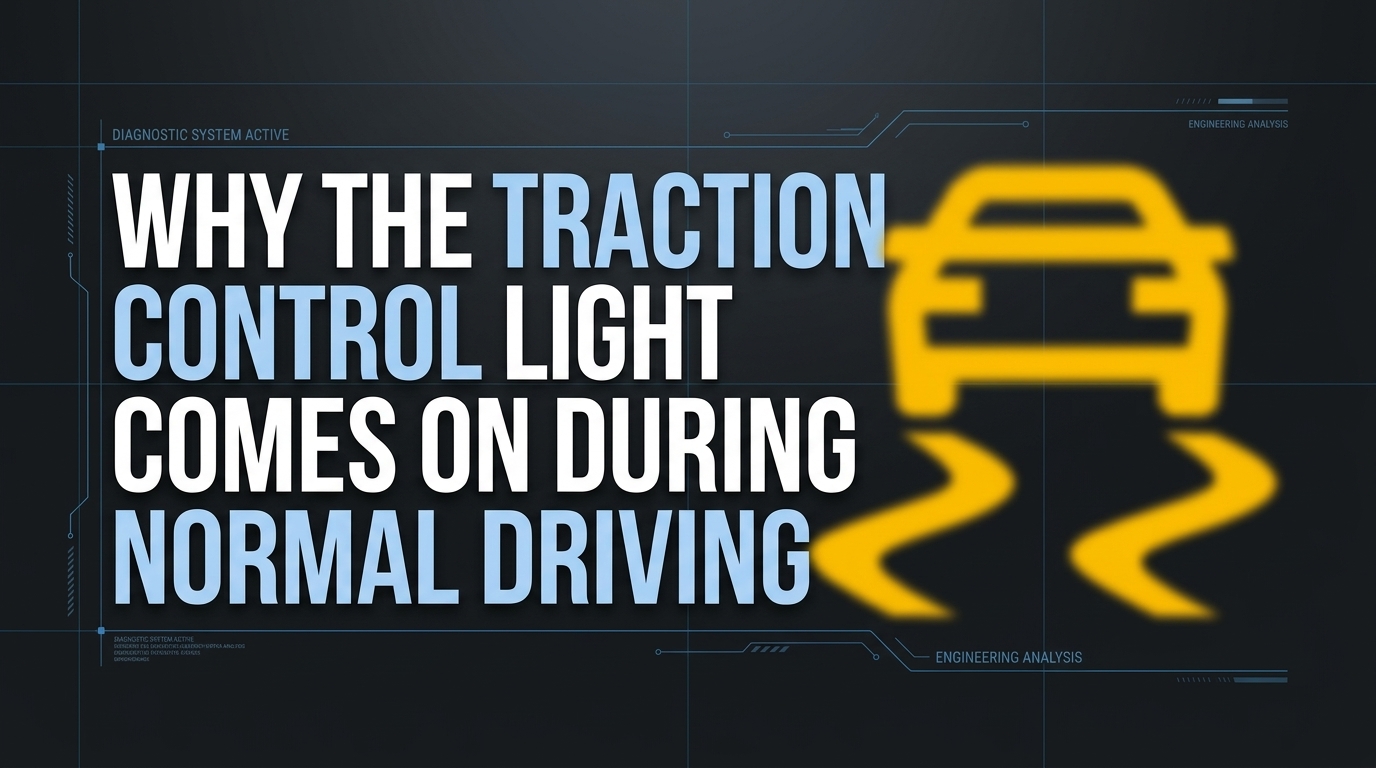
According to the National Highway Traffic Safety Administration, electronic stability control, which relies on the same wheel speed sensors as your traction control system, reduces the risk of a single vehicle crash by 49% for passenger cars. That is a massive safety net. NHTSA data confirms this. Yet I see drivers get confused every day when that little orange light with the squiggly lines flashes on a dry, sunny road. They think something is broken. The car is not broken. It is working. The problem is almost always a mismatch between what the driver feels and what the system detects.
Here is the article.
I hear the same line in the shop all the time. "I wasn't on a slippery road. The light came on for no reason." There is always a reason. The traction control system does not activate for fun. It activates because one of your drive wheels is spinning faster than the other, or because the car's computer senses a loss of grip that your right foot hasn't noticed yet. If you want to understand why this happens during normal driving, you need to look at the three most common causes. They are not mysterious. They are mechanical, tyre related, or sensor related. And one of them is almost certainly the reason for your light.
Your Tyres Are Not Matched or Not Inflated Correctly
This is the most frequent cause I see. And it is the easiest to fix. Your car's traction control system compares the rotational speed of all four wheels. It does this constantly, hundreds of times per second. When the system sees one wheel turning at a different speed than the others, it assumes that wheel is losing traction. It then cuts engine power or applies the brake to that wheel to regain grip.
Here is the problem. If your tyres are not the same size, or if the tread depth varies significantly between the front and rear axles, the wheels will naturally rotate at different speeds. The same thing happens if one tyre is underinflated. A low tyre has a smaller rolling radius. It has to spin faster to cover the same distance. The computer sees this difference and interprets it as wheel slip. The traction control light illuminates. You feel a slight hesitation in acceleration. And you think the car is malfunctioning.
I once had a driver bring in a car insisting the transmission was failing. "The car keeps jerking when I accelerate." The transmission was fine. The front tyres were two different brands with wildly different tread depths. The traction control was doing exactly what it was designed to do. The fix was a set of matched tyres. The driver said, "I know my vehicle." The vehicle knew better. Check your tyre pressures first. Then check that all four tyres are the same size and have similar wear. Most manufacturers recommend replacing tyres in sets of four for exactly this reason. This article explains why the tyre pressure light can behave similarly.
A Failing Wheel Speed Sensor Is Sending Bad Data
Each wheel has a speed sensor. It is a small magnetic pickup that reads a toothed ring attached to the wheel hub. When this sensor gets dirty, or when the gap between the sensor and the ring becomes too large, the signal becomes erratic. The sensor might report that a wheel is stationary when it is moving. Or it might report a sudden spike in wheel speed that never actually happened.
The traction control module relies on accurate data from all four sensors. When one sensor sends garbage data, the module gets confused. It may activate the traction control system unnecessarily. Or it may illuminate the warning light and disable the system entirely. This is not a mechanical problem. It is an electrical signal problem. And it is incredibly common on cars that drive on salted roads or through deep puddles.
A simple scan tool can read the live data from each wheel speed sensor. I do this in under two minutes. I look for a sensor that reads zero when the car is moving, or a sensor that shows a wildly different value than the other three. That sensor needs cleaning or replacement. Do not ignore this. A bad sensor can also trigger the ABS light and the check engine light. The ABS light shares the same sensor network, so if both lights are on, start with the sensors.
Driving on Loose Surfaces or Aggressive Acceleration
This one is the hardest for drivers to accept. You may think you are driving normally. But your car disagrees. Traction control activates when a drive wheel loses grip. That can happen on gravel, on a patch of sand, on wet leaves, or even on a freshly sealed road with loose grit. It can also happen if you accelerate aggressively from a stop, especially in a powerful front wheel drive car.
The system is designed to intervene before you feel the slip. This is what makes it so effective. You might feel a slight pulsing in the accelerator pedal or a brief reduction in power. That is the system cutting torque to regain grip. It feels unnatural. It feels like a fault. It is not a fault. It is a safety intervention that happens in milliseconds.
I tell drivers this. If the light flashes briefly and then goes out, the system did its job. If the light stays on solid, the system has detected a fault and disabled itself. That is the distinction you need to understand. A flashing light means active intervention. A solid light means a system fault. If the light is solid, you need a diagnostic scan. If it flashes occasionally on certain road surfaces, your car is working correctly. The skidding warning light operates on the same principle.
What To Do When The Light Comes On
Stop guessing. Start checking. Here is the order I use in my workshop every single time.
First, verify your tyre pressures are equal on both sides of the same axle. Use a gauge. Do not rely on the visual look of the tyre. A tyre can be 10 psi low and still look full. Second, inspect the tread depth on all four tyres. If the fronts are worn significantly more than the rears, or vice versa, that difference can trigger the system. Third, have the wheel speed sensors scanned for faults. This is a five minute job for any shop with a decent scan tool. Fourth, consider the road surface. If the light only comes on in the same spot every day, like a particular roundabout or a specific on ramp, the surface there is likely the cause.
Most traction control problems are simple. They are not transmission failures. They are not engine problems. They are almost always a tyre mismatch, a low tyre, a dirty sensor, or a perfectly normal system intervention that the driver misinterpreted. Electronic stability control is one of the most underappreciated safety systems on your car.
Final Word
The traction control light is not your enemy. It is your car's way of telling you that something is different. Sometimes that something is a safety intervention that just saved you from a slide you never felt. Sometimes it is a tyre that needs air. And sometimes it is a sensor that needs cleaning. But it is never a reason to panic.
Listen to the car. It is telling you the truth. The driver who says "the light came on for no reason" has not looked hard enough. There is always a reason. Find it. Fix it. Drive on.
Comments (0)
Please login to join the discussion
Be the first to comment on this article!
Share your thoughts and start the discussion