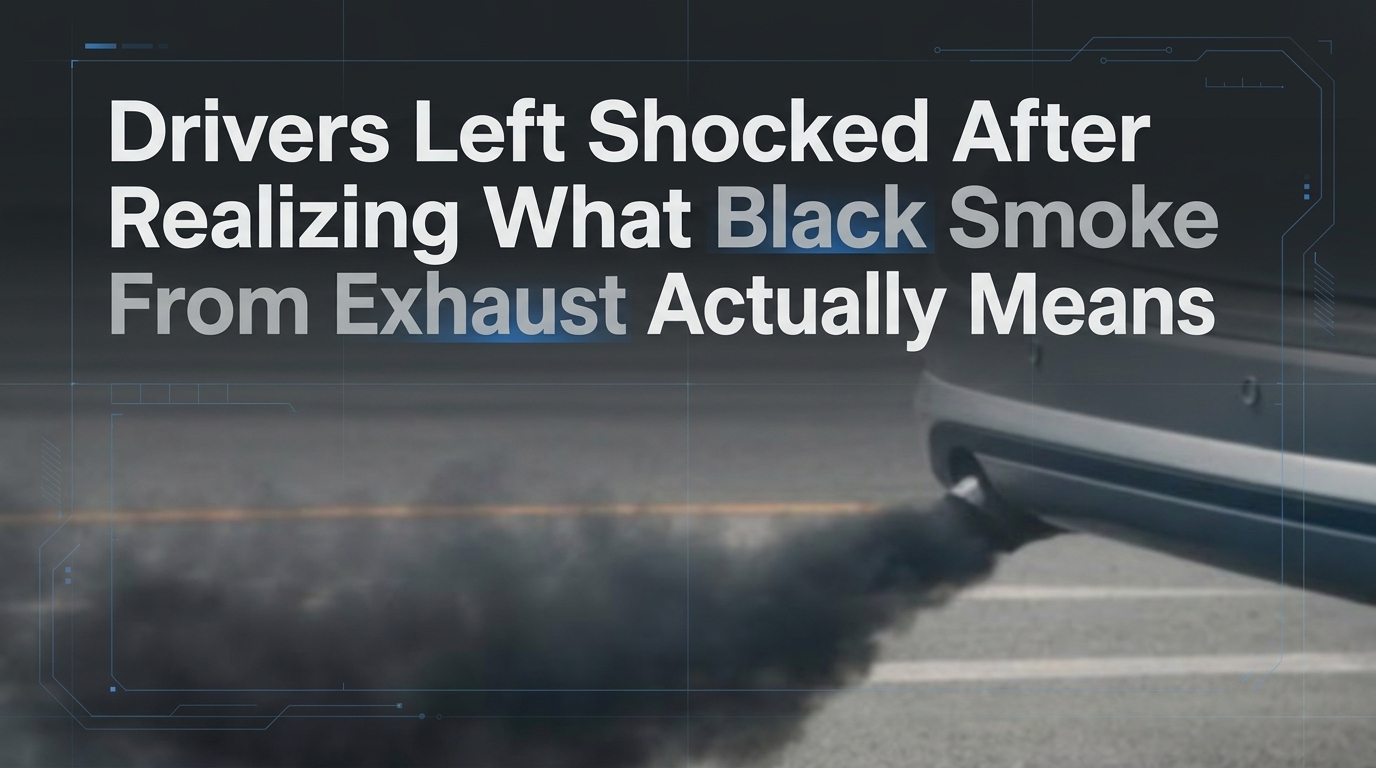
Here is a number that should unsettle you. According to the National Highway Traffic Safety Administration, roughly 200,000 vehicle fires are reported every year in the United States. Many of those fires trace back to a problem that first announces itself with a puff of smoke from your exhaust. The smoke itself is not the fire, but it is the warning you cannot afford to ignore. NHTSA
I have lost count of how many drivers have pulled into my shop with a story that starts the same way. "It was blowing a little black smoke on the highway, but I figured it was nothing." They figured wrong. Black smoke from your exhaust is never nothing. It is your engine sending you a clear message that something inside the combustion chamber has gone seriously wrong. The good news is that black smoke points to a specific set of problems. The bad news is that ignoring it turns a manageable repair into a catastrophic one.
If you see black smoke, you are seeing unburned fuel. That fuel is passing through your engine, through your exhaust system, and out into the air without doing the work it was meant to do. That is wasted money and a damaged engine all at once. Let me walk you through what is actually happening and what you should do about it.
What Black Smoke Actually Means
Black smoke is raw, unburned fuel leaving your engine. It is not oil. It is not coolant. It is fuel that entered the combustion chamber but never ignited properly. That tells me the air to fuel ratio inside your cylinders is too rich. There is too much fuel and not enough air for it to burn completely.
This condition can start small. You might notice a slight haze only when you floor the accelerator. Then it gets worse. Soon you see a dark plume every time you drive. I have heard people say, "It only does it when I push it hard." That is exactly when the problem becomes visible because the engine is under load and demanding more fuel. If the mixture is already off, the excess smoke pours out under pressure.
A rich mixture does more than waste fuel. It coats your spark plugs in carbon. It contaminates your engine oil. It destroys your oxygen sensors and clogs your catalytic converter. A converter that gets choked with unburned fuel can overheat and fail completely. That is a repair that runs into thousands of dollars. The smoke you see today is the beginning of a chain reaction that gets expensive fast.
The Most Common Causes You Can Check Yourself
Not every cause of black smoke requires a professional diagnosis. Some of them you can spot with your own eyes in your driveway. Here are the three places I always look first.
A Clogged Air Filter
Your engine needs air to mix with fuel. If the air filter is clogged with dirt, leaves, or debris, the engine cannot pull enough air into the intake. The fuel injection system still delivers its normal amount of fuel, but without enough air to burn it, the mixture goes rich. Black smoke follows.
I have pulled air filters out of cars that looked like they had been living under a construction site for two years. The driver said, "It has been running rough for a while." A new air filter fixed it in five minutes. Check yours. If it looks dirty, replace it. That is the cheapest fix on this list.
A Faulty Fuel Injector
A fuel injector that sticks open dumps extra fuel into the cylinder even when the engine does not need it. That extra fuel cannot burn completely. It turns into black smoke. You might also notice a rough idle, hesitation when accelerating, or a strong smell of gasoline from the exhaust.
If one injector is stuck, you can sometimes hear the engine misfire. The cylinder that receives too much fuel does not fire cleanly. That misfire can damage the catalytic converter over time. Injector cleaning can help in mild cases. If the injector is physically stuck, replacement is the only answer.
A Failing Mass Air Flow Sensor
The mass air flow sensor tells your engine computer how much air is entering the intake. If that sensor gets dirty or fails, it sends an incorrect reading. The computer then delivers the wrong amount of fuel. In many cases, it delivers too much. That creates the rich mixture that produces black smoke.
I have seen cars come in with black smoke, a rough idle, and terrible fuel economy. The owner had already replaced spark plugs and coils. A simple cleaning of the MAF sensor solved the problem. If cleaning does not work, the sensor needs replacement. It is a common failure point on many modern vehicles.
When the Problem Is Deeper
Sometimes the cause is not a simple sensor or filter. If you have checked the air filter, the injectors, and the MAF sensor, and the black smoke continues, the problem may be internal. A failing fuel pressure regulator can cause the fuel system to run at too high a pressure. That pushes extra fuel through the injectors regardless of what the computer commands.
In older vehicles with a carburetor, a stuck float or a worn needle valve can cause flooding. In modern turbocharged engines, a leaking turbo seal can allow oil to enter the intake stream. That oil burns and produces black or blue gray smoke. If you are losing oil and seeing black smoke, you need to look at the turbocharger system.
This is where I hear people say, "I will keep driving it until I can get it checked." Do not do that. Every mile you drive with a rich mixture damages the catalytic converter and contaminates the oxygen sensors. Those parts are expensive. The repair gets more expensive the longer you wait.
What You Should Do Right Now
If you see black smoke from your exhaust, take action immediately. Start with the simplest check. Look at your air filter. If it is dirty, replace it. Then check your check engine light. If it is on, get the code read. A code like P0172 System Too Rich points directly to a fuel mixture problem. That code can help you narrow down the cause to a sensor, an injector, or a pressure issue.
If the check engine light is off, that does not mean everything is fine. Some fuel to air issues do not trigger a fault code immediately. The computer only reports what it can measure. If a sensor is giving bad data that still falls within the acceptable range, the light stays off while the engine burns rich.
Do not ignore black smoke because it seems intermittent or only happens under hard acceleration. That is exactly when the problem is easiest to see. The damage is happening even when the smoke is not visible. A professional diagnosis takes an hour. A new engine takes weeks and costs thousands. Choose the hour.
Essential Guide: Diagnosing and Troubleshooting Different Types Of Exhaust Smokes
Your car is not trying to trick you. It is showing you a problem. Black smoke is one of the most visible and most ignored warnings on the road. Take it seriously. Your wallet and your safety depend on it.
Comments (0)
Please login to join the discussion
Be the first to comment on this article!
Share your thoughts and start the discussion