The technology falls into two main categories. Both are active in many vehicles sold today, though most owners have no idea how deep the monitoring goes.
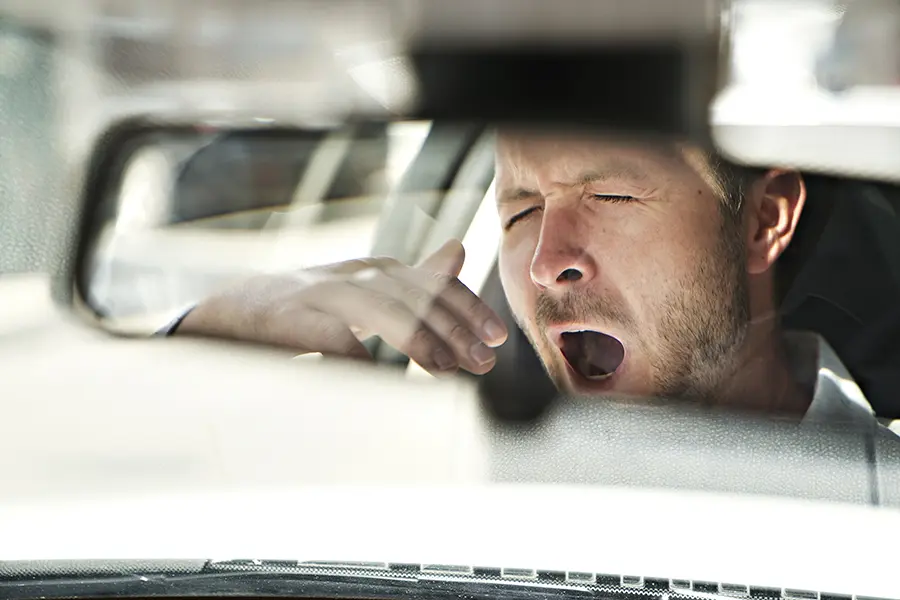
In 2016, the National Highway Traffic Safety Administration reported that drowsy driving was a contributing factor in over 800 fatalities in the United States alone. That is a number that should stop anyone cold. Yet most drivers still believe they can feel fatigue coming on and simply power through it. "I know when I'm getting tired," they say. "I can handle it." The data says otherwise. Your brain is a terrible judge of its own declining state. It will tell you everything is fine right up until the moment your eyes close at 110 kilometres per hour. That is where the latest generation of automotive sensor technology is changing the game. Cars are no longer just waiting for you to crash. They are watching you. They are measuring your eyelids, your steering inputs, your lane position, and even your heart rate through the steering wheel. The goal is simple: catch fatigue before the driver does.
The Two Systems Watching You Right Now
Camera Based Driver Monitoring Systems
This is the most common approach and the one that has advanced fastest in the last five years. A small infrared camera mounted on the steering column, typically just above the instrument cluster, tracks your face in real time. It looks at your eyelid closure patterns, your head position, and the direction of your gaze. If your eyes stay closed for longer than a typical blink, the system registers a microsleep event. If your head nods forward or your gaze drifts away from the road for too long, the system escalates its warnings.
The camera works in total darkness because it uses infrared light. It does not care if you are wearing sunglasses either. Many modern systems can track eye closure through most tinted lenses. The technology is robust enough that some manufacturers, like Subaru and Volvo, have been using it for years. Subaru's DriverFocus system, introduced around 2019, was one of the first to alert drivers not just for fatigue but also for distraction. If you look down at your phone for more than a few seconds, the car will chime at you. It does not wait for a swerve to decide you are distracted. It watches the distraction happen.
Here is the specific warning pattern you can expect from these systems. First, a visual alert appears on the dashboard, often a coffee cup icon or a message saying "Take a Break." If the driver ignores that, the system escalates to an audible chime. In some vehicles, like the latest Mercedes-Benz S-Class and EQS, the car can actually reduce the interior temperature and increase fan speed to help wake you up. It can also pulse the brakes gently or vibrate the seat. The escalation is deliberate and designed to break through the fog of fatigue.
Steering and Lane Behavior Analysis
This system does not use a camera. It uses data your car is already collecting. Every modern vehicle with electric power steering tracks how much you correct the wheel and how often you correct it. A tired driver does not steer the same way a fresh driver does. Fatigue causes microcorrections to become less frequent and then suddenly larger and more erratic.
The car's computer builds a baseline of your normal driving pattern over the first few minutes of a trip. It learns how you handle curves, how you respond to wind gusts, and how steady your lane position is. Once it has that baseline, it compares your real time inputs against it. If your steering becomes sloppy, if you let the car drift toward a lane marking and then jerk it back, the system flags that as a fatigue signature. This is the technology behind systems like Ford's Driver Alert and Volkswagen's Fatigue Detection System. They do not need to see your face. They can tell you are tired simply by how you move the wheel.
The interesting part is that these systems often catch fatigue earlier than the driver does. A study by the AAA Foundation for Traffic Safety found that drivers in simulator tests were significantly impaired after only four to five hours without sleep. Many of those drivers rated themselves as "a little tired but fine." The car's steering analysis disagreed. The car knew before the driver did.
What The Car Does With That Information
The response is not uniform across manufacturers. Some systems are conservative and only warn. Others are aggressive and take control. You need to know which type your vehicle uses.
Warning Only Systems
Most mainstream brands like Toyota, Ford, and Volkswagen use warning only systems. The car will give you a visual and audible alert suggesting you take a break. It will also display your driving time since the last stop. Some systems, like Ford's Driver Alert, score your alertness on a scale of one to five and show it on the dashboard. If you see a low score, the system is telling you it has detected degradation in your driving performance. You should listen to it.
These systems do not force you to stop. They cannot. They simply make the information available and rely on you to act. That is where human nature becomes the weak link again. I have seen drivers dismiss the coffee cup icon as a nuisance. "I know my vehicle," they say. "It's just a reminder." That reminder is based on real data. It is not a timer. It is a measurement of your declining ability to control a two ton machine.
Intervention Systems
Premium manufacturers are moving beyond warnings. Mercedes-Benz has a system called Attention Assist that not only warns but can also reduce engine power and limit vehicle speed if the driver does not respond. In some configurations, the car can autonomously steer back into the lane if the driver has drifted out while showing signs of fatigue. This is a significant step because it moves from passive monitoring to active safety intervention.
Volvo takes a slightly different approach with its latest models. The company announced in 2023 that it would begin equipping all new vehicles with interior cameras that can detect signs of intoxication or extreme distraction, not just fatigue. If the driver does not respond to escalating warnings, the car can slow down, pull over safely, and call for emergency assistance. That is a dramatic escalation from a coffee cup icon. It represents a fundamental shift in how much authority we are giving to the machine.
What You Should Do As A Driver
First, learn what system your car has. Check your owner's manual under the driver support or safety section. Look for terms like Driver Alert, Fatigue Detection, Attention Assist, or Driver Monitor. If your car has a camera based system, understand that the camera is not recording video. It is processing real time data and discarding it. Privacy concerns are valid, and manufacturers have addressed this by stating that no images are stored or transmitted. The data stays local to the vehicle. How Self-Driving Cars See and Detect Objects explains this sensor fusion concept in more depth.
Second, do not rely on the system as your primary fatigue management tool. These systems are a safety net, not a solution. They cannot prevent you from driving tired. They can only react to signs that you are already impaired. The only reliable way to fight fatigue is to stop driving. Pull off at a rest area. Take a 20 minute nap. Drink a caffeinated beverage and wait 30 minutes for it to take effect. That is the protocol recommended by the National Sleep Foundation and it works.
Third, if your car warns you, take it seriously. Do not override the alert because you are "almost home." The system detected a change in your driving that you missed. The Complete First Time Car Owner's Maintenance Schedule covers the importance of paying attention to all vehicle warnings, not just the check engine light. A fatigue warning is a diagnostic reading of your own body. Treat it with the same respect you would give a low oil pressure light.
Final Word
Fatigue detection technology is one of the most meaningful safety advances to reach mainstream vehicles in the last decade. It does not replace good judgment. It augments it. The car is watching, measuring, and calculating your state of alertness with a precision your own brain cannot match. The next time you see that coffee cup icon on your dashboard, do not dismiss it. The car is not guessing. It knows. And it is trying to keep you alive.
I have heard drivers say "I know my limits" with absolute certainty. The data from these systems proves that most of us do not. Accept the help. Your car is smarter about your fatigue than you are. Let it do its job.
Read Also: Hackers Can Now Steer Your Car Remotely And Here’s How to Stay Safe
Essential Guide: How safe are self-driving or autonomous driving cars?

Comments (0)
Please login to join the discussion
Be the first to comment on this article!
Share your thoughts and start the discussion