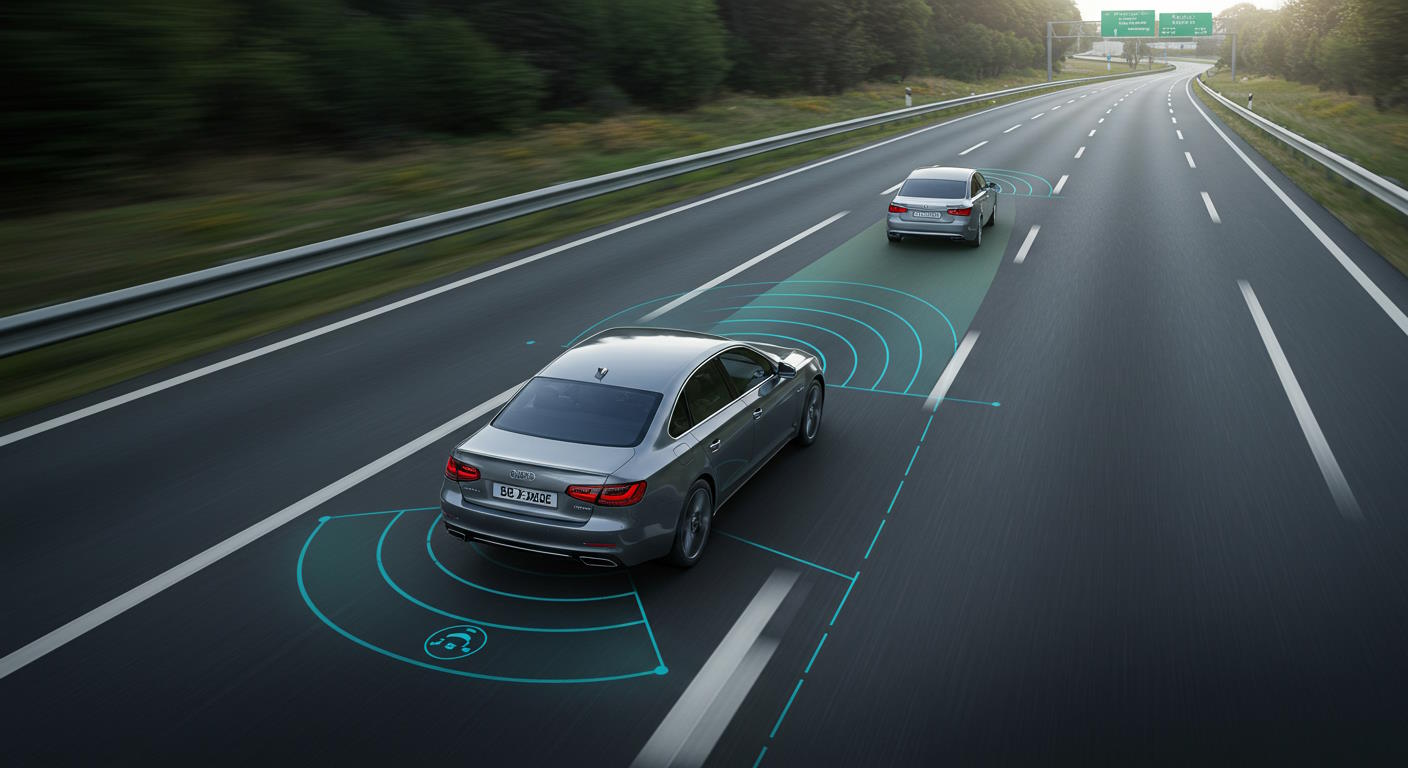
Every Adaptive Cruise Control system relies on three primary data sources working together. The first is the radar sensor, which is almost always mounted behind the front grille or behind the lower bumper cover. This sensor emits radio waves and measures how long they take to bounce back from objects ahead. The second is the forward facing camera, typically located behind the rearview mirror. This camera reads lane markings, identifies vehicles, and distinguishes between a car, a truck, a motorcycle, and stationary objects. The third is the wheel speed sensors, which tell the system exactly how fast each wheel is rotating at any given moment.
Over 90% of new vehicles sold today come equipped with Adaptive Cruise Control, according to the Insurance Institute for Highway Safety. That is a staggering number when you consider how few drivers actually understand what happens behind the dashboard when they set that speed. I hear it all the time in the shop. "I put the cruise on and the car just handles everything." It does not. It is making thousands of calculations per second that most people never think about. And when one of those calculations goes wrong, the car does something unexpected. That is when I get the call. Let me be clear about something right now. Adaptive Cruise Control is not a self driving system. It is a convenience feature that uses sensors, radars, and cameras to maintain a set speed while also keeping a safe distance from the vehicle ahead. Understanding how it actually works will make you a safer driver and a more informed car owner. It will also help you spot problems before they become expensive repairs.
The Three Sensors That Make It All Possible
These three components do not operate independently. They feed data into the Engine Control Unit, which processes the information and decides whether to accelerate, coast, or brake. The ECU is the brain. The sensors are the eyes and ears. If any one of them fails or provides inaccurate data, the system cannot function correctly. That is why a dirty radar sensor or a misaligned camera can cause the system to disengage completely. People say, "My cruise control just stopped working for no reason." There is always a reason.
How the System Calculates Safe Following Distance
This is where the real engineering happens. The system does not just measure distance to the car ahead. It calculates time to collision based on your speed, their speed, and the gap between you. Most manufacturers program the system to maintain a following time of between 1.0 and 2.5 seconds. You can usually adjust this setting through the steering wheel controls. A shorter gap means the car will brake later and accelerate sooner. A longer gap means it will brake earlier and maintain more distance.
The system also accounts for relative acceleration. If the car ahead is braking hard, the radar detects the rapid closure rate and applies more braking force. If the car ahead is accelerating away, the system eases off the brakes and gradually increases speed back to your set point. This is not a simple on off switch. It is a continuous adjustment loop that runs dozens of times per second. The Engine Control Unit manages this entire process, interpreting inputs from multiple sensors and issuing commands to the throttle, brakes, and transmission.
What Happens When the System Cannot See
Adaptive Cruise Control has limitations that every driver should understand. Heavy rain, fog, snow, and direct sunlight can all degrade sensor performance. The radar can still see through moderate rain, but the camera struggles when visibility drops. If the camera cannot identify lane markings or vehicles ahead, the system will disengage and alert you with a warning message on the dashboard. This is not a malfunction. It is the system protecting itself from making decisions based on bad data.
Another common scenario is the stopped vehicle problem. Most Adaptive Cruise Control systems are not designed to detect stationary objects at high speed. The radar is tuned to track moving targets, specifically vehicles that are traveling in the same direction. If a car ahead has stopped completely and you are approaching at highway speed, the system may not detect it until it is too late. This is why manufacturers explicitly state that the driver must remain attentive at all times. I have seen the aftermath of drivers who assumed otherwise.
If you notice your system disengaging frequently in clear weather, the most likely cause is a dirty or misaligned sensor. The radar module behind the grille can accumulate road grime, salt, and insect residue. A simple cleaning with a soft cloth and glass cleaner often resolves the issue. If the problem persists, the sensor may need professional recalibration. This is a precise procedure that requires specialized equipment. Do not attempt to adjust the sensor mounting yourself. Understanding cruise control functionality and best practices will help you recognize when professional attention is needed.
Why Braking Feels Different With ACC
When you apply the brakes manually, you decide how hard to press. When Adaptive Cruise Control applies the brakes, it does so electronically through the vehicle's stability control system. The system can apply up to approximately 30% of the vehicle's maximum braking capacity on its own. Beyond that threshold, it sounds an audible warning and requires the driver to take over. This is a deliberate safety measure. The system is not designed to perform emergency stops.
The braking feel is also different because the system prioritizes smoothness. It will begin braking earlier than you might expect and with less force than a human driver might use. This keeps the ride comfortable and prevents abrupt deceleration that could surprise other drivers. However, this also means that if the vehicle ahead brakes suddenly, the system will alert you rather than attempting a full emergency stop. You must be ready to intervene at all times. The braking system itself is capable, but the control logic has intentional limits.
What to Do When the System Acts Strange
If your Adaptive Cruise Control begins behaving unpredictably, start with the simplest checks. Inspect the front grille area for debris, snow, or ice buildup. Check the windshield area around the rearview mirror for cracks or obstructions that could affect the camera. Look for physical damage to the front bumper that could have knocked the radar sensor out of alignment.
Next, check for warning lights on the dashboard. Many vehicles will display a specific message indicating which sensor has a problem. If the system is working but feels inconsistent, consider whether you are driving in conditions that challenge the sensors. Hilly terrain, sharp curves, and roads with frequent merging traffic can all cause the system to behave differently than it does on a straight, flat highway.
If you have ruled out these factors and the problem persists, a diagnostic scan is the next step. The system will store fault codes that indicate which component is failing. Do not ignore these warnings. A failing radar sensor or camera module is not something that will fix itself. It will only get worse, and it can affect other safety systems that rely on the same sensors, such as automatic emergency braking and lane keeping assist.
The most important thing to remember is this. Adaptive Cruise Control is a tool, not a replacement for attention. It reduces fatigue on long drives and helps maintain consistent following distances. It does not see everything, and it does not react to everything. I have had drivers tell me, "The car should have stopped." The car was never designed to stop itself in every situation. That responsibility still belongs to you.
Maximizing fuel efficiency and reducing fatigue is one of the genuine benefits of using cruise control properly. But only when you understand what the system can and cannot do.
Essential Guide: The Power of Cruise Control: Advantages, Considerations, and Safety Precautions

Comments (0)
Please login to join the discussion
Be the first to comment on this article!
Share your thoughts and start the discussion