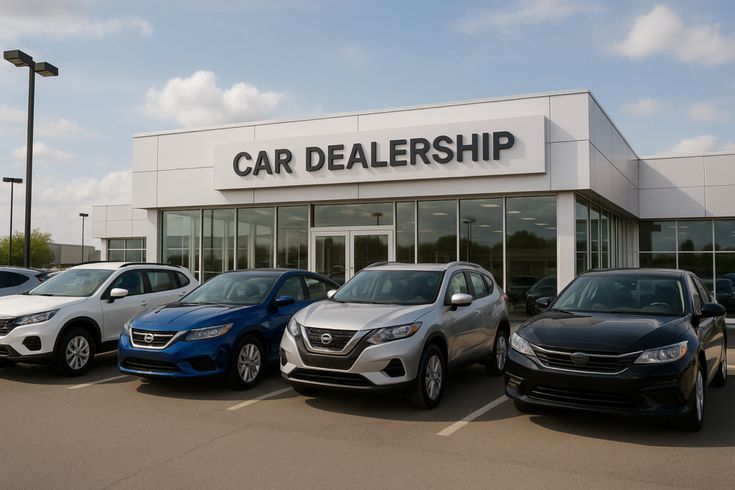
According to the National Automobile Dealers Association, there are nearly 17,000 franchised new-car dealerships currently operating across the United States. What that number doesn't show you is how many people tried to open one and walked away broke, licensing fees paid, lot leased, and inventory still sitting unsold.
I've worked with enough dealership workshops and spoken to enough dealers over the years to know that this industry eats unprepared people alive. "I've sold cars my whole career, how hard can running the business side be?" is a sentence I've heard more times than I can count, usually followed by a very difficult phone call about two years later.
Here is what you actually need to know before you write a single cheque.
The Decision That Shapes Everything
Most people entering this industry don't fully understand that "opening a car dealership" means two completely different things depending on which direction you take. The gap between those two paths, in terms of cost, complexity, and commitment, is enormous.
Opening a new car franchise dealership means securing a franchise agreement with a vehicle manufacturer such as Ford, Toyota, or General Motors. You don't buy this franchise outright in the traditional sense. Manufacturers don't charge an upfront franchise fee the way a fast-food chain does, but they impose strict capital requirements, facility standards, minimum inventory levels, and operational guidelines that carry the same financial weight. Industry guidance from firms like Manning Leaver puts franchise capital requirements at roughly $1,200 to $1,500 per unit of expected annual sales volume. For a modest operation, that adds up fast. A Reddit thread in the r/askcarsales community, well-sourced by former dealer principals, puts the total all-in investment for a new franchised dealership, covering working capital, land, facility construction, and inventory, at up to $11.3 million. This is not a business you enter on a hope and a handshake.
Opening an independent used car dealership is a significantly more accessible starting point. A small lot carrying 10 to 25 vehicles will typically require $50,000 to $250,000 in startup capital, according to Wexford Insurance data. A medium operation with 25 to 50 cars runs $250,000 to $500,000. You source inventory through auctions, trade-ins, and private purchases rather than direct manufacturer supply. You have more flexibility in what you sell, no manufacturer-imposed facility requirements, and a lower barrier to entry.
Profit margins in 2026 tell an interesting story. New car gross profit per unit averaged $2,326 according to Dealership Guy industry data. Used car gross profit averaged $1,264 to $1,628 per unit, based on publicly traded retailer figures compiled by Haig Partners. New cars look better on paper, but the capital required to play in that space is a different world entirely.
Decide which path fits your capital position before anything else. Everything downstream, from licensing to location to financing, flows from this choice.
Licensing, Surety Bonds, and the Paperwork Most People Underestimate
Here is where a lot of first-time dealers stumble. "I'll sort the licensing out once I find the right location" is the kind of thinking that causes costly delays and, in some cases, legal exposure.
Every state in the United States requires a dealer license issued through the state's DMV or equivalent authority before you can legally buy and sell vehicles as a business. The specific requirements vary by state, but the core framework is consistent across all 50.
You will need to complete a pre-licensing education course. In California, the DMV mandates a minimum six-hour course through an approved provider. You will undergo a background check. Criminal history, particularly involving fraud or financial crimes, can disqualify you. Application fees run between $50 and $500 depending on the state, with annual renewal fees on top of that.
The surety bond is non-negotiable and frequently overlooked by newcomers. A surety bond is required in every single state as a condition of obtaining a dealer license. It functions as a financial guarantee to customers and the state that your dealership will operate lawfully. California, for example, requires a $50,000 surety bond for all dealer types. The actual cost to you is a fraction of the bond value, typically 0.5% to 1% of the total bond amount annually, but the bond must be in place before your license is issued.
Zoning is a separate matter that catches people off-guard. Your dealership location must be zoned specifically to permit vehicle sales and display. Not all commercially zoned properties qualify. Before you sign a lease or commit to a purchase, verify with your local planning authority that the property is appropriately zoned for an automobile dealership. This applies to display lot requirements, office space, and in many states, a physical address that passes a law enforcement inspection.
The full licensing timeline, from application to approval, can take weeks to several months depending on your state. Build that timeline into your planning from day one, not after you've already committed to a location.
Floor Plan Financing and Your Real Operating Reality
Inventory is the lifeblood of a dealership and also its biggest financial pressure point. Most dealers, from small independents to large franchise operations, do not purchase their entire inventory outright with cash. They use floor plan financing.
Floor plan financing works as a revolving line of credit secured specifically against vehicle inventory. Think of it as a business credit card whose collateral is your cars. Lenders including Next Gear Capital, Kinetic Advantage, and traditional bank partners extend a credit line against which dealers draw to acquire inventory. When a vehicle sells, the dealer pays back that vehicle's floor plan advance, freeing the line of credit for the next purchase.
The cost of carrying floored inventory is real. Interest accrues on each vehicle from the moment it's drawn until it sells. Vehicles that sit on your lot unsold for an extended period don't just cost you a parking space. They cost you daily interest charges that compound against your margins. This is why experienced dealers obsess over inventory turn time, which is how many days on average a vehicle sits before it sells.
Understanding floor plan financing before you open is not optional. It affects how you price vehicles, how aggressively you acquire inventory, and how you manage cash flow month to month. Approach a floor plan lender early in your planning process, understand what credit lines you qualify for, and factor the carrying cost of inventory into your unit-level profitability model.
Your Online Presence Is Now Your Showroom
This section didn't exist in the original article, and that omission is significant. The car business in 2026 operates on a different foundation than it did even five years ago.
According to Cox Automotive's 2024 Car Buyer Journey study, 95% of car buyers research online before visiting a dealership, spending an average of 14 hours doing so. Eighty-three percent now prefer to handle more of the purchasing process from home, a figure that has climbed steadily from 69% in 2023 according to Car Gurus data. These are not fringe buyers. This is the mainstream.
A dealer without a strong, well-structured online inventory presence is functionally invisible to the majority of the market. Listings on platforms like AutoTrader, Cars.com, and CarGurus are table stakes. Your website, your Google Business profile, your response time to online leads, and the quality of your vehicle photos all directly influence whether a customer calls you or the dealership down the road.
On the operational side, a Dealer Management System, commonly called a DMS, is the software backbone of a modern dealership. Platforms like Reynolds and Reynolds, CDK Global, and Dealertrack handle inventory management, customer relationship tracking, finance and insurance processing, and service department operations within a single integrated system. Trying to run a dealership in 2025 on spreadsheets and sticky notes is not a cost-saving measure. It is a liability.
Starting a car dealership is a legitimate and potentially rewarding business path. It is also one that punishes under-preparation quickly and expensively. The decision between franchise and independent, the licensing process, the mechanics of floor plan financing, and the non-negotiable digital presence required to compete in today's market are the four areas that will determine whether your dealership survives its first three years.
Treat each one with the seriousness it deserves. The dealers I've seen succeed over the long term always did.
Comments (0)
Please login to join the discussion
Be the first to comment on this article!
Share your thoughts and start the discussion