For over a century, the most common explanation for how a wing works has been fundamentally wrong. You've heard it: air travels faster over the curved top, creating lower pressure, and lift magically appears. It's the "equal transit time" theory, and it's so deeply flawed that NASA has a dedicated page debunking it. The real physics is more elegant, more powerful, and frankly, more interesting. It's not about air bouncing off the bottom or taking separate trips. It's about turning the air itself.
The Popular Myth and Why It Fails
Let's clear the air first. The classic "longer path" explanation suggests air molecules that separate at the wing's leading edge must reunite at the trailing edge. To do this over a longer curved top, the air must go faster. Bernoulli's Principle then says faster air equals lower pressure, and lift is generated. It's a neat story. It's also physically impossible. As NASA's educational resource points out, there is no principle in physics that requires these air particles to meet up again. In reality, the air over the top moves much faster and does not wait for its partner from the bottom. This theory also completely fails to explain how inverted flight is possible. If lift came only from a curved top, aerobatic planes would fall out of the sky. They don't.
The Real Engine of Lift: Newton and Bernoulli Together
Lift is not created by one single action. It's the result of two interconnected physical principles working simultaneously: Newton's Third Law and Bernoulli's Principle. The wing is a master of both.
It's All About Turning the Airflow
Think of the wing as a tool designed to deflect air downward. Due to its shape and angle, it strikes the oncoming air and pushes it toward the ground. This is the Newtonian part. For every action, there is an equal and opposite reaction. The wing pushes air down (action), and the air pushes the wing up (reaction). This downward deflection is visible in wind tunnel smoke trails and is a direct, measurable force. You can feel a simplified version by sticking your flat hand out of a moving car window and tilting it slightly upward. Your hand gets pushed up and back. That's you deflecting air, creating both lift and drag.
Pressure Plays the Supporting Role
This is where Bernoulli comes in, correctly. As the wing moves, its shape causes the airflow over the top to accelerate. This isn't about a race to the trailing edge. It's about the air being squeezed through a constricted path between the wing's curved upper surface and the free-stream air above it. This acceleration genuinely does lower the pressure on the top surface. Simultaneously, the air on the bottom is being compressed and slowed slightly, increasing pressure there. So, you have higher pressure below and lower pressure above. This pressure difference contributes to the overall lift force. It's a consequence of the wing's interaction with the air, not the sole cause. The NASA page on incorrect lift theory emphasizes that it is the wing's ability to turn the flow that is primary.
The Critical Ingredient Everyone Forgets: Angle of Attack
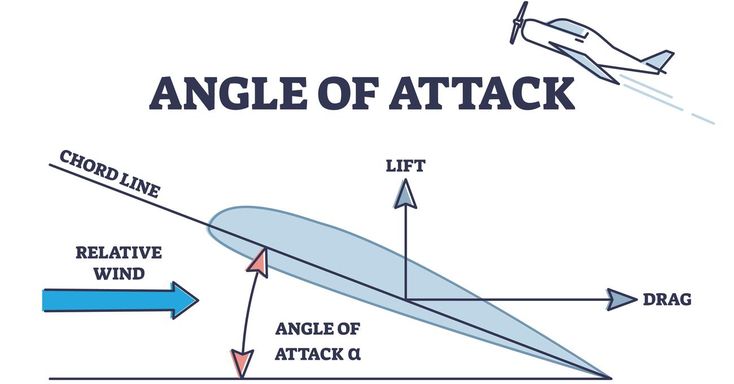
This is the secret sauce. A wing's angle of attack is the angle between the wing's chord line and the oncoming air. It is absolutely crucial. You can generate lift with a perfectly flat board like a barn door if you give it a high enough angle of attack. You'll also generate massive drag, but you'll get lift. Why? Because you are deflecting a large volume of air downward. Newton in action. For a curved wing, increasing the angle of attack increases both the downward deflection of air and the pressure difference. This is why planes pitch up to climb. It's also why there's a limit. Increase the angle too much, and the smooth airflow over the top breaks away, lift collapses, and you stall. The wing hasn't stopped working; it has stopped turning the air efficiently.
I hear pilots and enthusiasts say, "It's all in the curve." That's only half the story. The curve optimizes the flow for efficiency and reduced drag, but the angle of attack provides the control. A symmetrical aerobatic wing has no curve on top versus bottom. It flies perfectly well right-side up or upside down because the pilot controls lift entirely by managing the angle of attack. The FAA Pilot's Handbook of Aeronautical Knowledge states clearly that lift is created by the dynamic effect of the air acting on the airfoil, with angle of attack being a fundamental variable.
So, What's Actually Happening When You Fly?
Imagine the wing slicing through the air. It hits the air and, because of its tilted attitude and shape, it grabs a huge tube of air and redirects it downward. This action creates an upward force. The curved top accelerates the air above it, lowering pressure and adding to that force. The two effects are inseparable parts of a single phenomenon. They happen together. The next time someone tries to explain lift with a simple sketch of two air particles racing, you'll know the truth. It's not a race. It's a coordinated push. The wing is a device for managing momentum, trading the downward momentum of air for upward momentum of the aircraft. It's physics in motion, and it's far more beautiful than a fairy tale about reunited air molecules.
Understanding this changes how you see flight. It's not magic or a simple trick. It's the intelligent application of fundamental physical laws. As the scientific literature on aerodynamics details, the lift coefficient of a wing directly depends on its shape and, dominantly, its angle of attack. The wing works because it turns the air. Everything else is a detail in that magnificent process.
Comments (0)
Please login to join the discussion
Be the first to comment on this article!
Share your thoughts and start the discussion