Most drivers think a tire blowout is a random, violent event. They are wrong. The National Highway Traffic Safety Administration (NHTSA) attributes roughly 11,000 tire-related crashes annually to issues like tread wear and underinflation. That is a number with a direct cause. The path from a simple alignment issue to a shredded tire on the highway is not a mystery. It is a predictable chain of physical failure that you can see, measure, and stop. I have pulled too many tires off rims with cords showing on one shoulder and tread left on the other. The owner always says the same thing: "It looke
The Mechanics of a Slow-Motion Failure
Wheel alignment is the precise adjustment of your vehicle's suspension angles. When it is correct, the tires meet the road squarely and roll straight with even pressure. When it is off, the tires are forced to scrub or drag across the pavement at a slight angle. This is called misalignment. That constant, unnatural friction does not wear the tread down evenly. It attacks specific areas with focused intensity.
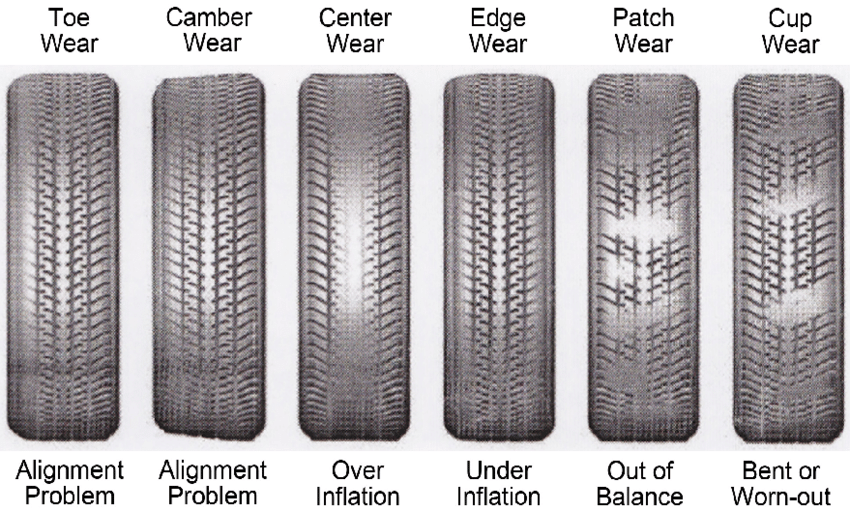
The most common culprit is excessive toe or camber. Toe misalignment means the tires are pointed slightly inward or outward, like pigeon-toed or duck-footed. This causes a rapid feathered or saw-tooth wear pattern across the tread blocks. Camber misalignment means the tire is leaning inward or outward from the top. This leads to severe wear concentrated on one shoulder of the tire. You can run your hand across the tread and feel the sharp edges. That is the sound of your tire being erased one mile at a time.
This uneven wear is not merely a cosmetic or financial problem. It fundamentally weakens the tire's structure. The carcass of a modern radial tire is built from layers of steel belts and fabric cords bonded together by rubber. Even pressure across the entire tread face keeps these layers working in unison as a flexible, strong unit. When one shoulder wears paper-thin, those critical steel belts are exposed to the elements and lose their protective cushion. They heat up faster and flex more under load. The structural integrity is compromised right where the stress is greatest.
From Thin Tread to Catastrophic Blowout
Here is where physics takes over. A tire with uneven, thin tread cannot dissipate heat properly. The NHTSA explicitly states that underinflation and excessive wear are leading causes of tire overheating, which can lead to a blowout. As you drive, especially at highway speeds, the thin section flexes more violently than the rest of the tire. This flexing generates intense internal heat. The rubber and adhesive that bond the steel belts together begin to break down.
Eventually, the bond fails. The separated belts start to move independently, creating more friction and heat in a vicious cycle. You might hear a rhythmic thumping or feel a vibration first. This is the telltale sign of a separated belt. Then, the weakened, overheated sidewall can no longer contain the air pressure. It ruptures. The sudden loss of pressure and structural support is what causes the explosive disintegration we call a blowout. It feels instant, but the process started thousands of miles earlier with a millimeter of misalignment.
What You Can Do Right Now
Do not wait for a vibration or a pull. Those are late-stage symptoms. Be proactive. Here is the actionable check anyone can do monthly.
First, inspect your tires for uneven wear patterns. Look for smooth, shiny patches on the inner or outer shoulder. Run your hand across the tread. If it feels smooth one way and jagged the other, you have feathering from toe wear. If one shoulder is visibly more worn than the other, you have camber wear. Any of these patterns mean your alignment is off and the tire is being destroyed. This wear can also point to other worn suspension components, like the ball joints. If you see this, get a professional alignment check immediately. Do not rotate the tires and think you have fixed it. You have only moved the problem.
Second, understand what causes alignment to go bad. It is not magic. Hitting a pothole, curb, or road debris can knock things out of spec. Worn suspension parts like tie rods, ball joints, or control arm bushings will let the wheels drift out of position. If your steering wheel becomes difficult when turning or feels loose, that is a direct signal your suspension needs attention. Regular impacts from poor roads will slowly degrade alignment settings. A proper alignment check will diagnose both the angles and the components holding them.
Third, act on the information. If you see uneven wear, replace the tire if it is beyond the wear bars. Then, and only then, get a full four-wheel alignment performed by a shop that shows you the before and after printouts. Aligning a car with badly worn tires is a waste of money. The machine will try to align to the irregular wear pattern. Install new or evenly worn tires first. This ensures the alignment is set on a true, round foundation.
The Professional's Final Word
A blowout from uneven wear is a maintenance failure, not bad luck. Your tires are the single point of contact between your car and the road. Their condition is non-negotiable. I tell my customers to look at their tires every time they fuel up. Check pressure. Look for odd wear. It takes 30 seconds.
Ignoring a slight pull or a slightly off-center steering wheel is the first step toward buying a new tire and possibly losing control of your vehicle. Do not be the person who says, "I was going to get it looked at next month." Next month is too late. The chain of failure is already in motion. Stop it at the first visible sign. Your safety, and your wallet, depend on it.
Comments (0)
Please login to join the discussion
Be the first to comment on this article!
Share your thoughts and start the discussion