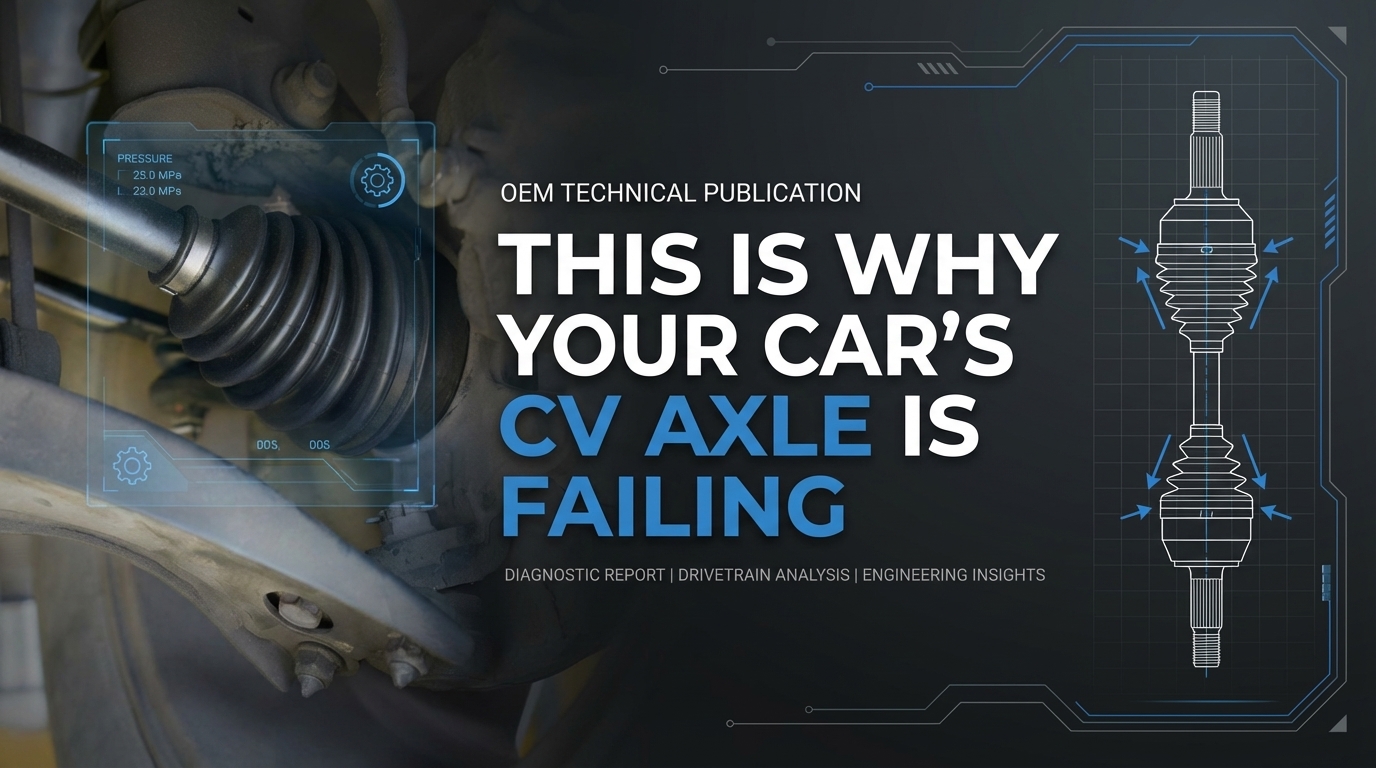
You hear a rhythmic clicking when you turn. You feel a shudder under acceleration. You might even see a torn rubber boot leaking grease. The diagnosis seems obvious. "It's the CV axle," the driver says with a shrug. "I'll get to it." But here's the part most people miss. A failing CV axle is rarely a random event. It's a symptom. And if you only replace the axle without asking why it failed, you're setting yourself up for a repeat performance, often within months. I've seen it happen countless times. The real cost isn't the part. It's the labor you'll pay for twice.
Your car's Constant Velocity (CV) axle is a brilliant piece of engineering. It transmits power from the transmission to the drive wheels while accommodating the up-and-down motion of the suspension and the steering angle. It's tough. It's designed to last the life of the vehicle under normal conditions. So when one fails prematurely, something in its environment has turned hostile. Let's look at what that really is.
Read Also: That Faint Vibration In The Seat Could Be The First Sign Of Drivetrain Failure
The Boot Is The First Line Of Defense
This is where almost every CV axle failure begins. The flexible rubber boot is the only thing keeping grease in and dirt and water out. Once it cracks, tears, or a clamp loosens, the protective grease flings out. Contaminants rush in. The finely machined CV joints inside, which rely on a smooth film of grease, now grind themselves to dust. It's a death sentence. People often notice a torn boot and think, "It's just a boot." No. A torn boot is a CV axle on borrowed time. The clock is ticking loudly.
What Actually Ruins The Boot
Boots don't fail on their own. They are victims of their surroundings. The most common assassin is physical damage from road debris. A sharp rock, a piece of metal, even a hardened chunk of ice can slice it open. The second is age and heat. The rubber deteriorates over years, becoming brittle and cracking. This is accelerated by exposure to certain chemicals and extreme underhood temperatures. The third, and most critical, is improper suspension geometry. If other components are worn, the axle might be operating at a more extreme angle than designed, putting constant stress on the boot's folds until they fatigue and split.
The Hidden Culprits That Kill Axles
Replacing a CV axle without checking these factors is like fixing a leaky ceiling without repairing the hole in the roof. You must look upstream.
Worn Suspension And Mounts
This is the big one. Your engine and transmission are mounted on rubber or hydraulic mounts. Your control arms, struts, and bushings position the wheel hub. If any of these are excessively worn, the entire drivetrain can shift. This misalignment forces the CV axle to operate at a severe, constant angle. It's not designed for that. The internal joints bind and wear rapidly, and the boots get overstretched. Before you blame the axle, check the engine mounts and the condition of the front suspension. A vibration at high speeds can often be traced back to these issues, which then take out the axle.
Aggressive Driving And Modified Vehicles
CV axles are robust for daily driving. But if you frequently launch a high-torque vehicle, put oversized tires on a lifted truck, or have a significantly more powerful engine than stock, you are applying forces the axle was never rated for. The joints can literally snap under shock load. The phrase "I drive it hard" is often followed by a trail of broken drivetrain parts. It's simple physics.
Poor Quality Replacement Parts
Not all CV axles are created equal. A cheap, remanufactured unit from a dubious source might have inferior joints, incorrect hardness on the bearings, or poorly fitted boots. I've seen new axles fail in under 10,000 miles because the joint tolerances were wrong. You get what you pay for. This principle applies to many parts, as highlighted in discussions about the risks of cheap brake pads.
Related Reading: Why Your Car Shakes After Repairs and What It Really Means
The Smart Diagnostic Approach
When you hear the classic "click-click-click" on turns, the axle is already far gone. Be proactive. Here's my professional sequence.
- Visual Inspection: Look at both inner and outer boots on each axle. Check for tears, grease slung around the wheel well or underbody, and loose clamps.
- Check For Play: With the vehicle safely raised, grip the axle near the joints and try to twist it. There should be no noticeable rotational play or clunking. Any in-and-out play should be minimal and smooth.
- Assess The Environment: This is the critical step most skip. Check engine and transmission mounts for excessive movement or collapse. Inspect control arm bushings and ball joints for wear. Look for any signs the suspension is sagging or misaligned.
- Consider The History: Was any suspension work done recently? Was the axle previously replaced? A pattern of failure points directly to an underlying cause.
Remember, a symptom like a shudder on acceleration could also point to other issues, such as a problem with ignition or fuel delivery. Diagnosis is about connecting all the clues.
Final Word
A CV axle doesn't fail without a reason. It's a durable component pushed beyond its limits by something else. The next time you see grease on the inside of your wheel or hear that telltale click, don't stop at the axle. Look at what surrounds it. Check the mounts. Inspect the suspension. Ask what changed. Fixing the root cause is what separates a lasting repair from a recurring invoice. Because in the workshop, we don't just replace parts. We solve problems.
Essential Guide: Extend Your Car's Lifespan to 300000 Miles with These Powerful Maintenance Tips
Comments (0)
Please login to join the discussion
Be the first to comment on this article!
Share your thoughts and start the discussion