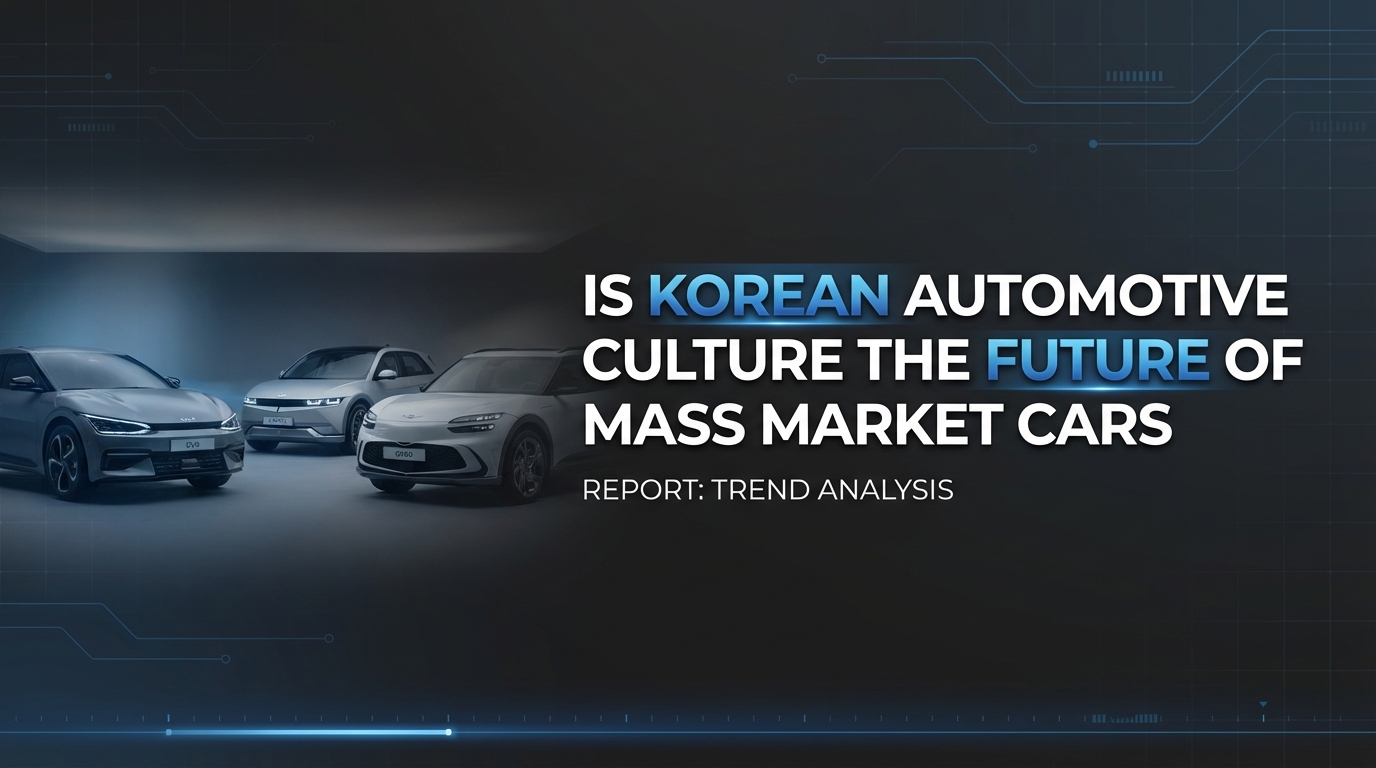
In 2023, South Korea exported over 2.7 million vehicles, a figure that has more than doubled in the last decade. That's not just volume. It's a statement. While other giants wrestle with legacy, Korean automakers have quietly redefined the formula for the mass market. They're not chasing niche trends. They're building the cars most people actually want to own and live with. I've seen the shift firsthand in workshops and on the road. The old guard's playbook feels outdated. The question isn't if Korean automotive culture is influential. It's whether it has already become the blueprint for the future of the global auto industry. From design to reliability and value, Korean automakers are setting the pace others are now trying to match.
The Philosophy: Obsession with the Ownership Experience
Forget horsepower wars or badge prestige for a moment. The core of the Korean strategy is a ruthless focus on the complete ownership lifecycle. It starts with a simple but radical idea: the car should cause no stress. This philosophy touches everything from the dealership visit to the tenth year of ownership. It's a direct challenge to the European model of engineered passion and the American model of sheer scale.
I hear mechanics say, "They just work." That's a profound compliment in our world. This reliability isn't accidental. It's the result of aggressive longevity testing and component sourcing that prioritizes durability over cutting the last cent from cost. The warranty packages reflect this confidence, often dwarfing the competition. It turns the anxiety of "what will break next" into a non-issue for the average buyer. This focus on hassle-free ownership is a massive shift in mass-market priorities.
Technology as a Standard, Not an Upgrade
Walk into a base-model Korean sedan today. You'll find a suite of advanced driver-assistance systems (ADAS), a large infotainment screen with smartphone integration, and a digital instrument cluster. Five years ago, these were luxury or top-trim exclusives. Korean brands made them standard. This democratization of tech reshapes buyer expectations across the entire market.
It's not about gimmicks. It's about integrating practical technology that enhances daily safety and convenience. The thinking is clear: if a feature genuinely improves the driving experience, it shouldn't be locked behind a paywall or a premium badge. This forces every other manufacturer to play catch-up on value. When a mainstream buyer can get semi-autonomous safety features in an affordable package, the entire value proposition of more expensive brands comes under scrutiny.
The Design and Engineering Pivot
Korean cars used to be accused of bland imitation. No longer. Their design language is now distinct, bold, and often the talking point. More importantly, the engineering beneath the sheet metal follows a specific ethos: maximize interior space and comfort within a given footprint. They master packaging. The cabin of a mid-size Korean SUV often feels a class above its competitors, with thoughtful storage and rear-seat legroom that families notice immediately.
This user-centric engineering extends to maintenance. I've worked on engines where routine service items like spark plugs or filters are placed with clear access in mind. It's a small detail that reduces shop time and cost, contrasting sharply with some European designs where a simple part swap can feel like a surgical procedure. This approachability benefits both professional technicians and DIY owners.
Related Reading: Gearing Up: Manual vs. Automatic Transmissions in Modern Cars
The Electrification Playbook
While others announced flashy super-EVs, Korean automakers focused on the electric mass market. They launched compelling, normal-looking electric crossovers with real-world range at accessible price points. The goal wasn't to make a statement car for the few. It was to make electric vehicles a logical, no-compromise choice for the many. This strategy is accelerating the EV transition far more effectively than any million-dollar hypercar.
Their integrated approach to electric vehicle platforms allows for faster development and better interior space utilization. They treat electrification as the new normal, not a separate skunkworks project. This seamless integration is what the mass market will ultimately demand.
What This Means for the Global Market
The impact is a recalibration of value. A buyer comparing cars today isn't just looking at sticker price. They're evaluating technology inclusion, predicted reliability, warranty safety net, and cost of ownership. Korean brands score highly on this matrix. They've created a culture where the car is a dependable, tech-forward appliance that also manages to be stylish. That's a powerful combination.
It pressures traditional leaders. German engineering must now justify its premium against Korean polish and peace of mind. American brands must match the tech standard in their volume sellers. Japanese stalwarts, long the kings of reliability, now face a competitor that matches their durability while offering more daring design and faster tech adoption. The entire market is being pushed toward a more consumer-advantageous position.
Keep Reading: Toyota: A Leader in Reliable and Efficient Cars - Explore the Most Popular Models
The Final Verdict
Is Korean automotive culture the future? For the mass market, I believe the answer is leaning strongly toward yes. They identified a universal desire: a car that looks good, feels premium, is packed with useful tech, and won't become a financial headache. They then engineered and packaged that desire relentlessly. They didn't try to reinvent the car. They perfected the ownership experience around it.
This isn't about one brand winning. It's about a philosophy winning. The future of mass-market cars belongs to whoever best delivers seamless, reliable, and technologically integrated transportation. Right now, the Korean playbook is the one everyone else is studying. The era of the car as a high-maintenance statement is fading for the average person. The era of the car as a sophisticated, dependable partner is here. That's the real cultural shift, and it's already in your neighbor's driveway.
Comments (0)
Please login to join the discussion
Be the first to comment on this article!
Share your thoughts and start the discussion