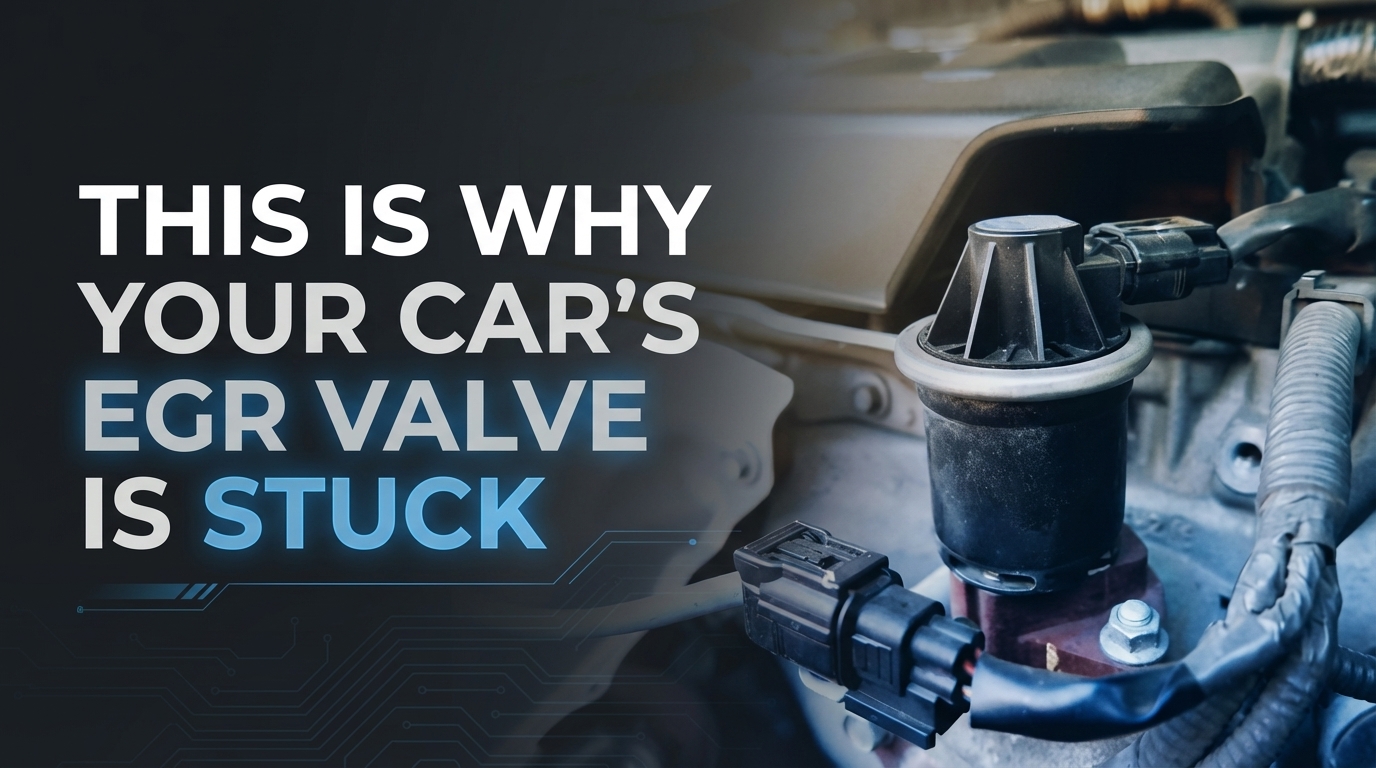
Your car's EGR valve is a master of disguise. It can fail in a dozen different ways, and each one will make your engine behave like it has a completely different problem. I hear it all the time in the shop. A driver will say, "It's got a rough idle and no power," and they're already convinced it's a bad fuel pump or clogged injectors. They'll tell me, "I know my vehicle." That confident certainty is often the first sign we're dealing with a stuck EGR valve. This one component, tasked with the dirty job of recycling exhaust gases, is a leading cause of mysterious drivability issues that stump even the best in the field. Small but deceptive, a failing EGR valve can imitate several engine issues at once making it one of the most misunderstood causes of poor performance.
Understanding how the Exhaust Gas Recirculation (EGR) system works is key to diagnosing its failure. In simple terms, the valve opens at specific times to allow a measured amount of exhaust gas back into the intake manifold. This inert gas lowers combustion temperatures, which dramatically reduces the formation of harmful nitrogen oxide (NOx) emissions. It's a brilliant, emissions-focused design. The problem is the environment it lives in. Hot, sooty exhaust gas is constantly flowing past it, and over time, carbon deposits build up like plaque in an artery. This carbon is the primary culprit behind a stuck valve, and whether it's stuck open or closed dictates the symptoms you'll experience.
When the EGR Valve Stuck Open
This is the failure mode that causes the most dramatic and noticeable problems. A valve that is stuck in the open position is allowing exhaust gas to flow into the intake manifold constantly, even at idle and during low-speed operation.
The Symptoms You Cannot Ignore
Your engine will run terribly, and the signs are unmistakable. The most common is a very rough, unstable idle. The engine may feel like it's shaking itself apart at a stoplight and could even stall. Acceleration becomes weak and hesitant. You'll press the gas, and the car will stumble before slowly building power. In severe cases, you might see black smoke from the tailpipe because the excess exhaust gas is disrupting the clean burn of the air-fuel mixture. It feels like a major engine failure. People often suspect a massive vacuum leak or a serious engine misfire, and they're not entirely wrong in their assessment of the symptom.
Why This Happens
Think of your engine as a precise air pump. It's designed to inhale a specific volume of fresh, oxygen-rich air. When the EGR valve is stuck open, it's flooding the intake with inert exhaust gas that displaces that fresh air. This creates an overly "rich" condition at idle and low RPMs where the engine can't compensate fully. The Engine Control Module (ECM) gets confused because the actual air entering the engine doesn't match its expectations, leading to rough running. It's like trying to breathe through a scarf all the time.
When the EGR Valve Stuck Closed
A valve stuck closed is more insidious. It fails to do its job, but the engine might seem to run "okay" at first glance. This is the silent killer.
The Deceptive Symptoms
You likely won't have a rough idle. Instead, you'll experience problems under load. The most telling sign is engine knocking or pinging, especially during acceleration, when towing, or climbing a hill. This is a metallic rattling sound from the engine bay. Why? Without exhaust gas to cool the combustion chambers, temperatures spike. This causes the fuel-air mixture to ignite too early or erratically, a condition known as detonation or knock. Over time, this hammering effect can cause real damage. You may also fail an emissions test with high NOx readings, and your check engine light will likely illuminate with a relevant code like P0401 (Insufficient EGR Flow).
The Long-Term Danger
This is where the "I'll deal with it later" attitude gets expensive. Persistent engine knock from a stuck-closed EGR valve stresses pistons, rings, and rod bearings. The elevated combustion temperatures also increase the risk of burning valves and can even warp components. You're essentially forcing your engine to run in a high-stress, high-temperature state it was never designed for. It's a slow-motion engine knock that leads to premature wear.
How to Diagnose and Fix a Stuck EGR Valve
Don't start by throwing a new valve at the problem. Diagnosis is straightforward and can save you money.
The Simple Physical Test
On many vehicles, especially older models, you can physically check the valve. With the engine off and cool, locate the EGR valve (usually on or near the intake manifold). The valve will have a small, movable plunger or diaphragm. Try to move it with your fingers or a small tool. It should move with some spring resistance and snap back when released. If it's completely seized or moves sluggishly and stays put, it's stuck. You can also apply vacuum directly to the valve's vacuum port with a hand pump. If the valve is working, the plunger should move and hold position. If it doesn't move, it's stuck. If it moves but the engine idle doesn't change or become rougher when you manually open it (engine running), the passageways are likely clogged.
Cleaning vs. Replacing
If the valve itself moves freely but the car has symptoms, the problem is often clogged EGR passages in the intake manifold. These tiny tubes get completely blocked with carbon. Cleaning is possible. For the valve itself, using a dedicated EGR or carburetor cleaner can dissolve carbon. You must remove the valve first. Soak it, carefully scrub the plunger and seat, and ensure all small ports are clear. Be gentle to avoid damaging the diaphragm. However, if the valve is electronically controlled or shows signs of internal failure, replacement is the reliable choice. When reinstalling, always use a new gasket.
Related Reading: A Comprehensive Guide to EGR: Function, Faults, and Fixes
Prevention is the Best Strategy
EGR problems are largely a maintenance issue. Using top-tier fuel with good detergents can help minimize carbon deposits. More importantly, drive the car hard occasionally. Long periods of gentle, low-RPM driving (like constant city commuting) allow carbon to build up faster. A sustained highway drive at higher engine speeds helps blow out some of that accumulation. It's not a cure, but it can prolong the system's health. Keeping up with general engine health, like addressing oil sludge and changing spark plugs on time, also contributes to cleaner combustion and less soot.
The EGR valve doesn't have to be a mystery or a budget-buster. Its symptoms are logical once you understand its role. A rough idle and stalling point to a valve stuck open. Engine pinging under load points to a valve stuck closed. A simple physical check or vacuum test often confirms it. Cleaning can work, but sometimes replacement is the permanent answer. Listen to what your car is telling you. That strange behavior isn't random. It's a direct message from a small valve buried under layers of carbon, asking for a little attention.
Deep Dive: The Evolution of Exhaust Gas Recirculation (EGR): Reducing Emissions, Enhancing Efficiency
Comments (0)
Please login to join the discussion
Be the first to comment on this article!
Share your thoughts and start the discussion