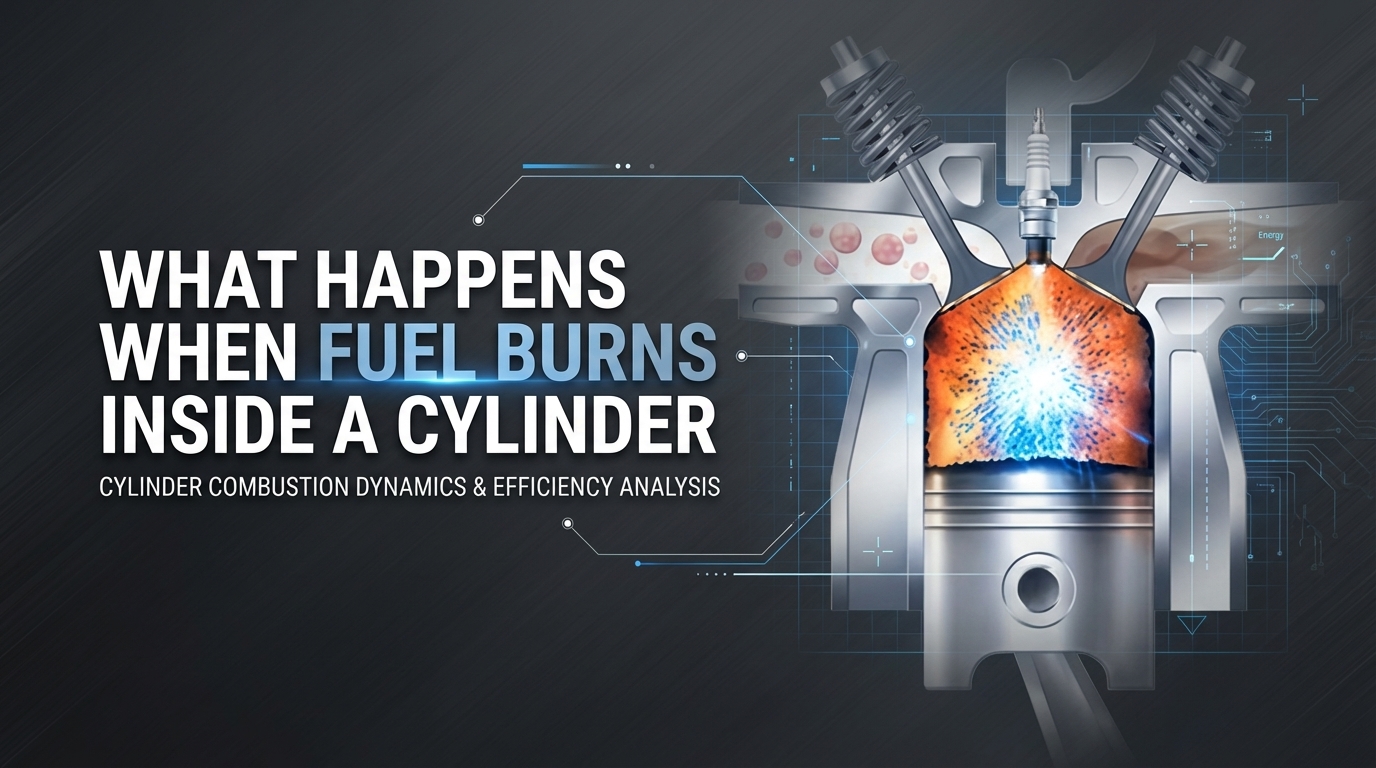
Think of your engine as a controlled chemical power plant. Every time you press the accelerator, you're commanding a series of tiny, perfectly timed explosions. The magic and the mayhem of an internal combustion engine all happen inside the cylinder. It's where fuel transforms from a liquid into motion, heat, and exhaust. Understanding this process isn't academic. It's the key to diagnosing problems, improving efficiency, and knowing exactly why your car behaves the way it does. I hear drivers say, "It's running rough," or "It feels down on power." Those feelings start right here, in the heart of the machine. Every symptom you feel on the road traces back to what’s happening inside the cylinder. Master this, and you understand the engine.
The Four-Stroke Cycle: The Engine's Heartbeat
Nearly every petrol engine on the road follows the four-stroke Otto cycle. It's a four-act play that repeats thousands of times per minute. Each cylinder performs this sequence, and the timing is everything.
Intake Stroke: Drawing a Breath
The piston moves down the cylinder, creating a vacuum. The intake valve opens, and the engine draws in a mixture of air and atomized fuel. This isn't just air. Modern engines precisely meter fuel through fuel injectors directly into the intake port or cylinder. The quality of this mixture is critical. A dirty air filter or a failing sensor can upset the balance before combustion even begins.
Compression Stroke: Building Pressure
Both valves close. The piston moves back up the cylinder, compressing the air-fuel mixture into a small space at the top. This compression heats the mixture and makes the subsequent explosion more powerful. The compression ratio of your engine is a fixed design number that greatly impacts power and efficiency. Problems here, like worn piston rings or leaking valves, lead to low compression and a weak, inefficient burn.
Power Stroke: The Controlled Explosion
This is the moment. Near the top of the compression stroke, the spark plug fires. The spark ignites the pressurized mixture. It doesn't explode like a bomb. It burns in a controlled, expanding flame front that pushes the piston down with tremendous force. This is the only stroke that produces power. All others consume it. The health of your ignition system is paramount here. A weak spark or incorrect timing robs power and damages the engine.
Exhaust Stroke: Clearing the Chamber
The piston moves up again. The exhaust valve opens, and the spent gases now a mixture of carbon dioxide, water vapor, nitrogen, and pollutants are pushed out into the exhaust manifold. The efficiency of this scavenging affects how cleanly the next cycle begins. A restricted exhaust or a faulty valve can trap exhaust gas, diluting the fresh air-fuel charge.
Read Also: The Heart of Your Car: How Does the Engine Actually Work?
Combustion Chemistry: What Are We Actually Burning?
Petrol is a hydrocarbon, a chain of hydrogen and carbon atoms. For perfect, complete combustion, it needs to mix with oxygen in a specific ratio about 14.7 parts air to 1 part fuel by mass. This is the stoichiometric ratio. The engine's computer, the ECU, constantly adjusts fuel delivery to try and hit this target using data from oxygen sensors.
When combustion is perfect, the main outputs are carbon dioxide (CO2) and water (H2O). But it's never perfect in the real world. Incomplete combustion creates carbon monoxide (CO), a poisonous gas. Excess fuel or oil burning creates unburnt hydrocarbons (HC) and soot. High combustion temperatures cause nitrogen and oxygen in the air to combine, forming nitrogen oxides (NOx). Your catalytic converter exists to clean up these three main pollutants before they exit the tailpipe.
When Combustion Goes Wrong: Knocking, Misfires, and Inefficiency
This is where theory meets the repair bay. The ideal burn is a smooth, outward-moving flame front from the spark plug. Deviations cause problems you can hear and feel.
Engine Knock (Detonation)
This is the sound of uncontrolled combustion. Instead of a single flame front, the remaining air-fuel mixture at the edges of the chamber ignites spontaneously from heat and pressure. Two flame fronts collide, creating a violent pressure spike and that characteristic metallic "pinging" sound. Knock is destructive. It can crack pistons and damage bearings over time. Causes include low-octane fuel, excessive carbon deposits creating hot spots, advanced ignition timing, or an overheating engine.
Misfire
A misfire is a complete failure of combustion in a cylinder. The fuel-air mixture doesn't ignite, or it ignites too weakly to produce useful power. You feel it as a shudder, a loss of power, and rough idle. The check engine light will often flash. Causes are classic: bad spark plugs or coils, a clogged fuel injector, or that low compression we talked about earlier.
Rich and Lean Conditions
These are imbalances in the air-fuel ratio. A "rich" mixture has too much fuel. It can cause black smoke, fouled spark plugs, and poor fuel economy. A "lean" mixture has too much air. It can cause hesitation, engine overheating, and potentially damaging pre-ignition. Sensors like the Mass Air Flow (MAF) and Oxygen (O2) sensors are the ECU's eyes and ears for managing this balance. When they fail, the system guesses, and combustion suffers.
Essential Guide: Mastering Fuel System Troubleshooting: Tips, Solutions, and FAQs
The Diesel Difference: Compression Ignition
Diesel engines work on a different principle. They have no spark plugs. During the compression stroke, they compress air alone to an extremely high pressure and temperature often over 500°C. Fuel is then injected directly into this superheated air at the precise moment, and it ignites spontaneously. This compression ignition is why diesels are inherently more thermally efficient and produce more torque. It also creates different byproducts, like particulate matter (soot), which is managed by a Diesel Particulate Filter (DPF).
Why This Knowledge Matters to You
You don't need to be a chemist. But connecting symptoms to the combustion process makes you a smarter owner. That "pinging" up a hill? Now you know it's knock, likely from bad fuel or carbon buildup. A rough idle and smell of fuel? You're thinking incomplete combustion, maybe a faulty spark plug or a dirty Mass Airflow Sensor. Sudden loss of power? Your mind goes to a major disruption in the cycle a severe misfire or fuel delivery issue.
Combustion is the core transaction. You put in fuel and air. You get out power, heat, and waste. Maximizing the power and minimizing the waste and destructive heat is the eternal goal of automotive engineering. Every maintenance item from changing spark plugs to cleaning injectors to using quality fuel is in service of preserving that perfect, controlled burn inside the cylinder. When you understand that, the whole machine makes a lot more sense.
Deep Dive: A Comprehensive Guide to Understanding the Essential Parts of an Engine
Comments (0)
Please login to join the discussion
Be the first to comment on this article!
Share your thoughts and start the discussion