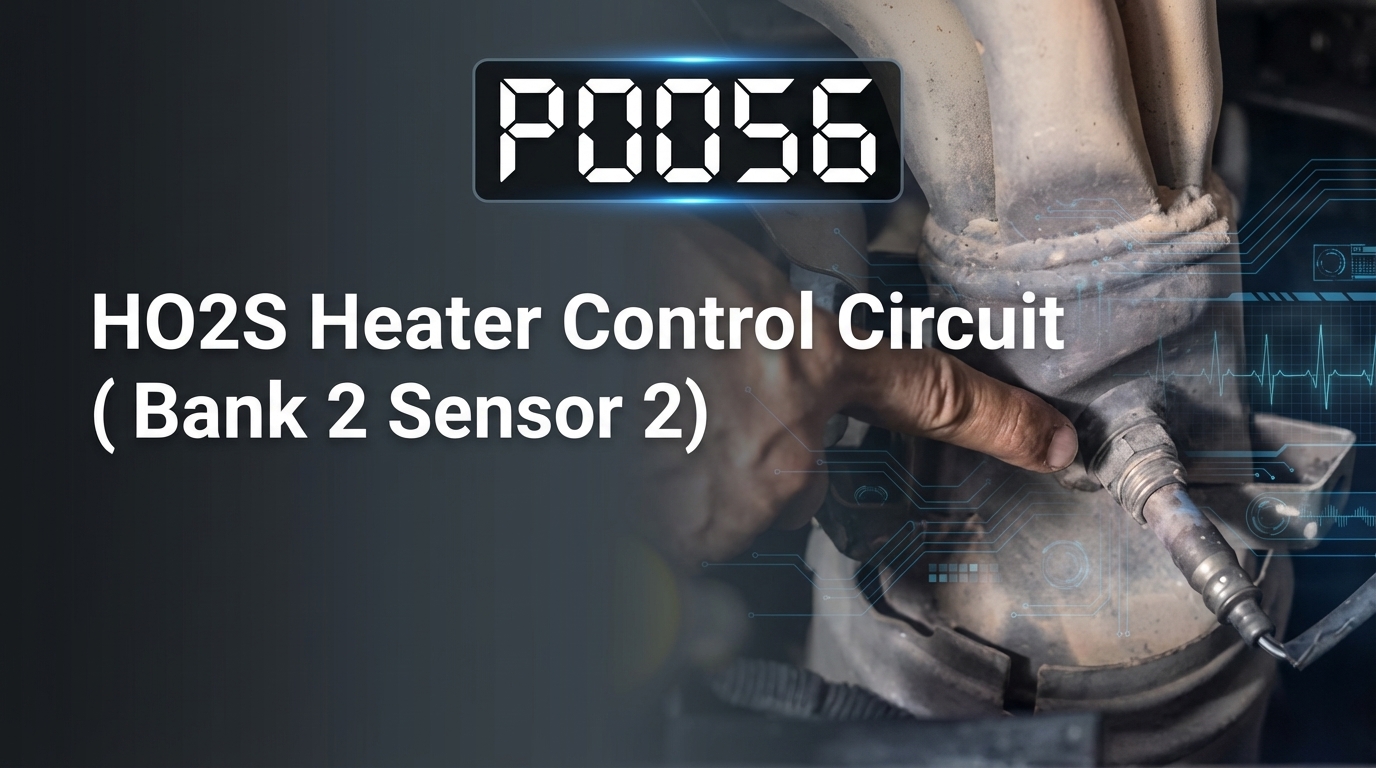
Your check engine light is on, and the scanner shows P0056. You hear the same phrase in my shop all the time: "It's just a sensor code, right?" That assumption is where the trouble starts. A 2023 study by the Society of Automotive Engineers found that heater circuit faults are among the most misdiagnosed OBD-II codes, leading to unnecessary part replacement and repeat visits. This code is not about the sensor's measuring ability. It's about its internal electric heater, a critical component that most drivers never think about. Ignoring it or guessing the fix can mask deeper electrical issues t
What P0056 Actually Means
Let's break it down. P0056 stands for "O2 Sensor Heater Control Circuit (Bank 2, Sensor 2)." Every oxygen sensor has a tiny heating element inside. Its job is to bring the sensor up to operating temperature (around 600°F) quickly after a cold start. A hot sensor provides accurate readings faster, which helps the engine control unit (ECU) manage fuel trim and reduce emissions almost immediately. When the ECU detects a problem in the electrical circuit powering that heater for the downstream sensor on Bank 2, it logs P0056. The sensor might still work, but inefficiently, often leading to poor cold-start performance and increased emissions. For a deeper dive into how these sensors function, our guide on understanding the oxygen sensor is essential reading.
Pro Tip: Mechanic's Secret: The Foolproof Way to Identify Oxygen Sensor Banks
Bank 2, Sensor 2 – Finding the Right One
This is the part that causes confusion. "Bank 2" refers to the side of the engine that does NOT contain cylinder number one. In a common V6 or V8 engine, Bank 1 is usually the side with cylinder 1. Bank 2 is the other side. "Sensor 2" always means the downstream sensor, located after the catalytic converter. So, P0056 points specifically to the post-catalytic converter oxygen sensor on the engine's Bank 2. If you have an inline engine (like a straight-4 or straight-6), there is only one bank (Bank 1), so a P0056 code should not appear. Its appearance on an inline engine suggests a wiring mix-up or a software issue.
A Professional Diagnostic Sequence
Do not buy a sensor first. That's the golden rule. The problem is in the "circuit," which includes the sensor heater, the wiring to it, and the power control from the ECU. Follow this order to find the real fault.
1. Check the Heater Resistance
This is your first physical test. With the engine cold, disconnect the electrical connector for the Bank 2, Sensor 2 O2 sensor. Using a digital multimeter set to measure resistance (Ohms), probe the two heater circuit pins on the sensor side of the connector. Consult a service manual for your specific model, but a typical functioning O2 sensor heater will show a resistance between 2 and 30 ohms. A reading of infinite resistance (open circuit) means the heater inside the sensor is broken. A reading near zero ohms indicates an internal short. Either result confirms a bad sensor. If the resistance is within spec, the sensor heater is likely fine, and you must look elsewhere in the circuit.
2. Inspect the Wiring and Connector
Now, check the vehicle's side of the circuit. Visually trace the sensor wiring back from the connector, looking for any obvious damage, chafing against the exhaust or body, or melted insulation. The connector itself must be clean, dry, and free of corrosion. A bit of dielectric grease can work wonders here. Next, with the connector still disconnected from the sensor, turn the ignition to "ON" (do not start the engine). Carefully back-probe the appropriate wire on the vehicle harness side with your multimeter set to DC Volts. You should see battery voltage (around 12V) on the power wire. No voltage here points to a problem upstream, like a blown fuse or a faulty relay. For broader electrical troubleshooting methods, our article on how to troubleshoot car wiring problems provides a solid foundation.
3. Verify the Fuse and Control Circuit
The heater circuit is almost always protected by a dedicated fuse in the engine bay or interior fuse box. Find it using your owner's manual, pull it, and inspect it. A blown fuse is a clear sign. But here's the critical part: do not simply replace it and assume victory. A blown fuse is a symptom of a short circuit. If the new fuse blows immediately, you have a confirmed short to ground in the wiring or a failed sensor with a shorted heater. The ECU controls the heater by providing a ground path. A problem with this control signal from the ECU is rare but possible. Diagnosing this requires checking for a pulsed ground signal with a scan tool capable of activating the heater circuit, or using a noid light.
Related Reading: P0056, P0057, and P0058: HO2S Heater Control Circuit (Bank 2 Sensor 2)
Common Pitfalls and Final Advice
The most frequent mistake is assuming the code means "replace oxygen sensor." I've seen countless vehicles come in with a new sensor installed and the light still on because the customer or another shop didn't check the fuse or the wiring. Another pitfall is not clearing the code and performing a full drive cycle after the repair. The ECU needs to see that the heater circuit is now functioning correctly under various conditions before it will extinguish the light. Use your scan tool to clear the code, then drive the vehicle through a mix of city and highway driving for at least 15-20 minutes.
If your diagnostics point to a failed sensor, replace it with a quality unit. This is not the place for the cheapest option. A faulty oxygen sensor can lead to sensor-related fuel consumption problems and even damage your catalytic converter over time. When the job is done, and the light stays off, you have fixed it correctly. You addressed the circuit, not just the part. That is the difference between a quick guess and a professional repair.
Essential Guide: This is Why Ignoring Your Oxygen Sensor Could Cost You Thousands
Because in the end, "It's just a sensor code" is what people say before they spend money twice. A methodical diagnosis is what professionals do to fix it once.
Comments (0)
Please login to join the discussion
Be the first to comment on this article!
Share your thoughts and start the discussion