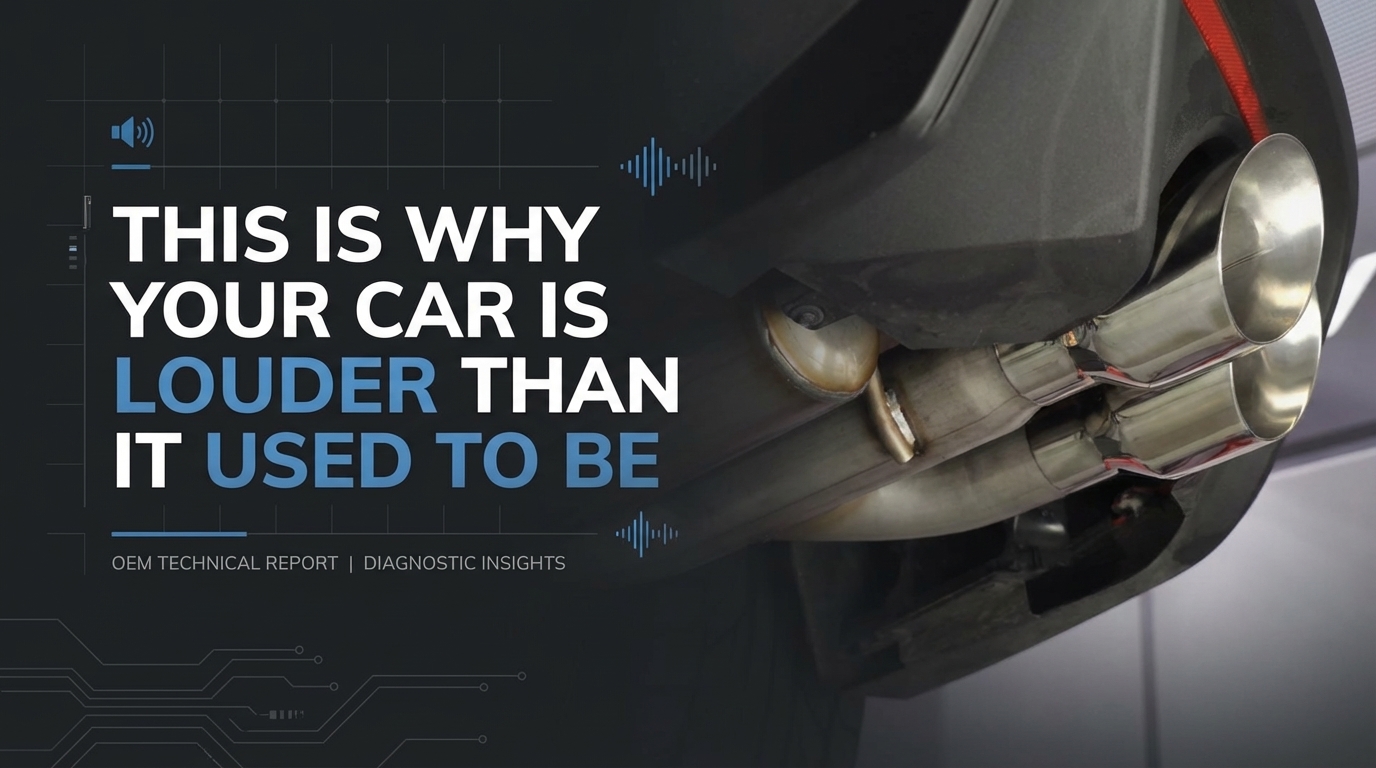
That new rumble you hear isn't your car developing a personality. According to a survey of automotive technicians, exhaust system issues are among the top five most common causes of abnormal vehicle noise reported by drivers. Your car is communicating a specific mechanical condition, and the type of sound you hear points directly to the failing component. I hear the phrase all the time: "It's always been a quiet car." That's the point. A sudden or gradual increase in noise is a direct signal, not a quirk. Let's decode what your car is actually telling you.
The Exhaust System Leak A Deep, Throaty Rumble
This is the most common culprit for a car that suddenly sounds louder, often described as a deeper, throatier, or "roaring" sound that gets worse under acceleration. The exhaust system is designed as a sealed pathway from the engine to the tailpipe. When a leak develops, hot, high-pressure gases escape before they reach the muffler, creating that characteristic rumble.
Where to Look and What It Means
The leak is rarely at the tailpipe. You need to check the entire run. Common failure points are the exhaust manifold gasket, the flex pipe (a corrugated section designed to absorb engine movement), and the connections between the catalytic converter, resonator, and muffler. A telltale sign is soot or black carbon streaks around a joint or a visible crack. A small leak will whisper. A large one will roar. This isn't a sound to ignore, as it can allow dangerous exhaust fumes like carbon monoxide into the cabin and can lead to other clear symptoms of exhaust problems.
Related Reading: Why Does Your Car Make Noise Even After You Turning It Off?
A Failing Muffler The Classic "Louder" Sound
If the exhaust note is simply louder overall, not necessarily deeper or raspy, the muffler itself is the prime suspect. Its entire job is to dampen sound waves. Internal baffles can rust out and break apart, or the casing can corrode through. The result is a direct, less-restricted path for sound. You might hear a droning noise at certain speeds, and the volume increase is often progressive. One day you notice it's a bit louder on the highway. A week later, your neighbors notice it too when you start the engine.
Don't Confuse It With the Catalytic Converter
People often point to the catalytic converter when the car gets loud. While a failed, internally broken cat can cause rattling and affect sound, the muffler is the dedicated sound-deadening component. A simple test? Have someone briefly block the tailpipe outlet with a rag (do not hold it there) while the engine is idling. If the sound decreases significantly, the muffler is likely doing its job and the leak is upstream. If the sound change is minimal, the muffler is probably compromised. For more on how exhaust components can fail, see our guide on identifying catalytic converter problems.
The Worn Bearing A Hum That Becomes a Growl
This sound is mechanical, not exhaust-related. It often starts as a faint humming or whirring that changes with wheel speed. As it worsens, it becomes a deep, grinding growl or a constant roar. This is typically a wheel bearing on its way out. The key identifier is that the sound changes in pitch with your vehicle's speed, not the engine's RPM. It may get louder when turning left or right, as cornering load shifts weight onto the failing bearing.
I've had customers say, "It sounds like I'm driving a truck all of a sudden." That's a classic bearing description. Ignoring it is a safety risk, as a bearing can seize and cause the wheel to lock up. This is a different beast from the vibrations caused by imbalanced wheels or drivetrain issues.
The Blown Exhaust Manifold Gasket A Ticking or Puffing Sound
This sound is more subtle at first but gets louder. It's a distinct ticking or puffing noise that is loudest when the engine is cold and may lessen as components expand with heat. It comes directly from the engine bay. The exhaust manifold bolts to the cylinder head, and the gasket in between can burn out or fail. This leak is at the very start of the exhaust system, so the escaping gas is extremely hot and under high pressure, creating that sharp ticking sound, almost like a small pneumatic tool.
This leak is serious. It can cause the engine to run poorly, trigger the check engine light due to incorrect oxygen sensor readings, and allow extreme heat to damage nearby wiring and components. It's a perfect example of a small noise preceding a big repair bill.
Essential Guide: From Knocks to Leaks: A Comprehensive Guide to Common Car Engine Problems
How to Diagnose It Yourself (Safely)
Be methodical. First, try to pinpoint where the sound is coming from front, rear, left, or right side. Is it present at idle, or only when moving? Does it change when you accelerate? With the engine cold and parked on level ground, do a visual inspection of the exhaust piping, looking for holes, heavy rust, or black soot marks at joints.
For a suspected exhaust leak, you can carefully feel around joints (without touching hot parts) for pulses of air when the engine is running. The safest and most effective method is to have an assistant briefly block the tailpipe while you listen for changes along the exhaust system. Remember, a louder car is a symptomatic car. Finding the source of the noise is the first step to a quiet, and more importantly, safe and efficient vehicle. For a deeper understanding of how all these systems work together, explore how a car engine actually works from start to finish.
Your car's normal voice is a hum. A shout, a roar, or a growl is a request for attention. Listen to it.
Comments (0)
Please login to join the discussion
Be the first to comment on this article!
Share your thoughts and start the discussion