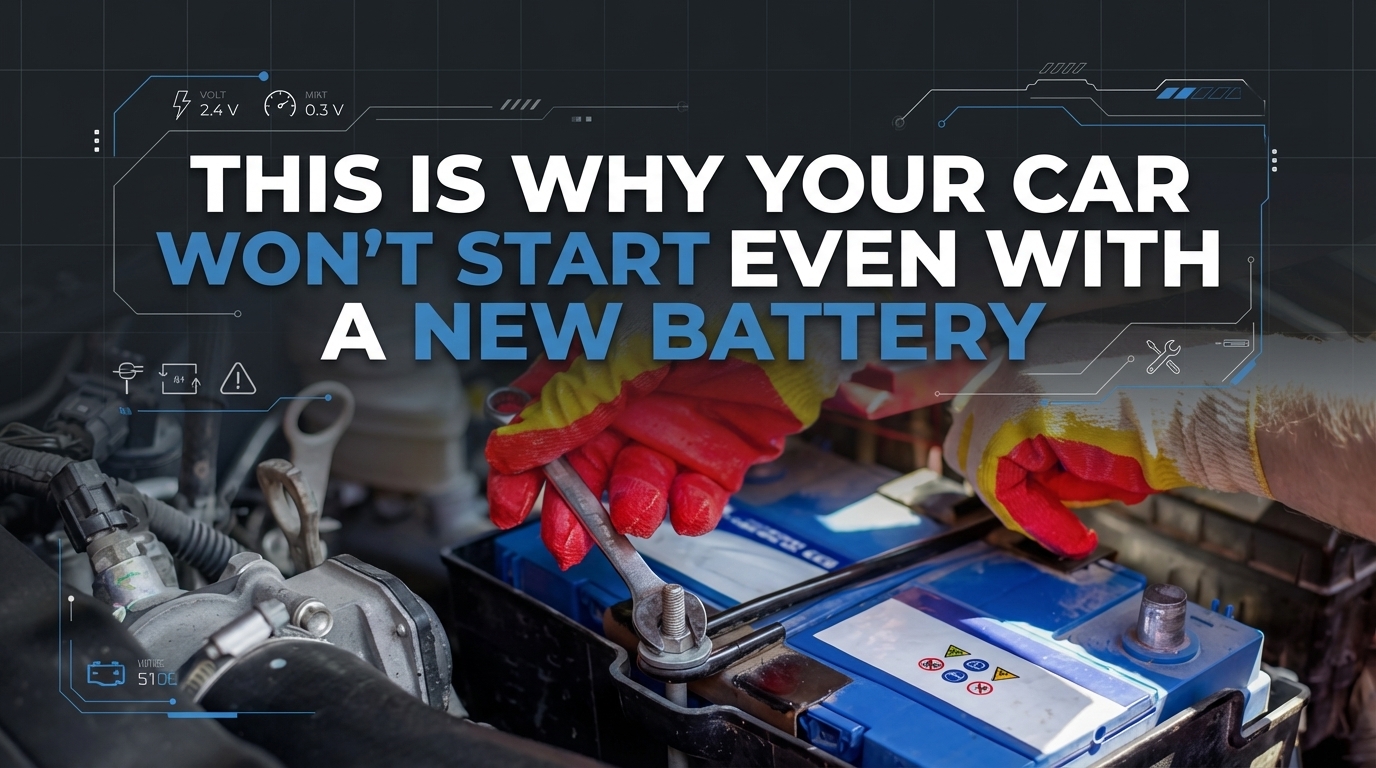
You fit a brand new battery, turn the key, and get nothing but a click or a silent dash. It's a uniquely frustrating moment. I hear the line all the time in the shop: "It's got a new battery, so it has to start." That logic feels unshakeable. Yet, a recent analysis of roadside data shows that battery-related issues, even with new units, remain a top cause for calls. The truth is, a battery is only one link in a chain. When it's new and the car still won't start, the problem is almost never the battery itself. It's what surrounds it.
Read Also: 11 Reasons Your Car Won't Start and How to Resolve Them
The Installation Check You Cannot Skip
This is where I start every single time. A surprising number of "new battery, no start" problems are solved right at the terminals. You must check your work. A loose terminal clamp is a non-connection. It can give you dash lights but not enough current to engage the starter. Corrosion hiding inside the cable end, where you can't see it, acts as an insulator.
Grab each battery terminal and try to twist it by hand. It should not move. Zero play. Next, trace the negative cable to where it bolts to the chassis or engine block. This ground connection is critical. If it's loose or corroded, the circuit can't complete. People often say, "I know my vehicle wouldn't have that." Trust me, corrosion doesn't care. For a deeper dive on this specific issue, our guide on why battery terminals corrode is essential reading.
Is the Battery Actually Good and Correct?
A new battery isn't always a good battery. It could have been on the shelf for years and lost its charge. It could be defective from the factory. This is rare, but it happens. Before you do anything else, verify the battery voltage with a multimeter. A fully charged battery should read at least 12.6 volts with the engine off.
Also, confirm it's the right battery for your car. The correct group size, terminal orientation, and Cold Cranking Amps (CCA) rating are not suggestions. An undersized battery will struggle to turn your engine over, especially in colder weather. Your owner's manual has the exact specifications. Don't guess.
The Hidden Damage From a Simple Mistake
Here's a scenario that causes instant panic. If the battery cables were connected incorrectly, even for a second, you may have blown a main fuse or fusible link. This is a protective feature that sacrifices an inexpensive fuse to save your expensive computer modules.
The main battery fuse, often located in the fuse box under the bonnet, is the first place I look. If it's blown, you'll typically have no electrical power at all. The starter relay is another common casualty. A quick test is to swap the starter relay with an identical one from another circuit, like the horn or fuel pump relay. If the car now cranks, you've found a cheap fix. Understanding how these relays control electrical loads can prevent future confusion.
Pro Tip: When Reconnecting The Battery, Which Terminal is Connected First?
The Battery Was Never the Problem
This is the hard truth many face. The old battery may have been a symptom of a deeper issue. You replaced the symptom, but the disease remains. There are three primary culprits that mimic a dead battery.
A Failing Starter Motor
A starter drawing too much current or with worn internal brushes will strain any battery. The old battery may have been weakened by the constant demand. The new battery faces the same faulty load. The telltale sign is one solid "clunk" or click when you turn the key, with no engine cranking. Sometimes you'll hear a slow, laboured groan. This points directly to the starter or its solenoid. Learn more about what causes a starter to turn slowly.
A Faulty Alternator
This is a classic misdiagnosis cycle. A bad alternator doesn't charge the battery while driving. The battery slowly drains until it lacks the power to start the car. You replace the battery. The car starts because the new battery has a full charge. But the alternator still isn't charging it. After a short drive or overnight, the new battery is now dead too. If your car starts with a jump but dies again later, the alternator is suspect number one. The team at AutoZone consistently lists a faulty alternator as a top reason for repeated battery failures.
A Parasitic Drain
This is when something electrical stays on after you turn the car off, slowly draining the battery. It could be a trunk light, a glove box lamp, a faulty module, or an aftermarket accessory. The old battery died from this constant drain. The new one will suffer the same fate, often within 24 hours. If the battery tests good but is dead after sitting, you need to track down a parasitic drain.
A Professional's Diagnostic Order
Follow these steps logically. Do not skip ahead.
- Verify Installation: Check for tight, clean terminals and a solid ground connection.
- Test the New Battery: Confirm it has at least 12.6V and is the correct specification for your vehicle.
- Inspect Fuses: Check the main battery fuse and the starter relay in the under-hood fuse box.
- Listen to the Starter: A single click points to the starter or its circuit. A rapid clicking often indicates a poor connection or a deeply discharged battery.
- Test the Charging System: If the car starts but the battery dies again, test the alternator output. It should produce between 13.5 and 14.5 volts with the engine running.
This sequence addresses the most likely issues first, saving you time and money. For a streamlined version of this process, the fastest way to diagnose a no-start is a fantastic resource.
A new battery should be a solution, not the beginning of a new puzzle. When it isn't, stop and trace the path of the power. The fault is almost always in the connections, the protection devices, or the components that work alongside the battery. Trust the process, not the assumption.
Comments (0)
Please login to join the discussion
Be the first to comment on this article!
Share your thoughts and start the discussion