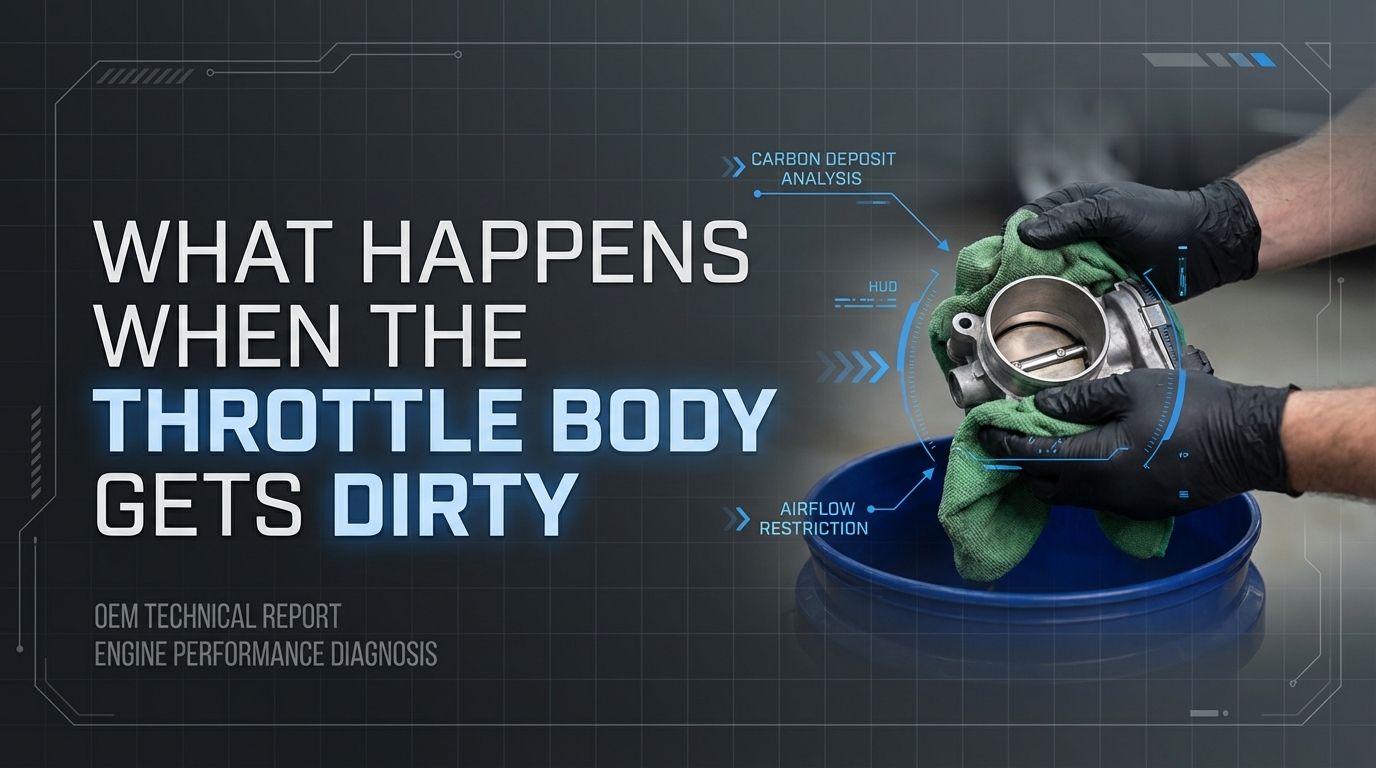
A clean throttle body is one of those maintenance items many drivers never think about until their car starts acting up. According to data from major parts suppliers, carbon buildup in the throttle body is a leading cause of drivability complaints that don't always trigger a check engine light. The car runs, but it doesn't run right. That's the frustrating part.
I hear it all the time in the shop. A customer describes a vague hesitation and says, "It feels like it's holding back." They might add, "It's been fine for years, so I figured it was normal." That assumption is where small problems start to cost you fuel and performance. Your throttle body is the gateway for air entering your engine, and when it gets dirty, the entire engine management system has to compensate.
How a Dirty Throttle Body Disrupts Your Engine
Modern engines rely on precise electronic control. When you press the accelerator, you're not pulling a cable. You're sending a request to the Engine Control Module (ECM). The ECM then commands the throttle body's electric motor to open the throttle plate a specific amount to let in the exact volume of air the engine needs.
Carbon and oil vapor from the crankcase ventilation system slowly coat the edges of the throttle plate and the bore it sits in. This gunk acts like a physical barrier. The plate can't close fully to its learned "home" position, and it can't move as freely. The Throttle Position Sensor (TPS) is still reporting correctly, but the actual airflow is now restricted and unpredictable.
The engine computer detects this mismatch. It tries to adjust the idle speed by opening the plate a bit more, but the crud interferes. The result is an unstable, rough idle that feels like the car might stall. This is often the first and most noticeable symptom.
The Two Major Problems You Will Feel
The issues caused by a dirty throttle body aren't subtle. They directly impact driveability and your wallet.
Sluggish and Erratic Throttle Response
This is the classic symptom. You press the pedal, and there's a momentary pause or stumble before the car accelerates. It feels lazy, especially from a stop. Drivers often describe it as, "I have to push the pedal further to get going." This happens because the sticky throttle plate doesn't respond instantly to the ECM's commands. The air-fuel mixture is thrown off, causing a lean condition that the computer then has to correct by adding more fuel, leading to hesitation.
This poor response isn't only annoying. It can be a safety concern when merging into traffic or making a quick maneuver. If you're experiencing this, it's worth checking out before it leads to more complex issues like those caused by a failing fuel pump.
Poor Idle and Stalling
A dirty throttle body wreaks havoc on idle control. The Idle Air Control (IAC) valve or the ECM's electronic throttle control can't maintain a steady rpm because the air passage is gummed up. You'll notice the rpm needle fluctuating at a stoplight, or the whole car might shudder. In severe cases, when the plate is so dirty it can't hold the minimum air opening, the engine will stall when you come to a stop.
People often mistake this for other problems. They'll say, "It idles rough, but it clears up when I drive." That's a textbook sign of throttle body grime interfering with low-speed airflow control. It's distinct from the random shaking caused by other ignition or fuel issues.
Read Also: Choking Up Your Ride? Signs You Need Throttle Body Cleaning
Beyond Annoyance: The Hidden Costs
Ignoring a dirty throttle body doesn't only make your car unpleasant to drive. It has real financial consequences. The engine computer, constantly fighting to correct the air-fuel ratio, will often command a richer mixture. This wastes fuel. Over months, that extra fuel consumption adds up. You're literally burning money because of a layer of carbon.
Furthermore, the inconsistent airflow and rough running put extra stress on engine mounts and can contribute to premature wear on other components. It also makes the ECM store adaptation values that are far from ideal. In some cases, the buildup can become severe enough to trigger a fault code like P0068, which indicates a performance mismatch between the throttle body and the Mass Air Flow sensor.
What You Should Do About It
Throttle body cleaning is a standard maintenance procedure, not a complex repair. For many vehicles, it's a straightforward job that can be done in under an hour. The key is to use a throttle body-specific cleaner and a soft cloth. Never use abrasive brushes or carburetor cleaner on modern electronic throttle bodies, as you can damage sensitive coatings or the throttle position sensor.
After cleaning, the ECM often needs to relearn the idle position. This usually involves a simple procedure like letting the car idle with all accessories off for a few minutes. The difference is immediate. Throttle response becomes crisp, idle smooths out, and that sluggish feeling disappears. For a detailed guide, our walkthrough on How to Perform a Throttle Body Cleaning for Improved Performance covers the steps.
Consider this service every 60,000 to 100,000 miles, or sooner if you do a lot of stop-and-go driving. It's one of the most cost-effective ways to restore lost performance and efficiency. As the specialists at Firestone Complete Auto Care note, addressing drivability issues early often prevents more expensive repairs down the line.
Your car's performance is a sum of its well-maintained parts. A dirty throttle body is a simple physical problem with direct consequences you can feel. Don't dismiss that hesitation or rough idle as "normal for its age." A quick clean can make an old car feel new again, saving you fuel and preventing the cascade of issues that start with poor airflow.
Comments (0)
Please login to join the discussion
Be the first to comment on this article!
Share your thoughts and start the discussion