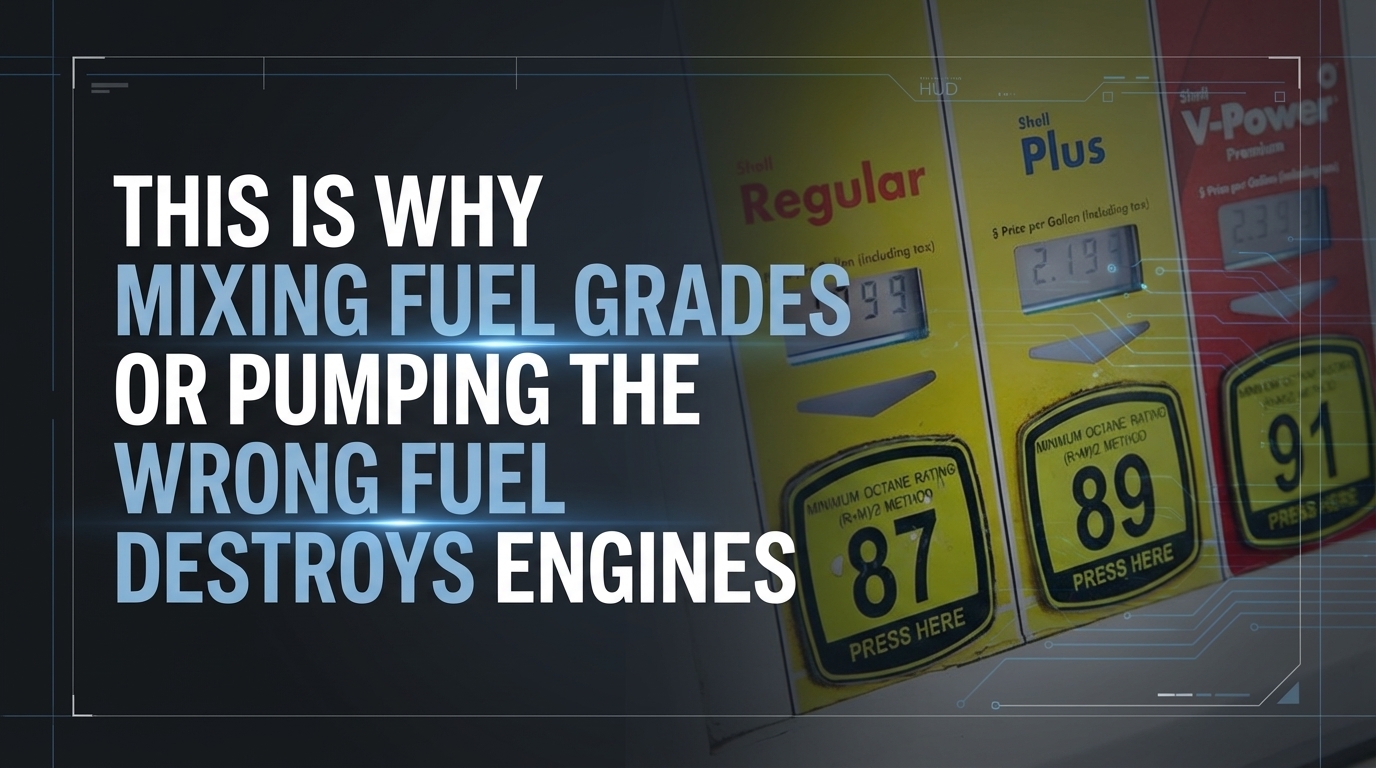
Think a little octane mix-up at the pump is no big deal? The UK's Automobile Association reports that misfuelling, putting the wrong type of fuel in a vehicle, is one of their most frequent roadside callouts, with over 150,000 drivers making this costly mistake each year. That's one driver every three and a half minutes facing a potential engine catastrophe. I hear the same bewildered statement after the fact: "It's all fuel, right? The car should run." This confidence is what turns a simple fill-up into a repair bill that can reach five figures.
Read Also: How A Simple Mistake At The Gas Pump Could Destroy Your Engine Overnight
Why Octane Ratings Are Not a Suggestion
Your engine's computer, the Engine Control Unit (ECU), is programmed for a specific fuel octane rating. Octane measures a fuel's resistance to premature ignition, or "knock." Using a lower grade than recommended forces the engine into a dangerous compromise. To prevent damaging knock from the inferior fuel, the ECU will aggressively retard ignition timing. You feel this as a significant loss of power and sluggish response. The engine is protecting itself, but it's running in a crippled, inefficient state. Long-term, this constant adjustment and the occasional knock that gets through can damage pistons and rings. Conversely, using a higher octane fuel in an engine designed for regular offers no benefit. The ECU cannot advance timing enough to utilize the extra knock resistance, so you're paying a premium for zero return. It's not harmful, but it's a waste. The real trouble starts when you cross the fundamental fuel line.
The Catastrophic Diesel in a Petrol Engine
This is the more common and initially less dramatic error, but its effects are insidious. Diesel fuel is oilier and denser than petrol. When you put it in a petrol tank, it doesn't vaporize properly. The diesel will coat the spark plugs and fuel injectors, preventing them from creating the spark and fine spray needed for combustion. The car may run for a short distance, sputtering and producing massive amounts of white smoke from the unburned diesel. Then it will stall. The immediate saving grace is that diesel is less volatile. The real damage comes from the lubrication issue. Petrol acts as a solvent; diesel acts as a lubricant. The diesel can ruin the fuel injectors and compromise the high-pressure fuel pump in direct injection engines. The repair isn't just draining the tank. It's a full system flush, and very often, a replacement of these expensive components.
The Explosive Petrol in a Diesel Engine
This mistake is far more severe and can destroy an engine in minutes. Diesel engines rely on compression ignition; the air-fuel mixture ignites from the intense heat of compression alone. Petrol has a much lower flash point. Introducing petrol into a diesel system drastically reduces the fuel's lubricity and its cetane rating, which governs ignition delay. The petrol causes two immediate failures. First, it destroys the fuel pump and injector nozzles that rely on diesel's lubricating properties. They will grind themselves to metal dust. Second, the petrol ignites too early and violently under compression. This causes catastrophic "runaway" pre-ignition, creating forces that can shatter pistons, bend connecting rods, and literally blow the head off the engine. If you even suspect you've put petrol in a diesel, do not start the engine. Not even to move it off the forecourt. Towing is your only option.
Essential Guide: What happens if you put petrol in a diesel engine?
What To Do The Moment You Realize The Mistake
Action is everything. Time is the enemy. If you're still at the pump and haven't started the car, consider yourself lucky. Do not turn the key. Do not insert it. Put the car in neutral and have it pushed to a safe spot. Immediately notify the station attendant. Your next call is to a professional recovery service that can flatbed tow the vehicle to a qualified workshop. They need to drain the entire fuel system, not just the tank. This includes the fuel lines, filter, pump, and rails. If the engine was started, even briefly, the scope of damage escalates rapidly. The workshop will need to inspect the fuel pump, injectors, and potentially the cylinder compression. This is where you hear, "But I only drove a mile." In the context of petrol in a diesel, that's more than enough distance for total engine failure.
The Cost of "I Thought It Would Be Fine"
Let's talk numbers, because this is where the reality hits. Draining and cleaning a fuel system where the engine was not started can cost between $500 and $1,000. If the engine was started and run, you are now in the realm of component replacement. Replacing a diesel high-pressure fuel pump and set of injectors can easily exceed $4,000. And if the petrol caused internal engine damage? You are looking at a bill that rivals the value of the car, often between $8,000 and $15,000 for a full engine replacement. This single moment of distraction is one of the most expensive errors a driver can make.
How to Build a Foolproof Routine
Prevention is embarrassingly simple. It's about creating a habit that overrides distraction. First, use the visual cue on your dashboard. That little arrow next to your fuel gauge? It points to the side of the car your fuel door is on. It's a reminder to position yourself correctly. Second, physically touch the correct fuel nozzle before you grab it. Diesel nozzles at most stations are larger and are often colored green or black. They are designed not to fit into the smaller filler neck of a petrol car. If you force it, you are doing something very wrong. Third, if you drive both petrol and diesel vehicles, or have just switched, make a conscious mental note as you pull in. Say it out loud: "This is the diesel car." It sounds silly. It works.
Don't Miss: Car Owners Shocked To Discover The Real Purpose Of The Arrow Next To The Fuel Gauge
Final Word
Your engine is not a flexible chemistry set. It's a precision instrument calibrated for a specific explosive reaction. Mixing fuels or choosing the wrong one corrupts that reaction at a fundamental level. The damage ranges from slow degradation to instant, violent destruction. Trust the manual, not the myth that "premium is always better." And if that moment of panic at the pump arrives, remember: the cost of a tow is nothing. The cost of a new engine is everything. Don't start the car. Your wallet will thank you.
Comments (0)
Please login to join the discussion
Be the first to comment on this article!
Share your thoughts and start the discussion