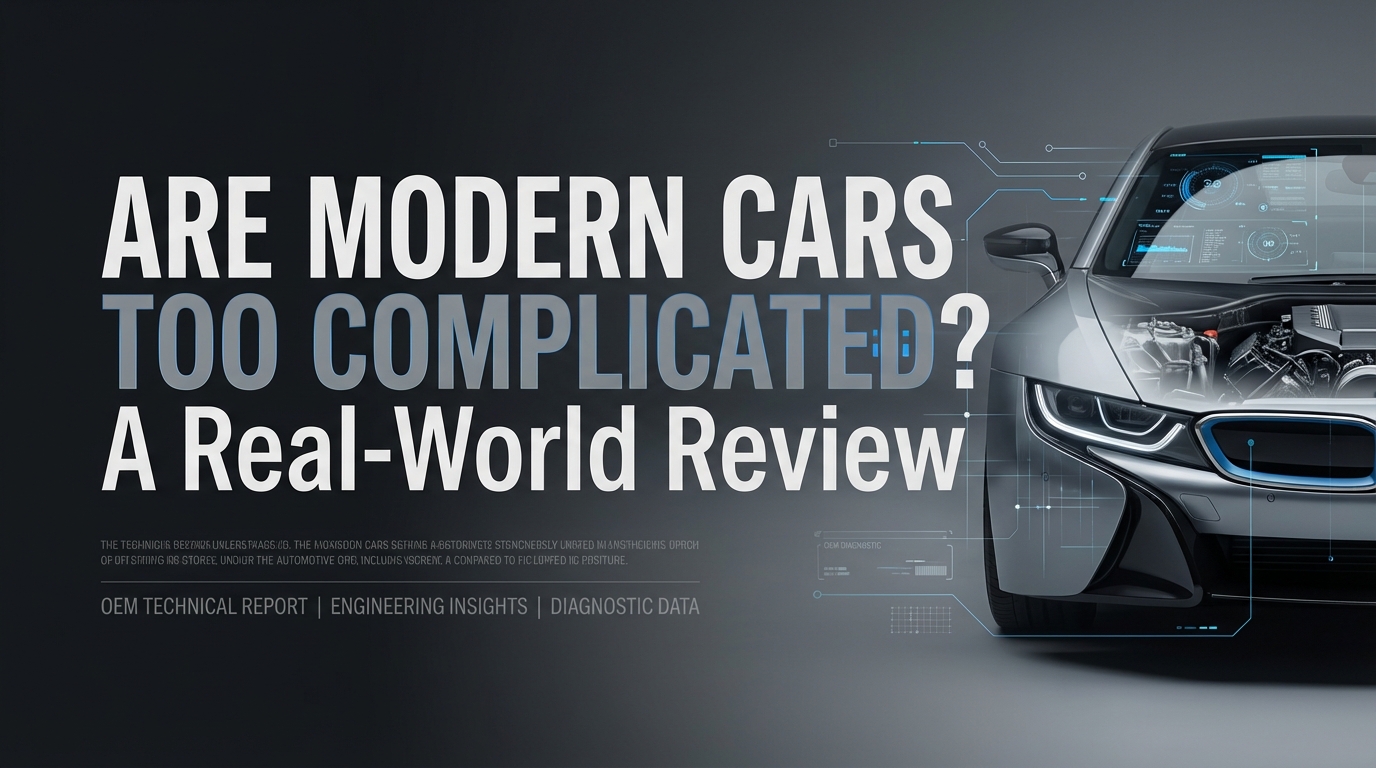
A recent study by the Society of Automotive Engineers (SAE) found that the average new car now contains over 100 million lines of software code. To put that in perspective, a modern fighter jet uses about 25 million. We are driving computers on wheels, and the complexity is not a marketing gimmick. It is a fundamental shift in how vehicles are built and maintained.
I hear the sentiment all the time from owners. "I used to be able to fix that myself," they say, looking at a dashboard lit up like a Christmas tree. There is a genuine feeling of being locked out of your own vehicle. The question is not whether modern cars are complicated. They are. The real question is whether this complexity serves the driver or simply creates a more fragile, expensive machine. Let us look at where this complexity truly matters for you.
The Diagnostic Dilemma
Gone are the days of listening for a telltale knock or spotting a leaking hose. Modern diagnostics revolve around a network of sensors and modules communicating over a digital highway called a CAN Bus. When something goes wrong, the car's computer logs a fault code. This is powerful, but it creates a dangerous illusion of simplicity.
People often tell me, "The scanner said it was the oxygen sensor, so I replaced it." But what if the faulty reading was caused by a vacuum leak, a failing fuel pump, or a problem in the wiring harness? The sensor was the messenger, not the culprit. Blindly replacing parts based on a single code is a fast way to waste hundreds of dollars. This system demands a technician who can interpret live data streams, not simply read code descriptions. For issues that fly under the radar, understanding fuel mixture problems or subtle sensor failures requires this deeper knowledge.
Repair Costs and The "Black Box" Effect
Complexity inherently raises the cost of repair. An integrated control module that manages the engine, transmission, and stability control is far more expensive than three separate components. More critically, it often makes repairs exclusive. You cannot solder a new chip onto a circuit board in your driveway. This creates a dependency on dealerships and specialized shops.
The justification from manufacturers is that this integration enables phenomenal advancements in safety, efficiency, and performance. Features like automatic emergency braking and adaptive cruise control rely on this dense web of electronics. However, it shifts the balance of power. When your infotainment screen fails, it might disable your backup camera and climate controls because they are all tied together. You are not paying to fix one thing. You are paying for a new "black box." This is a primary reason some cars are cheap to buy but expensive to maintain.
Deep Dive: The Hidden Tech Inside Modern Cars Most Drivers Don’t Understand
Navigating the Complex Car You Own
So, what can you do? First, change your mindset. Preventive maintenance is more crucial than ever. That minor hesitation you feel might be a software glitch or a sensor drifting out of spec. Addressing it early can prevent a cascade failure. Following the manufacturer's severe service schedule if you do lots of short trips is not a suggestion. It is a requirement for these tightly tuned systems.
Second, build a relationship with a trustworthy, well-equipped independent shop or a dealership technician you can talk to. Ask questions. A good mechanic will explain why a code points to a specific failure path. They will show you the data. Third, embrace the owner's manual. It explains the purpose of those many driver-assist features and the correct maintenance intervals for critical systems. That knowledge is power.
The complexity is not going away. It is the price we pay for vehicles that are safer, cleaner, and more efficient than ever before. The goal is not to go back to simpler times, but to become a smarter owner in this new era. Pay attention to your car's behaviour, invest in proper diagnostics, and understand that the phrase "It's probably nothing" is the most expensive assumption you can make today.
Related Reading: Drivers Are Accidentally Destroying Their Cars By Trusting This Common Assumption
Comments (0)
Please login to join the discussion
Be the first to comment on this article!
Share your thoughts and start the discussion