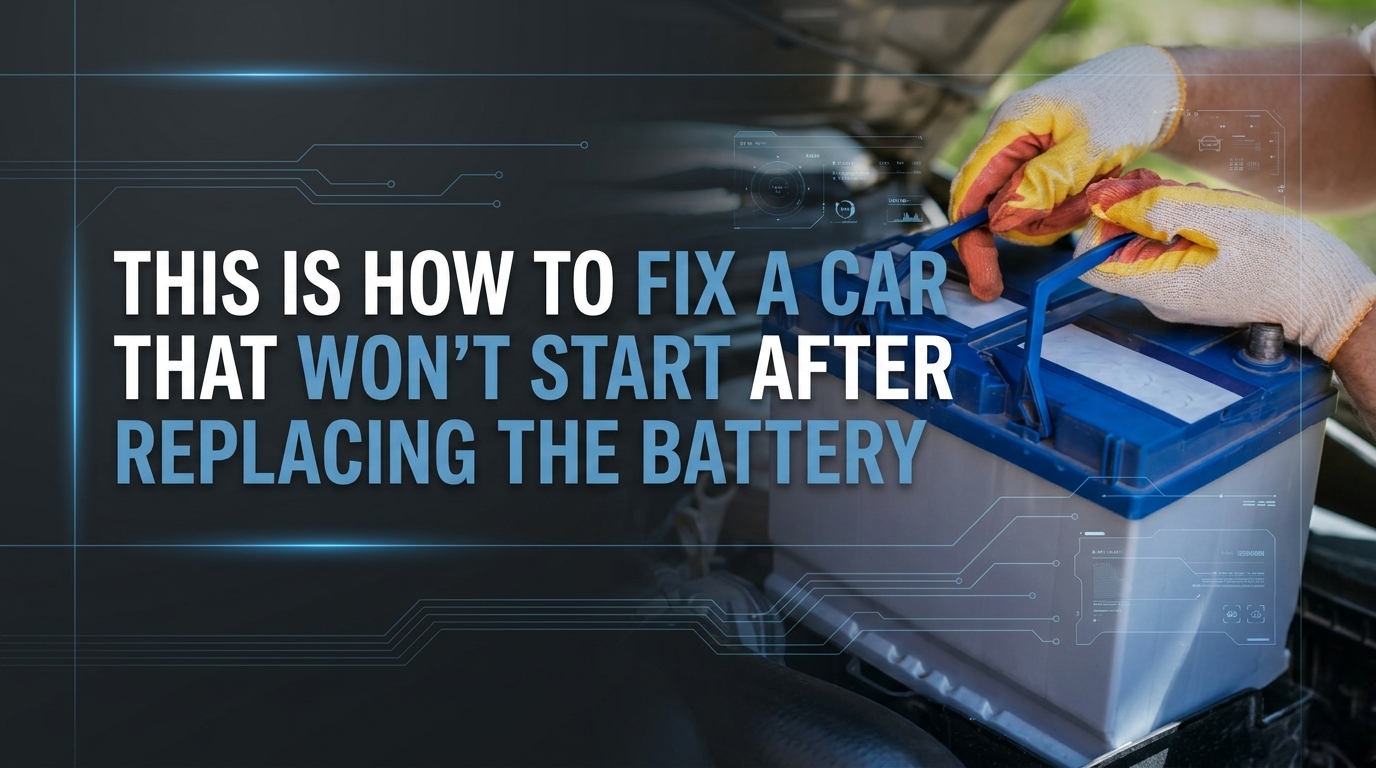
You've done the right thing. You replaced a dead battery, expecting a simple fix. You turn the key or press the button, and the result is the same silence or a weak click. The frustration is immediate. "It's a brand new battery, it has to start now," you think. I hear this exact scenario from customers more often than you'd believe. The truth is, a new battery is only one link in a chain. When the car still won't start, the problem is almost always in the connection, the protection circuits, or it reveals a deeper issue that was hiding behind the weak battery all along.
Don't start swapping expensive parts. Follow a logical path, starting with the work you just performed. This method saves time, money, and your sanity. Let's focus on the three most likely culprits you can check yourself.
Inspect Your Work First
This is the number one reason for a persistent no-start after a battery swap. A new battery is useless if the power can't flow from it. The connection must be physically tight and electrically clean.
Grab each battery terminal and try to twist it by hand. It should not move at all. A loose clamp is a very common oversight. Next, look for corrosion not just on the terminals, but inside the cable connectors themselves. That blue-green powder can creep up the wire, creating resistance you can't see. A poor ground connection, especially on the negative cable where it bolts to the chassis or engine block, is a frequent offender. People often say, "The terminals look clean to me," but looks can be deceiving. A voltage drop test across the connection tells the real story, but for a quick check, ensure everything is spotless and wrench-tight.
Read Also: This Is Why Your Car’s Battery Terminals Are Corroded
Check the Fuses and Relays You Might Have Blown
If you accidentally touched the positive cable to ground or reversed the polarity even for a second, you likely blew a fuse. This is a critical, fast check. Modern vehicles have multiple fuses protecting the starter circuit, engine control unit, and ignition system.
Locate your main fuse box under the hood. Consult your owner's manual to identify the starter fuse, ignition fuse, and the main battery fuse or fusible link. Visually inspect them. A blown fuse will have a broken metal strip inside the clear plastic top. Don't trust a glance; use a multimeter to check for continuity if you can. Also, find the starter relay. It's often possible to swap it with an identical relay from another slot, like the horn or A/C relay, to test it. I've solved many "no crank" situations with a simple relay swap. A customer will insist, "I'm sure I hooked it up right," but a five-minute fuse check is always worth it.
Essential Guide: No More Blown Fuses: A Guide to Finding and Replacing Car Fuses Like a Pro
The Battery Was a Symptom, Not the Cause
This is the hardest truth. The old battery may have failed because something else in the vehicle was killing it. Putting in a new one is like giving a patient a blood transfusion without stopping the bleeding. The two main suspects here are the charging system and a parasitic drain.
If the car starts with a jump but dies again after running, your alternator is the prime suspect. It's not replenishing the battery. A simple test with a multimeter can confirm this; with the engine running, you should see between 13.5 and 14.5 volts at the battery terminals. If it's lower, the alternator is failing. Resources like AutoZone offer free charging system tests that can pinpoint this.
If the new battery is dead again the next morning, you likely have a parasitic draw. Something is staying on and draining power. Common causes are a trunk light, glove box light, a faulty module, or an aftermarket accessory. Diagnosing this requires a multimeter and a systematic process to find the circuit that's pulling power with the car asleep. Thinking "It'll be fine overnight" is how you end up stranded again tomorrow.
Related Reading: Why Your Car Battery Dies Unexpectedly (And How to Stop It for Good)
Putting It All Together
Start with the simple, free checks. Verify your battery terminals are immaculate and tight. Inspect every relevant fuse and relay. If the engine still does nothing, listen carefully. A single, solid click points to a starter motor or solenoid problem. Silence often points to an ignition switch or a complete break in the starter control circuit. If it cranks but won't fire, you're dealing with a fuel or spark issue, which is a different diagnostic tree entirely. For a step-by-step approach to this broader problem, our guide on how to diagnose a car that won't start walks you through it.
A new battery should be a solution. When it's not, it's a clue. The problem is almost always in the connection you just made, the fuse you just blew, or the underlying fault you just uncovered. Follow the clues in that order, and you'll usually find the answer without the tow truck.

Comments (0)
Please login to join the discussion
Be the first to comment on this article!
Share your thoughts and start the discussion