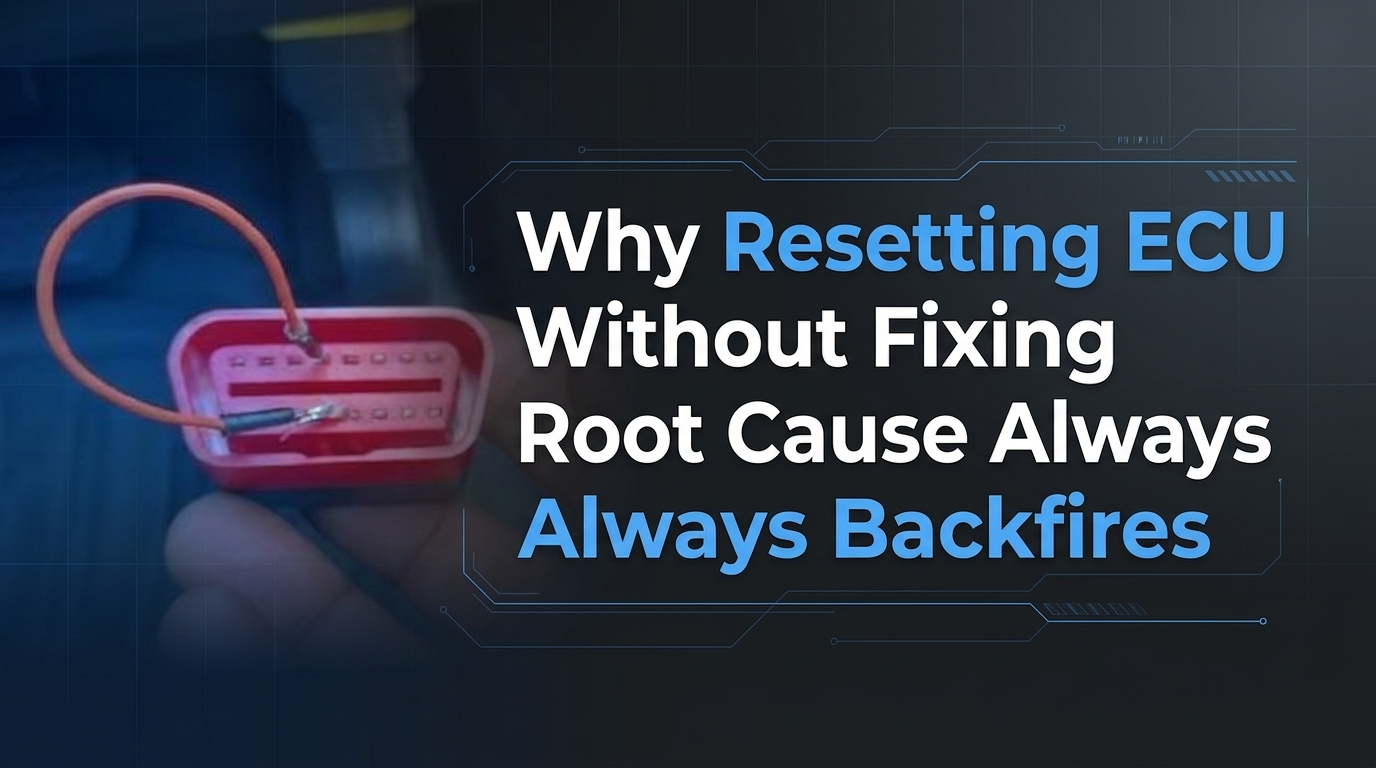
Your Engine Control Unit is the brain of your car. It monitors sensors, controls fuel delivery, manages ignition timing, and stores fault codes when something goes wrong. When you reset the ECU, you clear those stored codes. You also erase the adaptive learning data the computer has built up over hundreds of miles of driving.
A 2019 survey from the American Automobile Association (AAA) found that 34% of drivers believe their check engine light will come on whenever a problem exists. That is dangerously wrong. Your car's computer only flags about 60% of what is actually happening inside your engine. The rest is happening silently while you drive. I hear this line in the shop all the time: "I reset the ECU and the problem went away." No. It did not go away. You just turned the warning off. The fault is still there, waiting to return at the worst possible moment. Resetting the ECU without addressing the root cause is one of the most common and costly mistakes I see. It is like silencing a smoke alarm while a fire smolders behind the wall. The computer forgets the fault codes, but the mechanical problem remains. It will come back. It always does. And when it returns, it often brings a bigger repair bill with it.
What An ECU Reset Actually Does
That adaptive data is critical. The ECU learns how your engine behaves in different conditions. It adjusts idle speed, fuel trim, and shift points based on real world driving. When you reset it, the computer starts over. It returns to factory default settings and has to relearn everything from scratch. How to Read & Understand Live Data Streams from Your Car’s ECU explains why that learning process matters for proper diagnosis.
Here is the problem. If a sensor is sending inaccurate data, the ECU will relearn around that bad data. It will compensate. It will adjust fuel trims and timing to keep the engine running, but it will run inefficiently. You will get worse fuel economy. You will lose power. And eventually, the check engine light will come back on with the same code or a new one.
Why The Fault Always Returns
The Underlying Problem Does Not Change
Resetting the ECU clears the symptom. It does not fix the cause. If your oxygen sensor is failing, resetting the computer will not make that sensor work correctly. If your mass airflow sensor is dirty, clearing codes will not clean it. If your spark plugs are worn, the misfire will return after the ECU relearns the bad pattern.
I see this pattern constantly. A driver comes in saying "I cleared the codes and it was fine for a week." That week was the ECU relearning around the fault. Once it adapted, the problem reappeared. Some faults take longer to come back than others, but they always come back. The Reason Fault Codes Change After Driving For A While explains exactly why this happens in technical detail.
The Adaptive Learning Trap
Modern ECUs are designed to adapt. That is a feature for normal driving conditions. It becomes a liability when a component is failing. The ECU will adjust fuel trim to compensate for a vacuum leak. It will change timing to hide a weak ignition coil. It will modify idle speed to mask a dirty throttle body. You will not see a warning light until the compensation reaches its limit. Then the light comes on, you reset it, and the cycle repeats.
This is why I tell people "I know my car" is not a diagnosis. Your car is adapting around its own failure. You are not feeling the true problem. You are feeling the computer's best attempt to hide it.
The Real Cost Of Resetting Instead Of Repairing
Every time you reset the ECU without fixing the issue, you allow the underlying problem to worsen. A small vacuum leak that could have been repaired with a $5 hose becomes a lean condition that damages your catalytic converter. A weak ignition coil that causes a minor misfire today will eventually fail completely, leaving you stranded. What Happens If You Ignore A Check Engine Light For Too Long breaks down the financial consequences of delayed repairs.
The cost difference is dramatic. Replacing a $100 oxygen sensor now avoids a $2,000 catalytic converter replacement later. Cleaning a throttle body for $150 prevents the carbon buildup from causing idle control valve failure. Fixing a minor coolant leak today stops the overheating that warps your cylinder head tomorrow.
"I thought resetting it would save me money." That is the sentence I hear most often before a major repair. It saves nothing. It costs more in the long run.
When A Reset Is Actually Appropriate
There are legitimate reasons to reset your ECU. After completing a proper repair, a reset clears the old adaptive data and allows the computer to learn the new, correct operating parameters. After replacing an oxygen sensor, resetting the ECU helps the system recognize the new component faster. After fixing a vacuum leak, a reset lets the fuel trims return to normal range quickly.
The key difference is that the repair happens first. The reset is the final step, not the only step. The Little-Known Reason Mechanics Don’t Always Reset Your ECU After Repairs explains why some professionals choose not to reset even after a proper fix.
How To Diagnose Instead Of Reset
Stop reaching for the reset button. Start reaching for a diagnostic tool. Read the fault code. Look up what it means. Research common causes for that specific code on your vehicle make and model. Check live data streams from your oxygen sensors, fuel trim values, and mass airflow readings. Understanding DTC "Trouble Codes" in ECU: A Complete Guide gives you the framework to interpret what the computer is actually telling you.
If you do not have access to a proper scan tool, take the car to a shop that does. A diagnostic scan costs far less than replacing parts by guessing. And never, ever reset the ECU and assume the problem is solved. That is not a repair. It is a delay.
Your car's computer is trying to help you. It stores fault codes for a reason. It is not your enemy. It is telling you exactly what is wrong if you know how to listen. Resetting it without listening is the automotive equivalent of hanging up on the person trying to warn you. The problem does not disappear. It just stops calling for a while.
Read Also: Do Cars Actually “Remember” Previous Faults Even After Fixes?
Final Word
Resetting your ECU is a tool, not a cure. Use it after a repair, not instead of one. The next time your check engine light comes on, do not reach for the battery terminal or the code reader with your finger on the erase button. Read the code. Understand the problem. Fix the cause. Then reset with confidence.
Because "I reset it and it was fine" is not a success story. It is a countdown to a bigger failure. And I have seen too many engines pay the price for that mistake.

Comments (0)
Please login to join the discussion
Be the first to comment on this article!
Share your thoughts and start the discussion