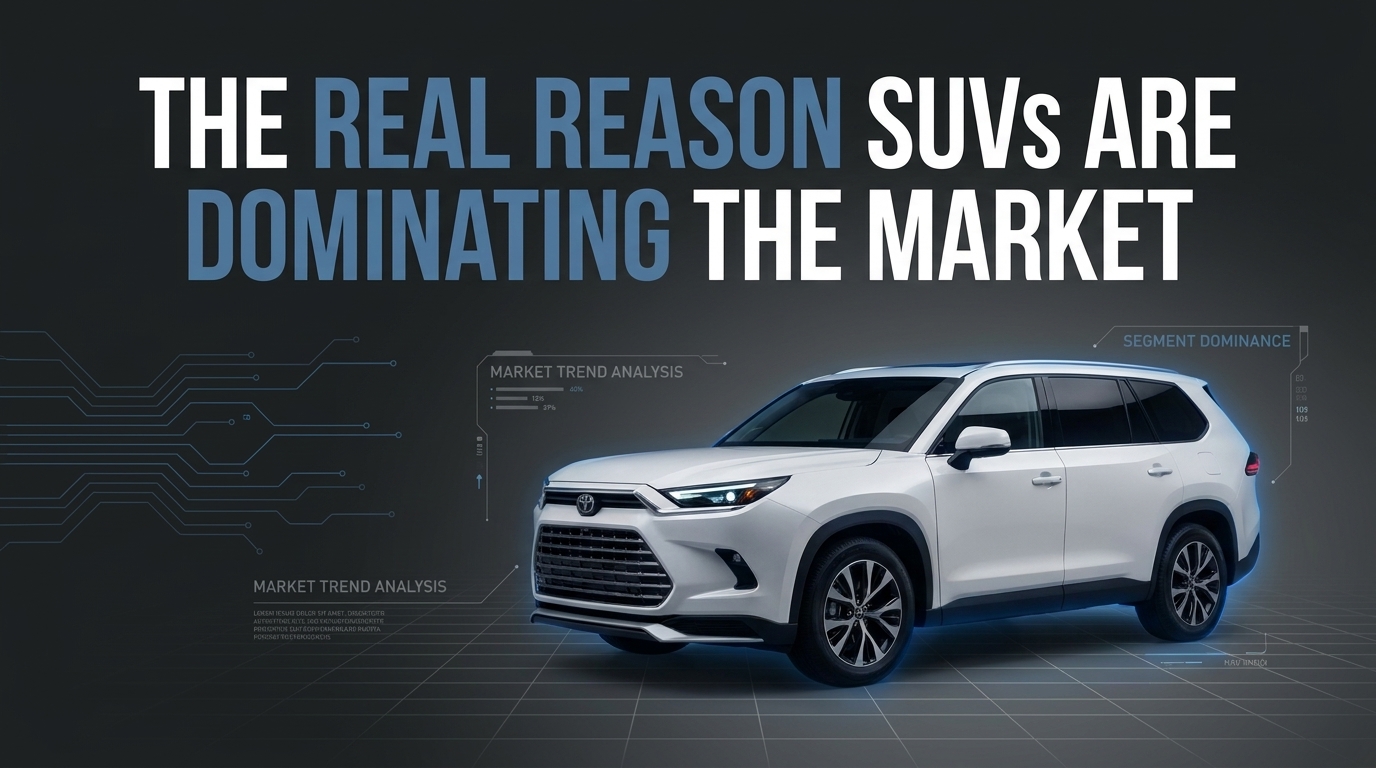
This is the part most people miss. Government fuel economy standards in the United States and Europe effectively penalize large sedans while leaving room for trucks and SUVs to thrive. The rules are structured around a vehicle's "footprint" the area between its tires. A bigger footprint gives a manufacturer a lower fuel economy target to meet. Automakers responded by making vehicles bigger. That is how a crossover became easier to build profitably than a midsize sedan. Why Car Prices Keep Increasing Every Year is a related topic that shows how these regulations interact with manufacturing costs. The result is a marketplace where the sedan is slowly disappearing from dealer lots, not because nobody wants one, but because the rules made it harder to sell.
In 2023, SUVs and crossovers accounted for nearly 48% of all new car sales in the United States, according to data from the U.S. Bureau of Transportation Statistics. That number has been climbing for more than a decade. Sedans? They are down to just over 20%. The shift is not a trend anymore. It is a fundamental change in what people drive. I hear the same line from buyers all the time. "I need something versatile." Versatile, in this context, has come to mean a vehicle that does everything reasonably well and nothing perfectly. That is the SUV bargain. And it is a deal most drivers are happy to make. The numbers do not lie. Global SUV sales have more than doubled in the last ten years. But the real question is not what people are buying. The question is why. I have spent years working on these vehicles, and I can tell you the reasons go far beyond marketing or style. They are practical, financial, and even regulatory. Let me walk you through the real forces driving this dominance.
Regulations Reshaped the Automobile
NHTSA Corporate Average Fuel Economy Standards directly influenced this shift. When a manufacturer can meet its CAFE targets more easily by building a larger SUV, that is what gets built. Sedans become an expensive compliance problem. I have heard engineers say it bluntly. "We can sell an SUV with a bigger margin and a smaller regulatory headache." That single sentence explains more about the market than any ad campaign ever could.
Perception of Safety Drives the Decision
There is a powerful psychological factor at work here. Drivers feel safer in a larger vehicle. That feeling is not entirely wrong. Data from the Insurance Institute for Highway Safety shows that occupants of larger vehicles generally have lower fatality rates in multi vehicle crashes. But there is a catch. The extra height and weight of an SUV also change handling characteristics. Rollover risk is higher than in a sedan. What Happens When Car Safety Systems Fail explains how modern safety tech attempts to mitigate these inherent risks. I see this trade off in the shop all the time. People trade nimble handling for perceived security. They say, "I feel safer up high, I can see the road better." That elevated seating position gives a sense of control. Whether it actually makes you safer depends on the specific vehicle and how you drive it.
I will add this. The safety argument also extends to families. Parents buying a vehicle for their children often default to an SUV because it looks like a fortress. This Is Why Your Car's Rear Passengers Are Protected covers the specific engineering that goes into protecting those in the back seats. The reality is that modern sedans are also extremely safe. But perception is a powerful force in a purchasing decision. And the perception is clear. Bigger equals safer in most buyers' minds.
Practicality That Fits Modern Life
The hatchback layout of an SUV is genuinely more useful than a traditional sedan trunk for most people. A dog fits in the back. A flat folded seat lets you carry a piece of furniture from the store. The roof rails can hold a cargo box for a road trip. These are not marketing gimmicks. They are real advantages that people discover after owning a sedan and feeling limited by it. How to Choose the Right SUV covers how to match these practical features to your actual needs. I have had customers tell me, "I never thought I would need the space, but now I use it every weekend." That is the SUV effect. It adapts to your life instead of forcing you to adapt to it.
There is also the all weather capability factor. Many SUVs come standard with all wheel drive or offer it as an affordable option. That gives drivers confidence in rain, snow, or loose gravel. Do most people need all wheel drive every day? No. But when winter hits, they are glad they have it. I live in an area that gets snow. I cannot count how many times I have pulled a sedan out of a ditch while an SUV drives past without issue. Drivers Urged To Check Their Tires Immediately After Experts Reveal A Silent Killer is a reminder that even an SUV is only as capable as its tires. But the ground clearance and drivetrain options give a real, not just perceived, advantage in poor conditions.
The Used Market Accelerates the Shift
Once the new car market tilts toward SUVs, the used market follows. This creates a feedback loop. More SUVs in the used pool mean more buyers get exposure to them. They drive one for a few years and realize it suits them. When it is time to buy again, they buy another SUV. Why Buying A New Model Car In Its First Year Could Be Your Expensive Mistake is relevant here because the SUV market is so saturated that first year depreciation can be steep. But that also makes used SUVs more accessible. The cycle continues. Sedans become less common on used lots. Buyers who might have considered a sedan cannot find one in good condition at a reasonable price. So they buy an SUV. The market feeds itself.
I see this in my own shop. Ten years ago, I worked on equal numbers of sedans and SUVs. Now, SUVs are easily 70% of what comes through the door. The parts supply reflects this. These Simple Car Maintenance Hacks Have Never Been This Easy applies to SUVs just as well as cars. But the volume of SUV specific components on the shelf is much higher. That makes repairs faster and sometimes cheaper. It also means manufacturers are investing their engineering dollars into SUV platforms. Sedans are getting less attention, less development, and fewer new models each year.
The Final Reality
SUVs dominate the market because of a convergence of factors. Regulations incentivized their production. Perception of safety drove consumer preference. Practical utility proved itself in daily use. And the used market locked the cycle into place. The sedan is not dead, but it is no longer the default choice for American drivers. That is unlikely to change anytime soon.
I tell people this when they ask what to buy. Think about how you actually use your vehicle. If you need versatility, ground clearance, and cargo space, an SUV is a logical choice. If you prioritize fuel economy, handling, and lower purchase price, a sedan still makes sense. Just know that the market is working against you finding that sedan. You have to look harder. And when you find one, hold onto it. They are becoming rare.
Because the line "I just need something practical" sounds simple. In the real world, practical has come to mean one thing. An SUV. And that is the real reason they are dominating the market.

Comments (0)
Please login to join the discussion
Be the first to comment on this article!
Share your thoughts and start the discussion