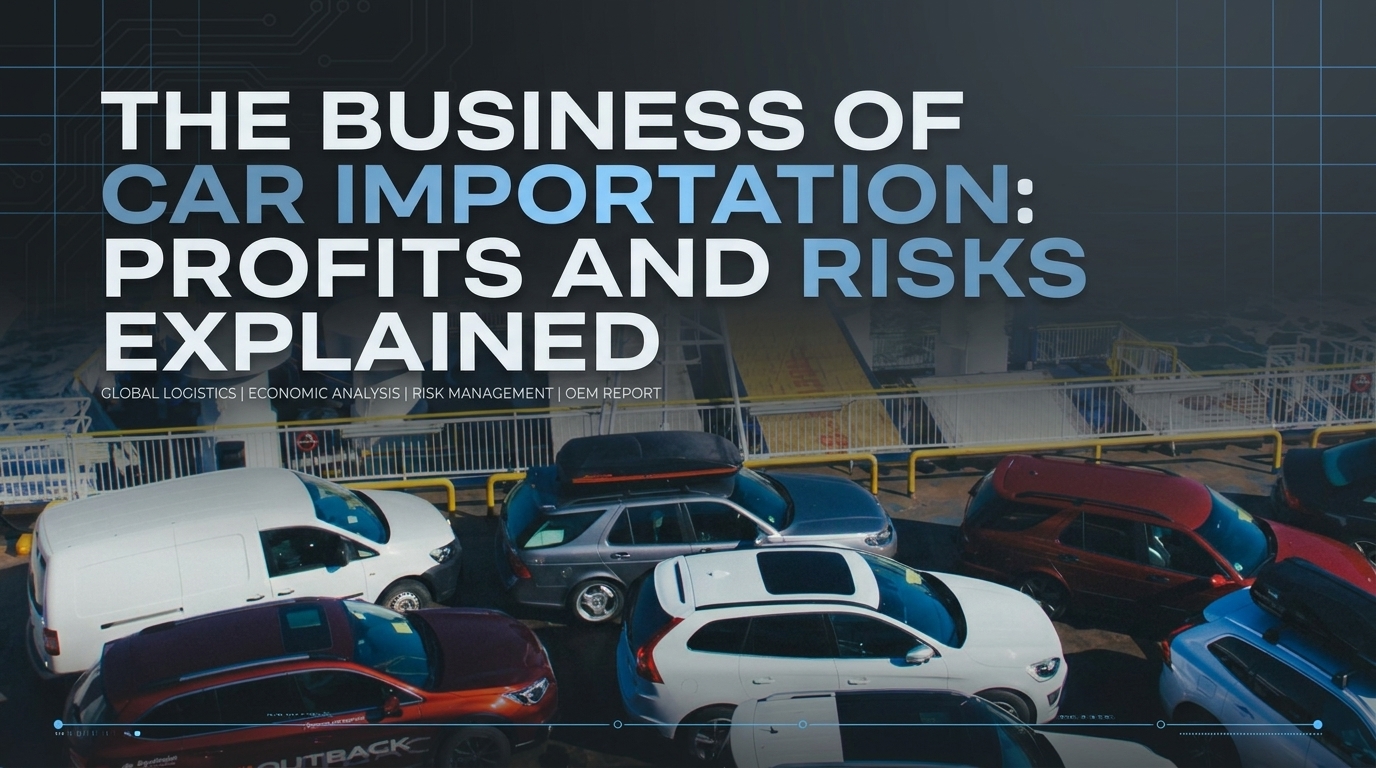
The price you see on an auction listing is only the beginning. Many new importers focus entirely on the purchase price and forget the layers of cost that stack up after the hammer falls. Your actual cost includes the auction fee, the domestic transport to the port, the export documentation, the ocean freight, the marine insurance, the import duties and taxes in your country, the customs clearance, the port handling fees, the inland transport from the port to your location, and the cost of any necessary reconditioning or compliance modifications.
The global used car market is valued at over 1.5 trillion dollars, and a massive portion of that value moves across borders every single day. That is a staggering amount of money flowing through ports, auctions, and shipping containers. I have seen people turn a single container of well chosen vehicles into a profit that covers their entire annual overhead. I have also seen people lose their entire investment on one bad shipment. The difference between those two outcomes is not luck. It is knowledge of the specific risks and the discipline to manage them. People often say, "I know a good deal when I see one." That confidence can be expensive in this business. A car that looks like a steal in photos can become a financial anchor once it lands. The import game is not about finding cheap cars. It is about understanding the total cost equation before you commit a single dollar. Let me walk you through the real profit structure and the hidden risks that separate successful importers from the ones who learn the hard way.
The Real Profit Equation Most Beginners Miss
I have watched people calculate a 30 percent margin on the purchase price alone, only to discover that the total landed cost wiped out their profit entirely. The rule I follow is simple. Estimate your total landed cost first. Then subtract that from your realistic local selling price. If the margin is not at least 25 percent after that calculation, I walk away. There is no room for error in thinner margins because one unexpected repair or a delay in customs can erase it completely.
Compliance and Documentation: Where Deals Fall Apart
Every country has its own rules for vehicle importation. Some require the vehicle to be a certain age. Others demand specific emissions or safety modifications. A few require a certificate of conformity from the manufacturer, which can be impossible to get for certain models. I have seen a container full of perfectly good cars sit at the port for three months because the importer did not check the local compliance requirements for headlight alignment and side marker lights.
This is where having a reliable customs broker or a clearing agent is not optional. It is essential. Do not trust online forums for compliance advice. Go directly to your local vehicle registration authority or a licensed clearing agent and get the requirements in writing. A car dealership business depends on inventory that can be legally registered and sold. If the car cannot be registered, it is not inventory. It is scrap metal on wheels.
Vehicle Condition: The Gap Between Photos and Reality
This is the risk that catches the most people. Auction photos are taken with care. They avoid showing the rust hiding under the carpet, the accident damage that was poorly repaired, or the engine that has a terminal knock. I once had a client who bought a popular SUV from a Japanese auction based on a grade 4 inspection report. When it arrived, the frame was bent from an unreported rear collision. The repair cost exceeded the vehicle's value.
The solution is to use a pre purchase inspection service in the source country. These are independent inspectors who go to the auction yard or the seller's location and physically check the vehicle. They check for structural damage, engine compression, transmission behavior, and signs of odometer tampering. The fee for this service is usually between 100 and 300 dollars. That is a small price to avoid a 10,000 dollar mistake. If a seller refuses to allow an independent inspection, that refusal is your answer.
Market Timing and Model Selection
Not every popular car in one market is popular in another. A sedan that sells quickly in Singapore might sit for six months in a Nigerian market. The key is to import vehicles that have proven demand and parts availability in your local market. Importing a rare or obscure model might seem like a good way to avoid competition, but it often leads to slow sales and expensive parts sourcing for the buyer.
Look at what is selling consistently in your local classifieds and dealer lots. Focus on models from major manufacturers like Toyota, Honda, and Nissan. These brands have widespread parts support and strong resale value. If you are considering a newer model, check for common issues with first year models that could affect reliability and your reputation. A car that has known problems will be harder to sell and more likely to come back with warranty complaints.
Also pay attention to the currency exchange rate between your local currency and the source country's currency. A sudden shift can add thousands to your cost overnight. I recommend locking in your exchange rate with your bank or using a forward contract if you are dealing with large sums. Do not leave that variable unmanaged.
Hidden Costs After Landing: Reconditioning and Warranty
Even a well inspected vehicle will need some work after a long ocean voyage. Batteries die. Tires lose pressure. Fluids leak. And many vehicles arrive with minor cosmetic damage from the shipping process. Budget at least 5 to 10 percent of the vehicle's value for reconditioning. That covers a basic service, new tires if needed, a thorough cleaning, and any minor paint touch ups.
More importantly, consider the warranty you will offer. In many markets, selling a used car without some form of warranty is a fast way to build a bad reputation. Even a 30 day powertrain warranty shows buyers that you stand behind your product. Factor the cost of potential claims into your pricing. If you sell ten cars and one comes back with a transmission issue, that one repair can erase the profit from the other nine. Build a warranty reserve into your business model.
Shipping and Logistics: Timing Is Everything
Ocean freight rates fluctuate wildly. I have seen the cost to ship a container from Japan to West Africa double in a single quarter. Book your freight as close to your purchase date as possible, and always include a buffer for delays. A two week delay in departure can turn into a three week delay in arrival if the vessel misses its berth slot. That delay costs you storage fees at the port and ties up your capital.
I also recommend using roll on roll off (RoRo) shipping for standard vehicles rather than container shipping. RoRo is generally cheaper and faster. Use containers only for luxury or high value vehicles where you want the extra protection from damage and theft. Always insure the cargo for its full market value, not just the purchase price. Marine insurance is cheap compared to the loss of a full container.
The Final Word
The business of car importation rewards discipline and punishes shortcuts. It is not a get rich quick scheme. It is a logistical and financial puzzle that requires careful planning at every step. Check the compliance rules. Inspect the vehicle before you buy. Calculate the total landed cost. Choose models with proven demand. Budget for reconditioning and warranty. Lock in your exchange rate. Insure your cargo.
I hear people say, "I got a great price on that car." That is not the same as making a great profit. The difference is in the details you manage before the container ever leaves the dock. Manage those details, and this business can be consistently profitable. Ignore them, and the market will teach you a lesson you will not forget.
Essential Guide: Why Spare Parts Shops Are One of the Most Profitable Businesses

Comments (0)
Please login to join the discussion
Be the first to comment on this article!
Share your thoughts and start the discussion