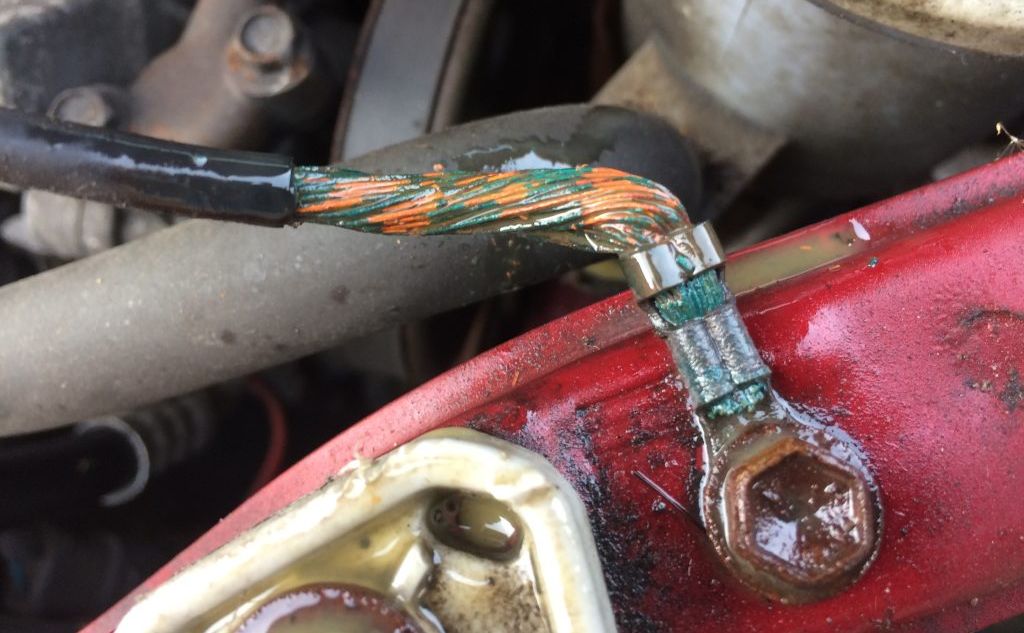
A modern car has thousands of electrical connections, but only a handful are truly critical. One of the most important is also one of the most neglected: the ground connection. It's the silent partner in your car's electrical system, the return path for every electron. When it's dirty or loose, nothing works right, but the symptoms are often blamed on something else entirely.
I see this confusion weekly. A customer comes in with a complaint about flickering lights, a slow crank, or a weird sensor reading. They've already tried a new battery or are convinced a specific module is failing. The real culprit, more often than you'd think, is a simple ground strap caked in road grime or a connection point hidden under a layer of corrosion. People assume, "The ground is just a wire bolted to the frame, how complicated can it be?" That assumption is where the trouble starts.
A bad ground doesn't announce itself with a single, clear fault. Instead, it creates a cascade of seemingly unrelated electrical gremlins that drain your wallet and your patience. Understanding how to spot and fix these issues is some of the most valuable diagnostic knowledge you can have.
The Ground is Your Electrical Foundation
Think of your car's electrical system like a water circuit. The battery positive terminal is the pump, sending current out to components. The ground is the drainpipe, the path back to complete the loop. If that drainpipe is clogged or pinched, water backs up everywhere. In electrical terms, when the ground path has high resistance, current seeks any other path back to the battery. This can cause voltage to appear where it shouldn't, sensors to send false readings, and modules to behave erratically.
Manufacturers design specific ground points on the chassis and engine block for a reason. These are not random bolt holes. A study by the Society of Automotive Engineers (SAE) details the critical importance of maintaining low-resistance ground paths for vehicle network communication and sensor accuracy. When you add resistance through corrosion or a loose bolt, the entire network suffers.
I hear it all the time: "My radio cuts out when I hit the brakes," or "The engine runs rough when the headlights are on." To a driver, these seem like separate issues. To a technician, they scream "bad ground." The extra current from the brake lights or headlights is disrupting the shared ground path, affecting other sensitive electronics.
Spotting the Symptoms of a Dirty Ground
Bad grounds rarely cause a total failure. They cause intermittent, confusing problems. Learning to recognize the pattern is half the battle.
Unexplained Electrical Glitches
This is the most common category. Your dashboard lights flicker or dim when you activate another circuit, like the power windows or the A/C compressor. Your stereo resets itself. Your power locks act up. You might see warning lights for the ABS or airbag system come on randomly, then disappear after restarting the car. The driver's thought is usually, "This computer stuff is so flaky." Often, it's not the computer; it's the dirty foundation the computer is built on.
Poor Engine Performance and Sensor Issues
Your engine control module (ECM) relies on clean sensor signals to manage fuel, ignition, and emissions. Sensors like the oxygen sensor, crankshaft position sensor, and throttle position sensor all need a perfect ground reference. A corroded engine-to-chassis ground strap can corrupt these signals.
The result? You might experience rough idle, hesitation on acceleration, or even a no-start condition. The kicker is that the ECM might not set a clear diagnostic trouble code because the sensor is still working; it's just sending bad data due to the faulty ground. A technician might chase a "bad sensor" for days when a five-minute ground cleaning fixes it. I've had customers say, "I replaced that sensor twice already." That's when I go straight to the grounds.
Slow Cranking and Charging System Headaches
The starter motor requires a tremendous amount of current. It has its own heavy-duty ground path, usually directly from the engine block to the chassis or battery negative. If this connection is corroded where it bolts to the block or frame, resistance skyrockets. The starter tries to pull current but can't get enough, resulting in a slow, labored crank that sounds exactly like a weak battery.
Similarly, the alternator needs a solid ground to properly regulate its output. A faulty ground can lead to overcharging or undercharging, confusing both you and your battery. AutoZone lists poor grounding as a primary cause of alternator testing failures and erratic charging system behavior. You could replace the alternator and battery repeatedly and never solve the root cause.
Finding and Fixing Common Ground Points
The good news is that checking and cleaning major grounds is a straightforward task you can often do yourself. You don't need to find them all; focus on the critical ones.
Start with the battery negative cable. Follow it from the terminal to where it bolts to the chassis or engine block. This is ground zero. Next, look for the engine ground strap, a thick braided wire or flat strap connecting the engine to the firewall or frame. Finally, many vehicles have a dedicated ground point for the ECM, often on the firewall or inner fender, where several smaller wires converge.
To fix them, disconnect the battery negative terminal first. Then, unbolt the ground connection. Scrape away any paint, rust, or corrosion from both the cable terminal and the metal surface it contacts on the car. A wire brush, sandpaper, or a dedicated terminal cleaning tool works perfectly. Make the metal shine. Rebolt the connection tightly. Applying a thin coat of dielectric grease after reassembly will prevent future corrosion. This isn't a "maybe" step. A clean, tight, metal-to-metal contact is non-negotiable.
I can't count how many times this simple process has resolved issues that had owners ready to sell their car. The next time your vehicle starts acting possessed with electrical issues, before you buy a single new part, ask yourself one question: when was the last time anyone looked at the grounds? The answer is probably never. And that's likely your problem.
Comments (0)
Please login to join the discussion
Be the first to comment on this article!
Share your thoughts and start the discussion