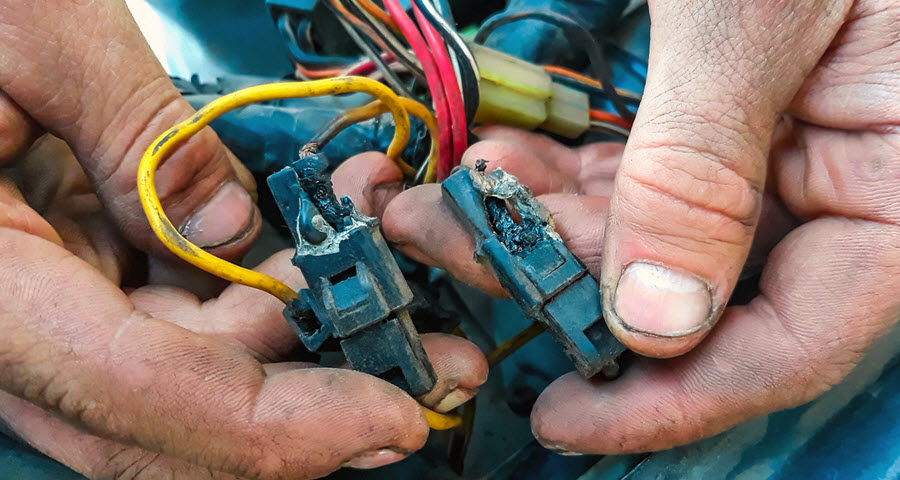
That acrid, sharp smell of burning plastic inside your car is not something you can ignore. It's a direct signal, a physical alarm your vehicle cannot sound any other way. According to data from the National Fire Protection Association, vehicle fires account for roughly 17% of all reported fires in the United States, and electrical failures or malfunctions are a leading factor. That smell under your dash is your first and best warning that you're moving toward that statistic. I've seen the aftermath of ignored electrical shorts, and it never starts with flames. It starts with that exact smell,
Essential Guide: Common Car Electrical Problems and How to Troubleshoot Them
What That Burning Smell Actually Is
You are smelling insulation cooking off a wire. Modern automotive wiring is coated in a thin layer of plastic or vinyl insulation. When a wire shorts to ground or another power source, it creates an unintended path for electricity. This causes a massive, instantaneous surge of current. The wire heats up violently, far beyond its design capacity. The insulation melts, smokes, and burns. This process releases that distinct, toxic odor. The heat can also damage adjacent wires, connectors, and plastic trim, compounding the problem. This is not a slow burn. It is an electrical event.
Pinpointing the Source Under the Dash
Your dashboard is a dense network of wires, connectors, modules, and switches. The key is to act methodically and safely. First, do not continue driving. Pull over, turn the car off, and let it cool. Open the doors to ventilate. The source is often near a high-current accessory or a point of physical wear.
Start by checking the fuse box. It is usually located on the driver's side kick panel or under the dash. A blown fuse is a symptom, not the cause, but it can point you to the circuit at fault. The label on the fuse box cover will tell you which circuit corresponds to the blown fuse. Was it the radio, the power windows, or the cigarette lighter? This is your first major clue. Our guide on understanding car fuse colors and amperage can help you decode what you find.
Next, visually trace that circuit. Look for aftermarket installations. I cannot stress this enough. A poorly spliced wire for a new stereo, a dash cam, or a phone charger plugged into the accessory port is the most common culprit I find. People say, "The installation was clean." Often, it is not. The wire taps can loosen, insulation can be nicked, and grounds can be poorly chosen. This creates resistance, and resistance creates heat.
The Critical Role of Ground Connections
Many electrical faults are not about the power wire, but the ground path. Every electrical component needs a complete circuit back to the battery. A bad ground forces current to find another path, often through smaller wires or even metal brackets. This causes overheating where it should not. Check where the main dashboard harness grounds to the vehicle's chassis. It is often a bolt behind the dash or on the firewall. A loose or corroded ground point here can cause system-wide issues and localized heating. For a deeper understanding of this critical failure point, read about how a bad ground wire can ruin your car.
Immediate Actions and Professional Diagnosis
If you find the source, do not simply wrap it in electrical tape. Tape does not fix the underlying short. It only hides it, and the heat will eventually burn through. The damaged section of wire must be cut out and properly spliced with a solder-sealed connection or a quality crimp connector, then protected with heat-shrink tubing.
If you cannot find the source, your next step is not guesswork. It is diagnosis. This is where a professional technician with a wiring diagram and the right tools becomes invaluable. They will perform a voltage drop test on suspect circuits and use a thermal imaging camera to pinpoint hot spots behind the dashboard that are invisible to the eye. Trying to trace this without a method is like looking for a needle in a haystack while blindfolded.
Read Also: How to Track Electrical Problems in Your Car with Clear Beginner-Friendly Steps
Why Ignoring It is Not an Option
The risk escalates quickly. That smoldering wire can ignite flammable sound deadening or insulation material behind the dash. The fire can then spread to the ventilation system, circulating smoke throughout the cabin before you even see flames. Furthermore, a short circuit can damage expensive control modules, like the body control module or the engine computer, leading to hundreds or thousands of dollars in repairs beyond the wiring itself. A simple smell can become a catastrophic failure.
Your car's electrical system is a network of precise pathways. A burning odor is a breach in that network. Treat it with the seriousness it demands. Investigate. Isolate. Repair correctly. Your safety, and your vehicle's integrity, depend on it.
Deep Dive: Automotive Electrical Components: Functions, Troubleshooting, and Repairs
Comments (0)
Please login to join the discussion
Be the first to comment on this article!
Share your thoughts and start the discussion