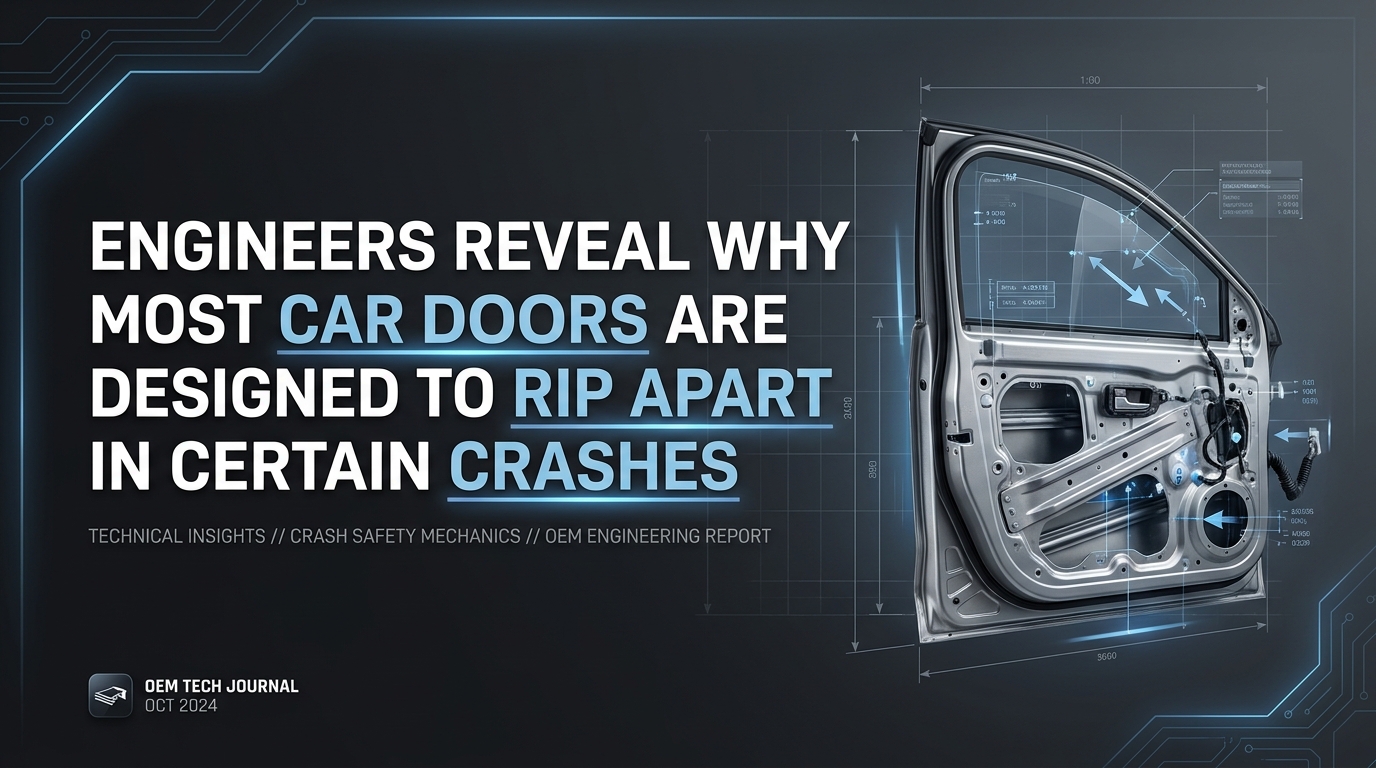
I hear the same thing every time I explain this: "I've been in accidents before. The door held fine." That confidence is exactly what engineers count on when they design a car door to detach from the vehicle in a specific collision. In 2023, the National Highway Traffic Safety Administration reported that side impact crashes accounted for roughly 25% of all passenger vehicle occupant fatalities in the United States. That number stays stubbornly high because the forces involved in a side collision are brutal. Your door is the only thing between your body and whatever is coming at you. Yet in certain crashes, that same door is designed to tear away from the hinges. It sounds wrong. It is not.
Let me be direct about this. The door that rips apart in a crash is not a failure of engineering. It is an intentional safety feature. The engineers who design modern vehicles build them with something called a side impact crash structure. That structure includes the door, the B-pillar, the rocker panels, and the roof rails. All of these parts work together to absorb and redirect crash energy. When the energy exceeds what the door can handle, the door is designed to separate. This prevents the entire side structure from collapsing inward and crushing the occupant. I have pulled doors off wrecked cars in my shop and seen the exact moment where that separation saved the passenger compartment. It is not guesswork. It is physics.
The Load Path Strategy That Changes Everything
Vehicle structures manage crash energy through load paths. Think of them as predetermined routes that force travels through the car. In a side impact, the load path starts at the point of impact and moves through the door into the B-pillar, the floor structure, and the roof. If the door stays rigid and transfers all that energy directly into the cabin, the occupant gets crushed. That is the outcome engineers are trying to avoid.
So the door is designed to be the weak link in that chain. It breaks away at the hinges and latches when the force becomes too high. This is not a guess. It is a documented engineering principle used by manufacturers like Ford, Toyota, and BMW. The door becomes a sacrificial component. It absorbs some energy as it deforms, then releases the rest by separating from the body. The cabin stays intact. The occupant has a better chance of survival.
The Hinge Design That Makes It Possible
Look at the hinges on a modern car door. They are not the massive welded blocks you might expect. They are stamped steel brackets with precisely engineered breakaway points. Some manufacturers use a shear bolt design. Others use a hinge that is intentionally thinner at a specific location. When the crash force reaches a certain threshold, that hinge snaps. The door releases.
I have seen drivers argue with me about this. "That hinge looks weak." Yes. That is the point. If the hinge were stronger, the force would transfer to the B-pillar or the latch mechanism. The latch might hold, but the B-pillar might bend into the seat. That is far worse than a door that flies off. The hinge is designed to fail first. It is the same philosophy that makes crumple zones work. You want the structure to collapse in a controlled way, not stay rigid and kill the people inside.
The Latch Release Timing
There is another piece of this puzzle that most people never see. The door latch also plays a role. In a severe side impact, the latch mechanism can be designed to release the door from the striker. This is not a random failure. It is a planned event. The latch releases the door so it can swing away from the body or separate entirely. This prevents the door from being forced inward against the occupant.
Some modern vehicles use pyrotechnic devices in the door latch. These small explosive charges are triggered by the same crash sensors that deploy the airbags. When the sensors detect a side impact above a certain severity, the charge fires and the latch releases. The door pops open or separates. This sounds alarming. It is actually a sophisticated safety measure. The door is no longer a battering ram aimed at the occupant. It becomes a piece of debris that flies away from the vehicle.
What the Occupant Experiences
If you are sitting in the passenger seat and the door rips off in a crash, you will feel the air pressure change. You might see the road rushing past where the door used to be. It is terrifying. But the alternative is worse. If the door stayed attached and pushed inward, it would compress your rib cage, your pelvis, or your head. That is how side impact fatalities happen. The door is not there to keep you comfortable during the crash. It is there to redirect energy away from you.
I have had customers say, "I know my vehicle. It saved my life." That is true in many cases. But the door that saved their life did so by failing. The separation was the success. The door did its job by breaking. That is hard to accept when you are looking at a car with a missing door and a passenger who walked away with bruises instead of broken bones.
The Data That Supports This Design
The Insurance Institute for Highway Safety (IIHS) tests side impact crashworthiness with a specific barrier that strikes the vehicle at 50 km/h (31 mph). The test measures intrusion into the occupant space. Vehicles that perform well in this test often have doors that exhibit significant deformation or separation. The IIHS data consistently shows that lower intrusion into the cabin correlates with better occupant survival. The door that separates is often the door that prevents that intrusion. It is a direct trade off. The door takes the hit and leaves the cabin intact.
You can see this in real world crash photos. The vehicle with the door still attached might look better at a glance. But measure the cabin intrusion. That door is likely pushed deep into the seat. The vehicle with the door missing might look destroyed. But the passenger space is preserved. Which one would you rather be inside?
Why This Matters for Your Safety
Understanding this design principle changes how you should think about your vehicle. When you get into a car, you are trusting a system of engineered failures. The crumple zones collapse. The airbags explode. The seatbelts lock. The doors detach. Every one of these is a controlled failure designed to preserve your life.
Do not assume that a door that stays attached in a crash is a good door. It might be a door that transferred too much force into the cabin. And do not panic if you see a door that came off in a collision. That might be the exact outcome the engineers worked years to achieve. The car did its job. The occupant survived because the door did exactly what it was supposed to do. It failed on purpose.
If you want to understand more about how modern vehicles protect you in ways you do not expect, read about what happens when car safety systems fail and how those failures are often the safety feature working as intended. You might also find value in learning how rear passengers are protected by similar engineering principles. The same thinking that removes a door in a crash also protects everyone inside the cabin.
Deep Dive: Drivers Urged To Check Their Tires Immediately After Experts Reveal A Silent Killer
Next time you close your car door and hear that solid thunk, remember what it really does. It keeps you comfortable on the highway. And in a crash, it is designed to leave you behind. That is not a flaw. That is the whole point.

Comments (0)
Please login to join the discussion
Be the first to comment on this article!
Share your thoughts and start the discussion