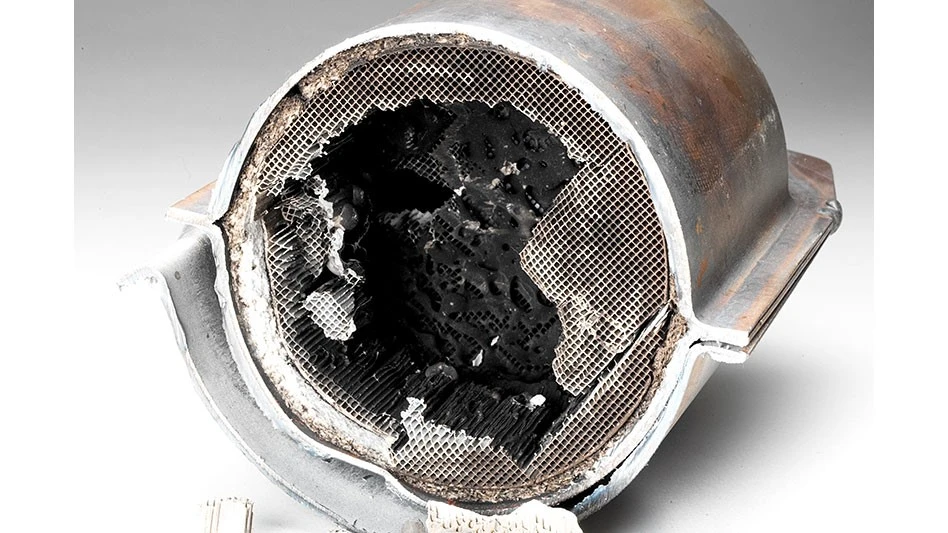
Your catalytic converter is designed to handle normal combustion byproducts. That is it. It is not built to process the contamination that comes from bad fuel. When you pump fuel that contains high levels of sulfur, sediment, water, or incorrect octane, the combustion process changes drastically. The engine cannot burn that mixture cleanly.
In 2025, the U.S. Environmental Protection Agency estimated that a single misfueling event or a tank of contaminated gasoline can slash a catalytic converter's lifespan by up to 40%. That is not a slow decline. That is a fast, expensive clock that starts ticking the moment you leave the station. You cannot see it happening. You will not get a warning light immediately. But inside that ceramic honeycomb, damage is accumulating. I have seen drivers stand in my shop and say, "I only filled up at that cheap station once." They say it with that confident certainty right before I show them the plugged converter. The truth is bad fuel does not just hurt your engine's performance. It quietly destroys the component that costs the most to replace on your entire exhaust system. And most people do not realize it until their car fails an emissions test or starts stalling at red lights.
The Chemistry That Kills Your Converter
Unburned fuel passes through the exhaust system and lands directly on the catalytic converter's substrate. That substrate, typically a ceramic honeycomb coated with precious metals like platinum, palladium, and rhodium, gets overwhelmed. The excess hydrocarbons and carbon monoxide that should have been burned in the cylinder now bake onto the catalyst surface. This is called poisoning. Once those precious metal coatings are covered in contaminant deposits, they stop doing their job.
According to data from the National Highway Traffic Safety Administration, fuel quality directly impacts emission control system longevity. The converter relies on the engine burning fuel within a very specific air to fuel ratio. Bad fuel throws that ratio off. The result is a component that overheats, clogs, and eventually fails.
I have pulled converters off cars that looked fine from the outside. A tap on the bench told the real story. A dull thud instead of a clean ring. Inside, the honeycomb was glazed over with a hard, glassy deposit that no amount of cleaning could remove. The driver had been running on off brand fuel for three months. Three months cost them a $2,000 replacement part.
You Will Feel It Before You See It
Your catalytic converter does not fail silently. It gives you signs. The problem is most drivers misinterpret them. You will notice a gradual loss of power during acceleration. The engine feels like it is working harder to maintain highway speed. You might smell a rotten egg odor from the exhaust, which is a direct sign of sulfur contamination in the fuel overwhelming the catalyst.
Another sign is a rattling noise from underneath the car. That is the ceramic substrate breaking apart internally. When bad fuel causes repeated overheating events, the ceramic expands and contracts beyond its design limits. It cracks. Those loose pieces then block exhaust flow further, creating a backup that forces unburned fuel back into the engine. That is the moment your fuel economy drops hard.
I have heard drivers say, "It runs fine, just a little sluggish." That is the exact moment the damage is already done. The converter is a flow through device. Once the internal structure is compromised, it cannot be repaired. It must be replaced. And that replacement is expensive because the precious metals inside are now worth more than the part itself. Understanding and fixing catalytic converter problems starts with recognizing that bad fuel is a primary root cause.
How Water and Sediment Accelerate the Damage
Bad fuel often contains water. Water does not burn. It enters the combustion chamber and turns to steam. That steam disrupts the combustion process and sends a shockwave through the exhaust system. Over time, that thermal shock stresses the ceramic substrate. Sediment in the fuel, particles from old storage tanks at low volume stations, can clog fuel injectors first. That causes a lean or rich condition that dumps raw fuel into the converter.
The chain reaction is predictable. Contaminated fuel leads to incomplete combustion. Incomplete combustion leads to excess hydrocarbons in the exhaust. Excess hydrocarbons ignite inside the converter, causing it to overheat to temperatures above 1,800 degrees Fahrenheit. At that temperature, the ceramic melts and fuses shut. The engine then struggles to breathe, and you get that classic symptom of a car that revs freely but has no power on the road.
What You Can Actually Do About It
You cannot control what comes out of the pump. But you can control where you fill up. Stick to high volume stations. Stations that move a lot of fuel have fresher gasoline with less chance of water condensation in their underground tanks. Avoid filling up when you see a tanker truck delivering fuel at the station. That process stirs up sediment that has settled at the bottom of the storage tank.
If you suspect you have put bad fuel in your tank, do not wait for symptoms to appear. The moment your engine feels different, act. An immediate fuel system cleaning can prevent the contamination from reaching the converter. How to clean a contaminated fuel tank is a procedure that can save your converter if performed quickly enough. Draining the tank, replacing the fuel filter, and running a fuel system cleaner through the injectors can stop the poisoning process before the deposits bake onto the catalyst.
Another practical step is monitoring your oxygen sensor data. Your car's oxygen sensors sit before and after the catalytic converter. They measure how efficiently the converter is working. If your scan tool shows a slow switching rate on the downstream sensor, or if the sensor reading stays flat, that is a sign the converter is losing efficiency. The connection between oxygen sensors and catalytic converters is critical for early detection. I recommend checking these readings every time you change your oil.
Read Also: How to Prevent Catalytic Converter Failure and Maintain Its Efficiency
When Replacement Becomes the Only Option
If your converter is already clogged or melted, no cleaner will fix it. The part must come off. A new OEM catalytic converter for a modern vehicle can cost between $1,500 and $3,500 including labor. That is a hard bill to swallow when the root cause was a $40 tank of bad fuel.
Some people try to cut costs by installing a used converter or a cheap aftermarket unit. I strongly advise against that. The precious metal loading in cheap converters is much lower. They fail faster. They also may not meet your state's emissions standards. You end up paying twice. Inside the three way catalytic converter, the chemistry is precise. Replacing it with an inferior part is throwing money at a problem that will return.
There is also the option of a full exhaust system evaluation. Sometimes the damage is not limited to the converter. Bad fuel can also ruin oxygen sensors and clog the exhaust manifold. I have seen cases where the driver replaced the converter, but the contaminated fuel had already killed the upstream oxygen sensor. The new converter then failed within weeks because the engine was still running rich. Bad fuel does not just hurt performance it quietly destroys your catalytic converter and everything connected to it.
Final Word
I have replaced more catalytic converters than I can count. Almost every single one traced back to a fuel quality issue that the driver ignored. The line "It was only one tank" does not hold up in the workshop. One tank of bad fuel is all it takes to start the clock on a $2,000 repair.
Pay attention to where you buy fuel. Pay attention to how your car feels after a fill up. And if you ever smell rotten eggs from your exhaust, do not shrug it off. That is your converter telling you it is in trouble. Listen to it before you hear the rattle. Because once you hear that, the conversation is over. The only fix is replacement.

Comments (0)
Please login to join the discussion
Be the first to comment on this article!
Share your thoughts and start the discussion