Interactive Explorer
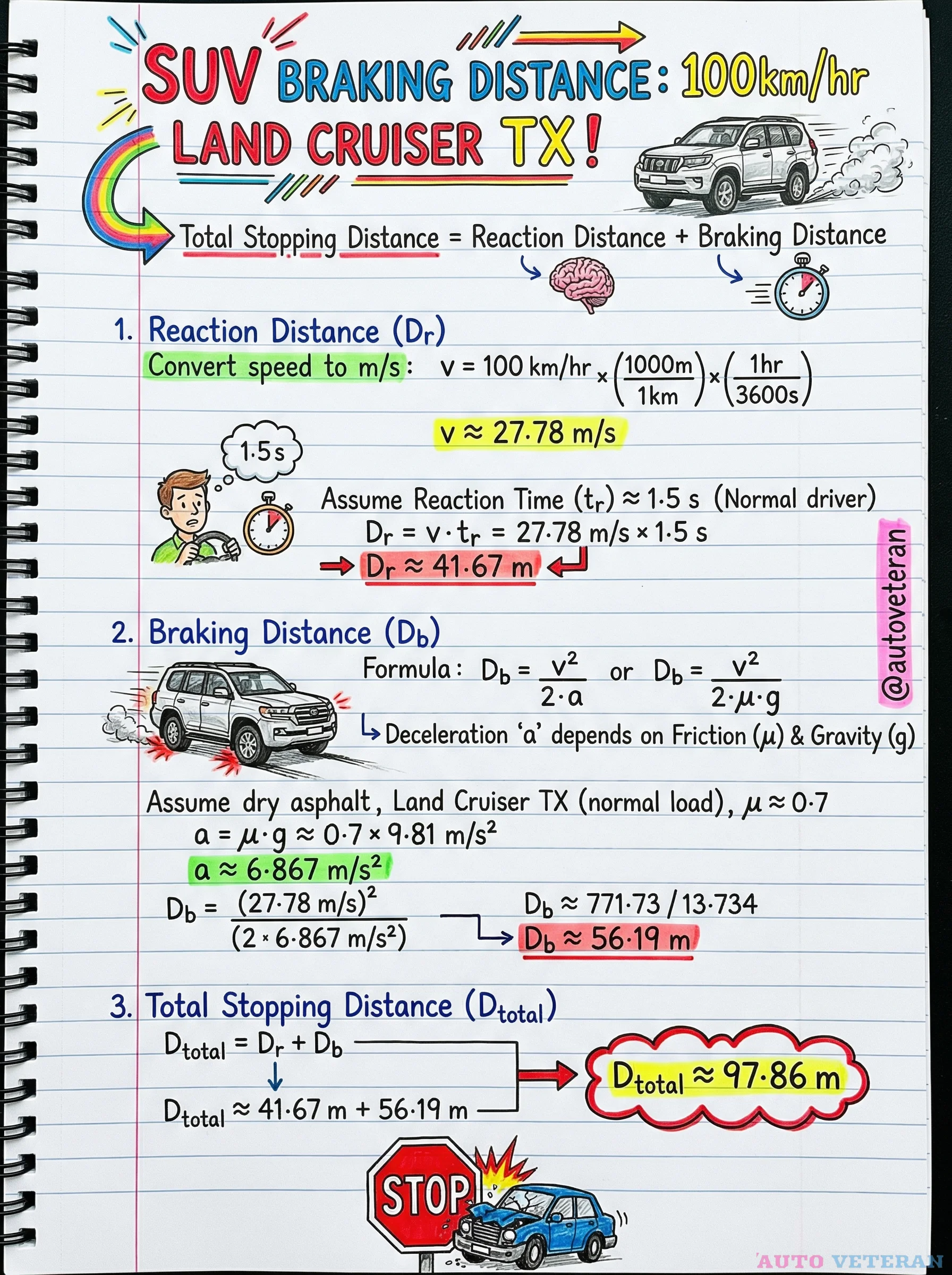
Land Cruiser TX Braking Distance Calculation at 100 km/h
This detailed analysis calculates the total stopping distance for a Toyota Land Cruiser TX traveling at 100 km/h on dry asphalt with normal load. The calculation breaks down the reaction distance, assuming a 1.5 second driver reaction time, and the braking distance using a friction coefficient of 0.7. The result shows a reaction distance of approximately 41.67 meters and a braking distance of 56.19 meters, yielding a total stopping distance of about 97.86 meters. Understanding these precise calculations helps drivers appreciate the physics behind emergency braking scenarios and the importance of maintaining proper following distances.
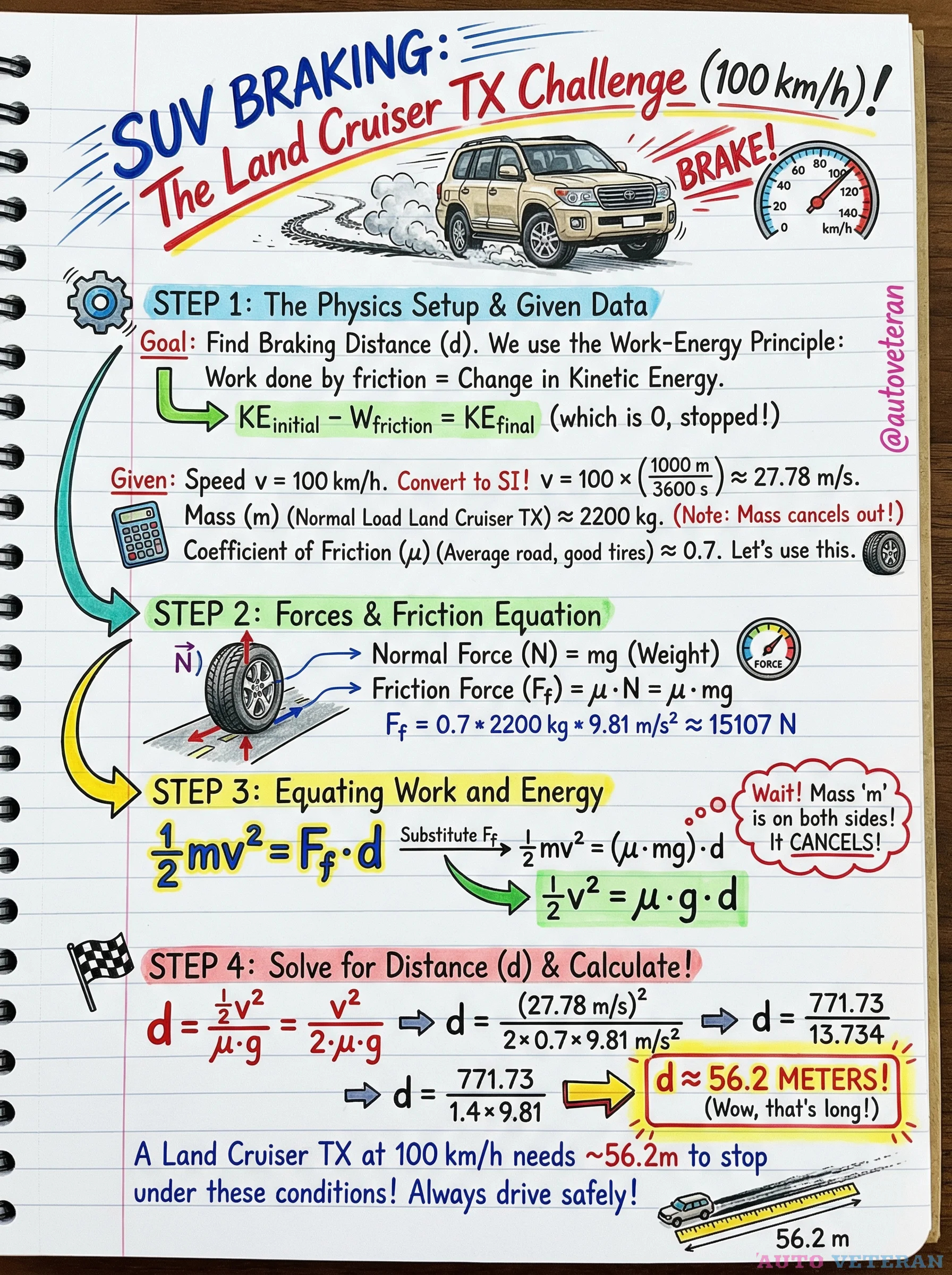
Land Cruiser TX Braking Distance Physics Calculation
This detailed physics analysis calculates the braking distance for a Land Cruiser TX traveling at 100 km/h under specific conditions. Using the work-energy principle, the calculation accounts for a vehicle mass of 2200 kg, a coefficient of friction of 0.7 for average road conditions with good tires, and gravitational acceleration of 9.81 m/s². The step-by-step solution demonstrates how mass cancels out in the equation, revealing that stopping distance depends primarily on initial velocity and friction. The final result shows the Land Cruiser TX requires approximately 56.2 meters to come to a complete stop from 100 km/h, highlighting the significant energy dissipation needed for safe braking in a heavy SUV.
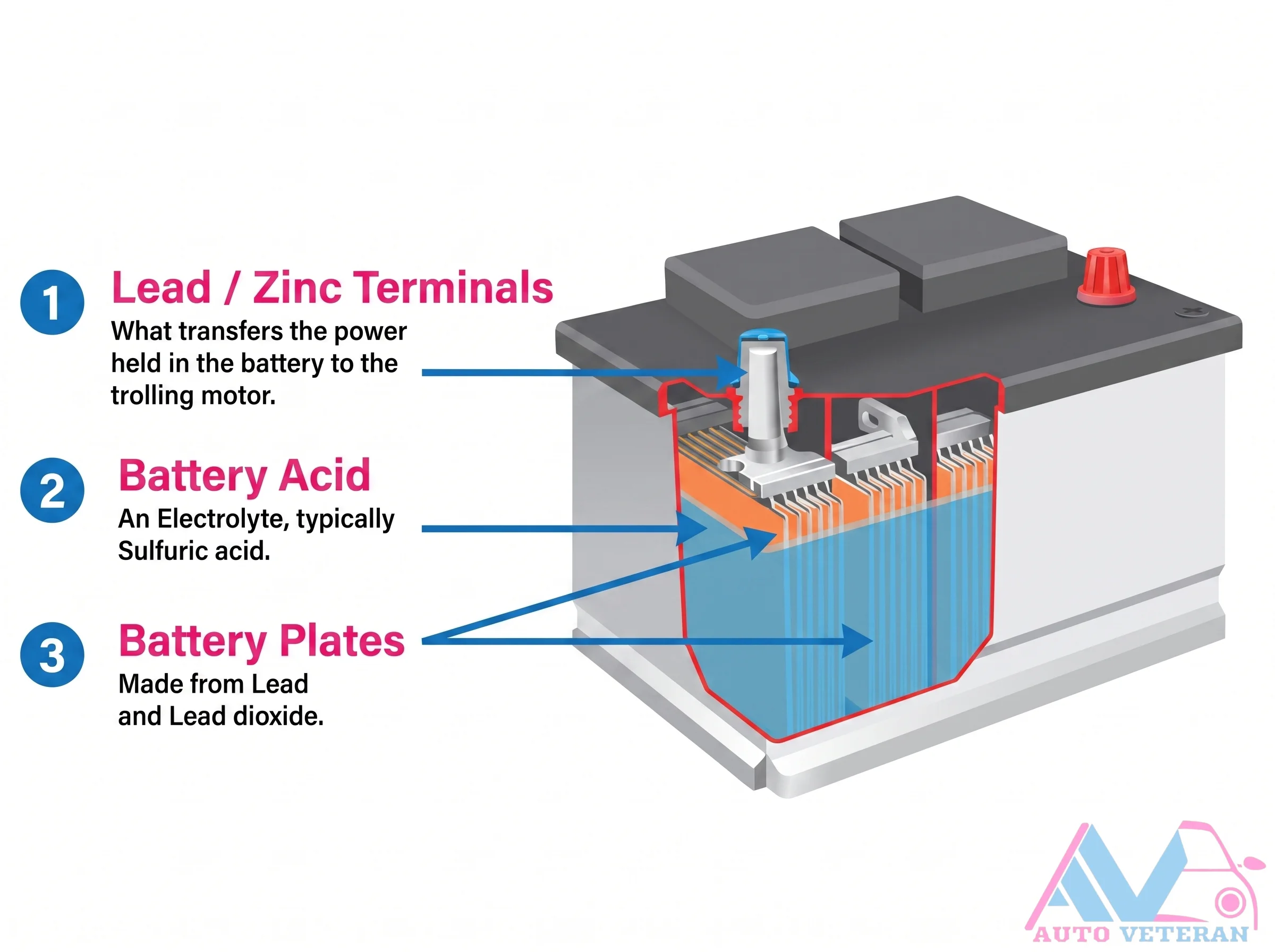
Lead Acid Battery Anatomy
A marine deep cycle battery is disassembled to show its core parts: lead zinc terminals that transfer power to the trolling motor, sulfuric acid electrolyte that conducts ions, and lead and lead dioxide plates that store and release energy. Understanding these elements helps you maintain battery health and diagnose failure.
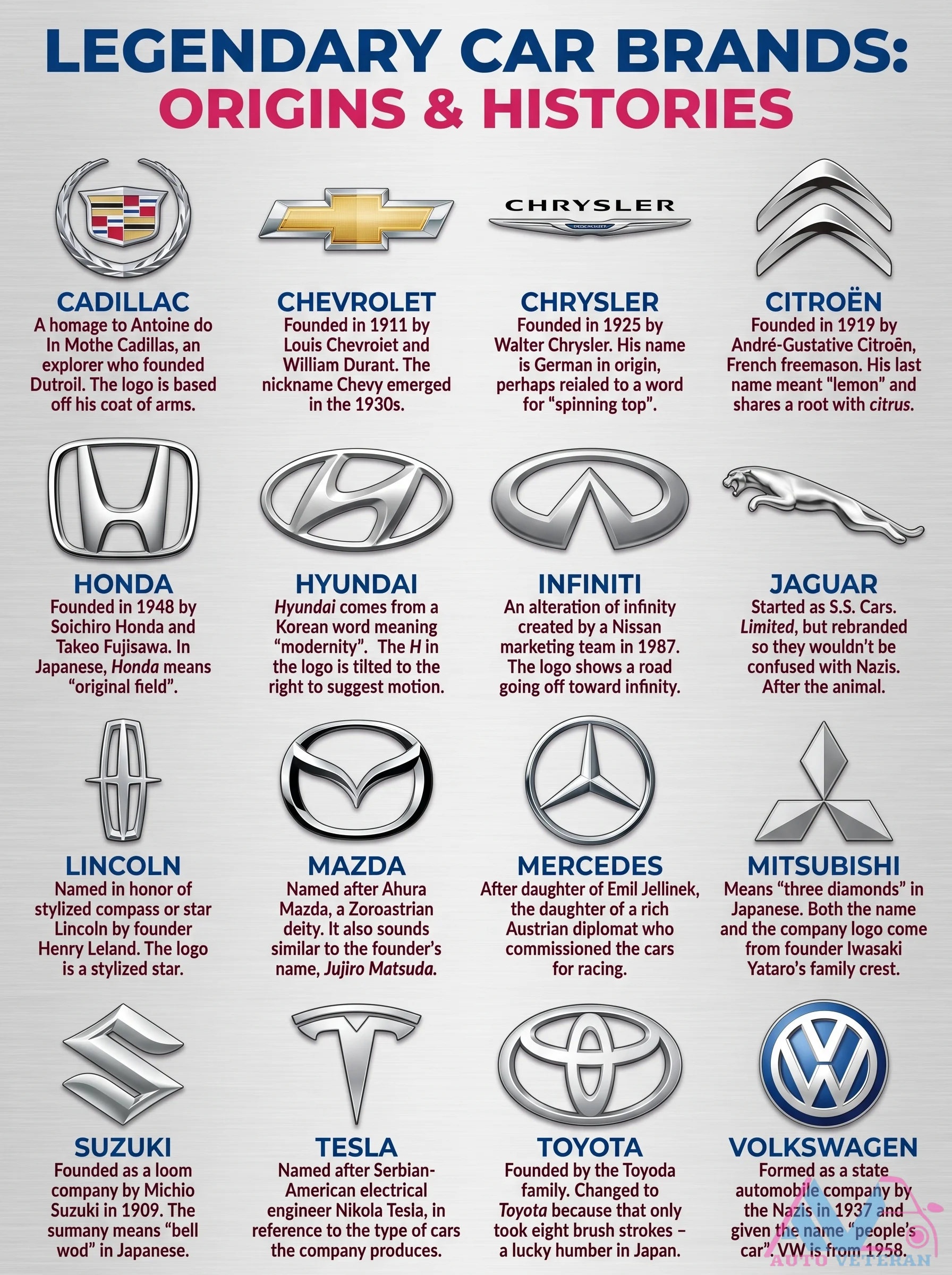
Legendary Car Brands Origins & Histories
This infographic presents fascinating origin stories of iconic car brands from around the world. Cadillac founded in 1911 honors explorer Antoine de la Mothe Cadillac while Chevrolet founded in 1925 by Louis Chevrolet and William Durant saw the nickname Chevy emerge in the 1930s. Chrysler founded in 1919 by Walter Chrysler has a German origin name possibly related to a word for spinning top. Citroen founded by Andre Gustave Citroen a French freemason uses a logo based on his coat of arms and his last name means lemon sharing root with citrus. Honda founded in 1948 by Soichiro Honda and Takeo Fujisawa means original field in Japanese. Hyundai comes from a Korean word meaning modernity. Infiniti an alteration of infinity was created by a Nissan marketing team in 1987 with a logo showing road going off toward infinity. Jaguar started as S.S. Cars Limited but rebranded after the animal to avoid confusion with Nazis. Lincoln named after Abraham Lincoln uses a stylized star logo. Mazda named after Ahura Mazda a Zoroastrian deity also sounds similar to founder Jujiro Matsuda. Mercedes named after daughter of Emil Jellinek an Austrian diplomat who commissioned cars for racing. Mitsubishi means three diamonds in Japanese with both name and logo from founder Iwasaki Yataro's family crest. Suzuki founded as loom company by Michio Suzuki in 1909 with sumany meaning bell wood in Japanese. Tesla named after Serbian American electrical engineer Nikola Tesla. Toyota founded by the Toyoda family changed to Toyota because eight brush strokes was a lucky number in Japan. Volkswagen formed as a state owned automob company by the Nazis in 1937 and given the name people's car with VW from 1958.
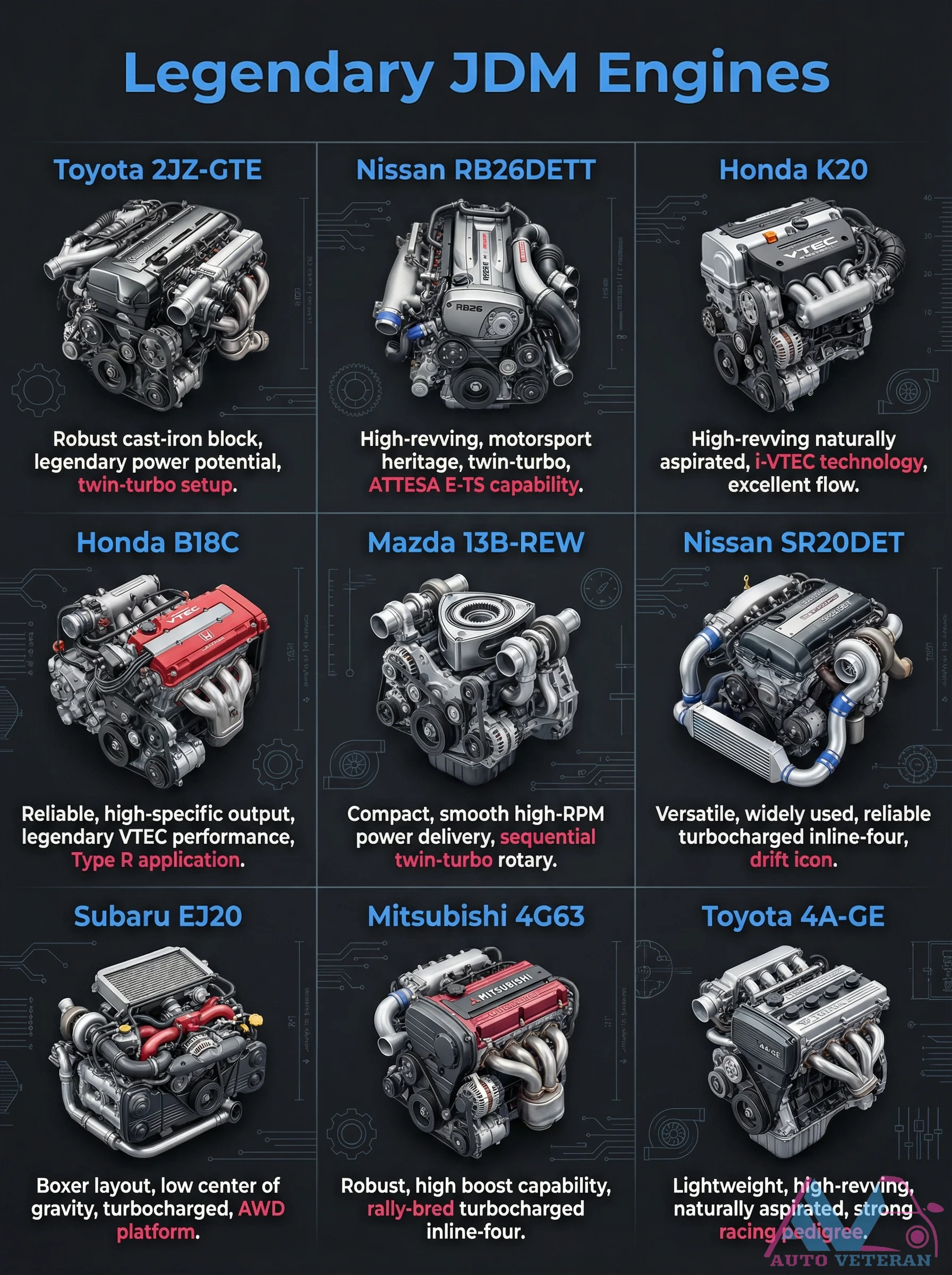
Legendary JDM Engines Specs and Capabilities
The Toyota 2JZ-GTE features a robust cast-iron block with legendary power potential and a twin-turbo setup. The Nissan RB26DETT offers high specific output and ATTESA E-TS capability, while the Honda K20 delivers high-revving naturally aspirated performance with i-VTEC technology. The Mazda 13B-REW provides compact, smooth power delivery with sequential twin-turbo rotary design. The Nissan SR20DET is a versatile, widely used turbocharged inline-four, and the Subaru EJ20 boasts a boxer layout with low center of gravity for AWD rally performance. The Mitsubishi 4G63 demonstrates high boost capability with racing pedigree, and the Toyota 4A-GE is a lightweight, high-revving naturally aspirated engine.
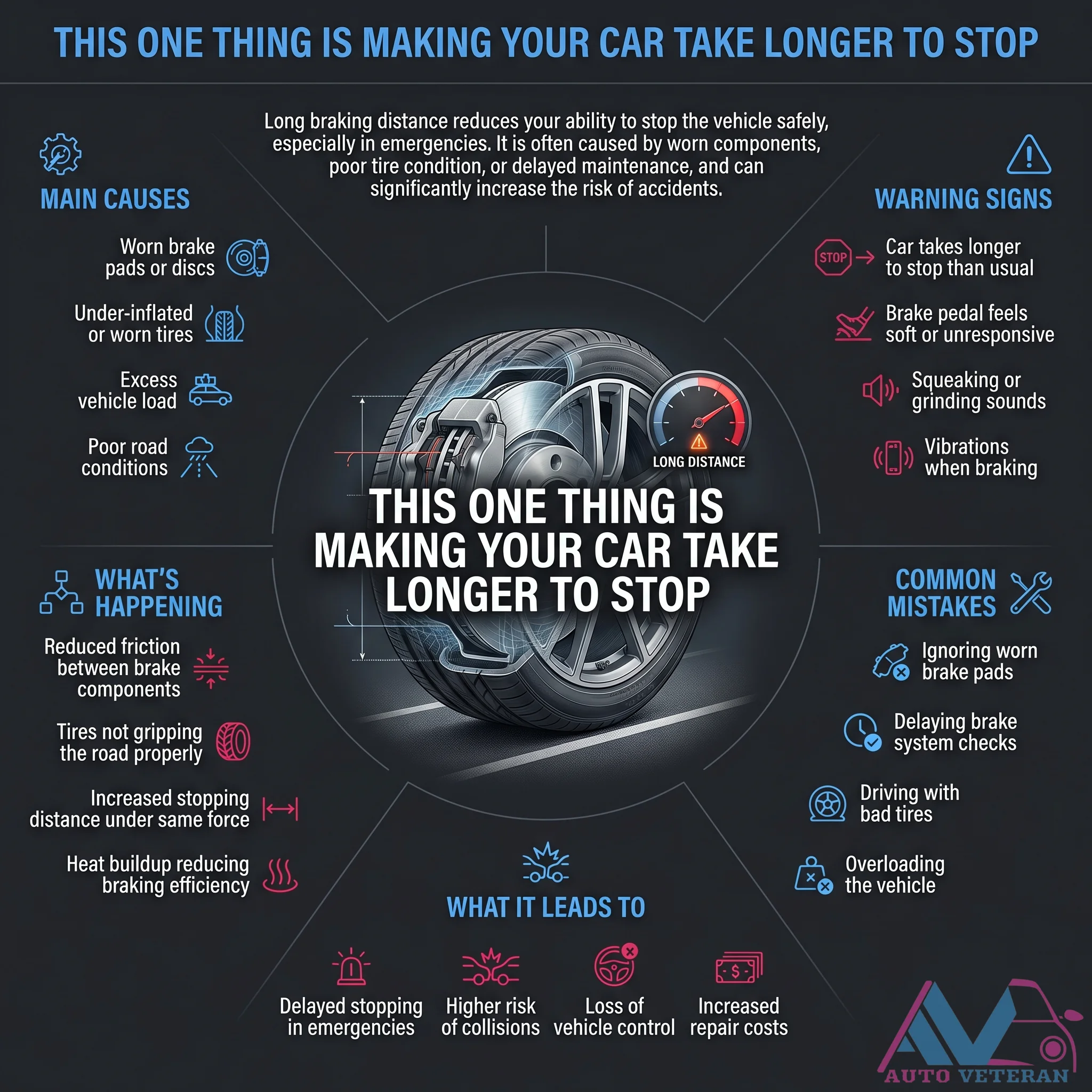
Long Braking Distance Causes and Warning Signs
When your vehicle takes longer to stop than usual, it's often due to worn brake components like pads and discs, under-inflated or worn tires, or excessive vehicle load. Warning signs include a soft or unresponsive brake pedal, squeaking or grinding sounds, vibrations during braking, and reduced friction between components. Common mistakes that exacerbate this dangerous condition include ignoring worn brake parts, delaying brake system maintenance, driving with bad tires, and overloading the vehicle. This leads to delayed emergency stopping, higher collision risk, loss of vehicle control, and increased repair costs.