Interactive Explorer
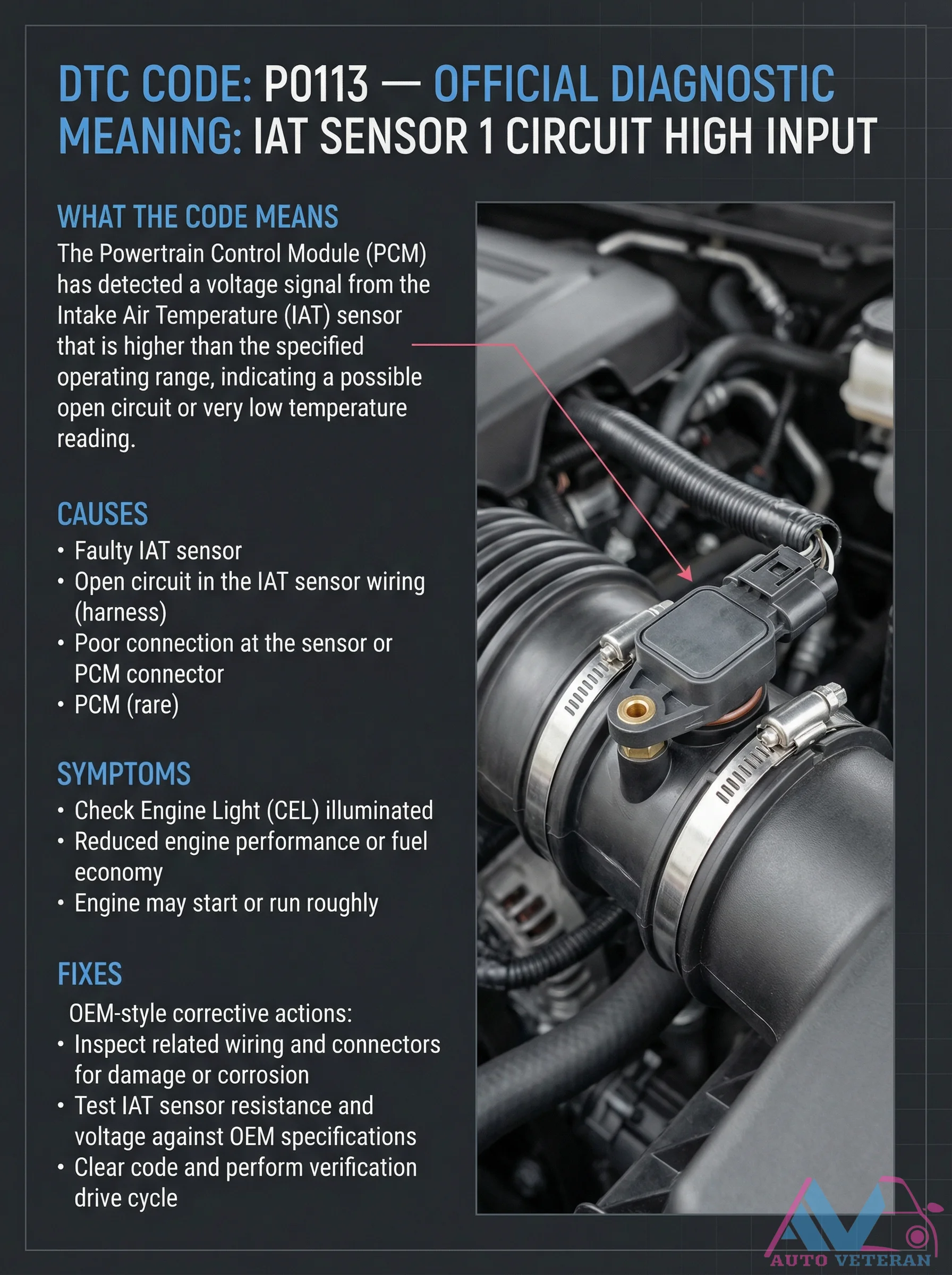
P0113 IAT Sensor Circuit High Input Code
The P0113 diagnostic trouble code indicates the Powertrain Control Module has detected an abnormally high voltage signal from the Intake Air Temperature sensor, suggesting an open circuit or extreme low temperature reading. This condition typically triggers the Check Engine Light while potentially causing reduced engine performance, rough running, and decreased fuel economy. Common causes include a faulty IAT sensor, damaged wiring harness, poor electrical connections at the sensor or PCM connector, or rarely a malfunctioning PCM itself. Proper diagnosis involves inspecting wiring for damage or corrosion, testing sensor resistance and voltage against manufacturer specifications, clearing the code, and completing a verification drive cycle to confirm repair success.
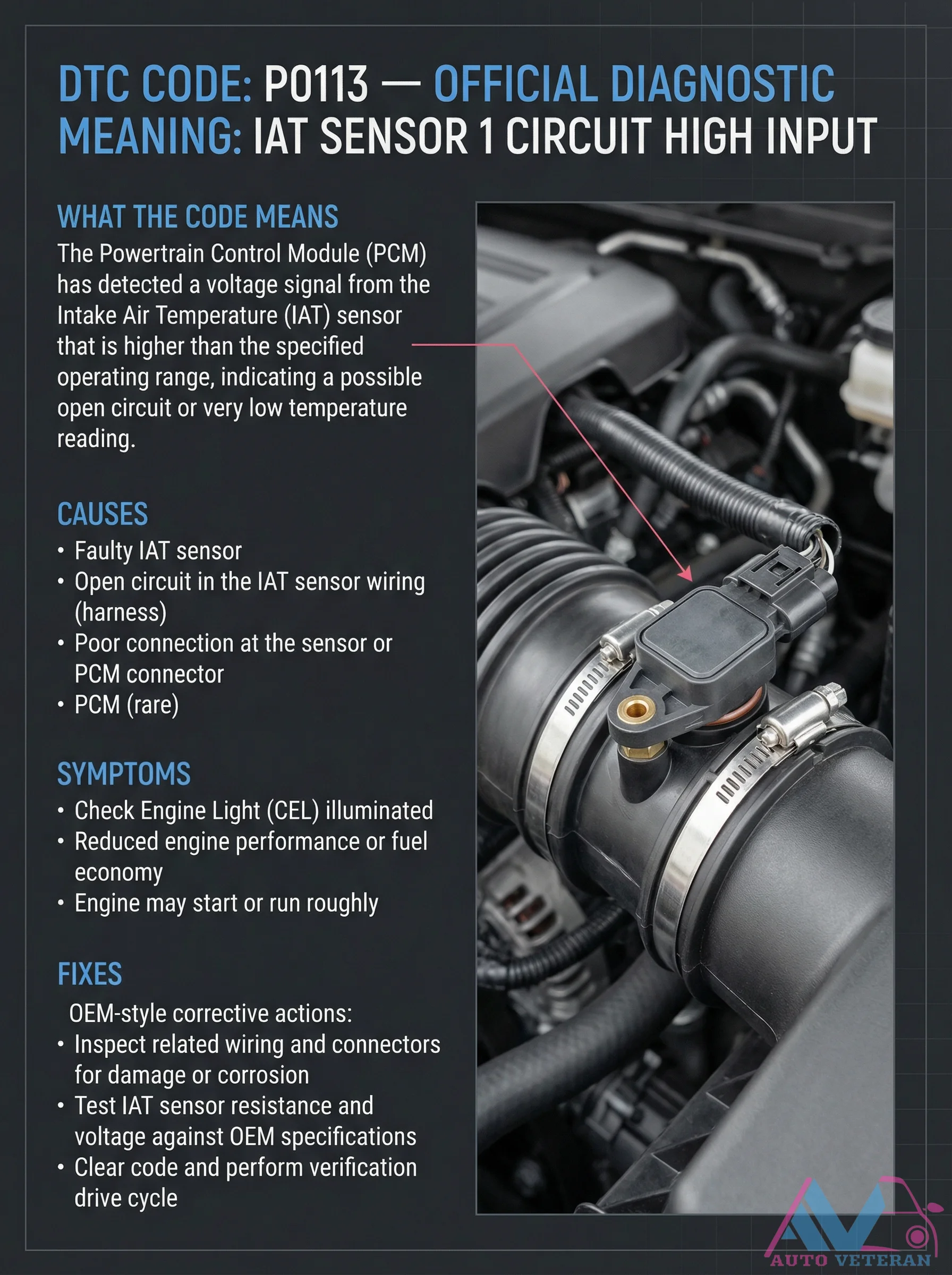
P0113 IAT Sensor Circuit High Input Diagnosis
When your vehicle's Powertrain Control Module detects a voltage signal from the Intake Air Temperature sensor that exceeds the specified operating range, it triggers Diagnostic Trouble Code P0113. This condition typically indicates an open circuit in the sensor wiring or an abnormally low temperature reading, often resulting from damaged harness connections, sensor failure, or corrosion at the PCM connector. Common symptoms include an illuminated Check Engine Light, reduced engine performance, decreased fuel economy, and rough engine operation during startup or running. Proper diagnosis involves inspecting all related wiring and connectors for visible damage, testing the IAT sensor's resistance and voltage against manufacturer specifications, and performing a verification drive cycle after clearing the code to confirm the repair.
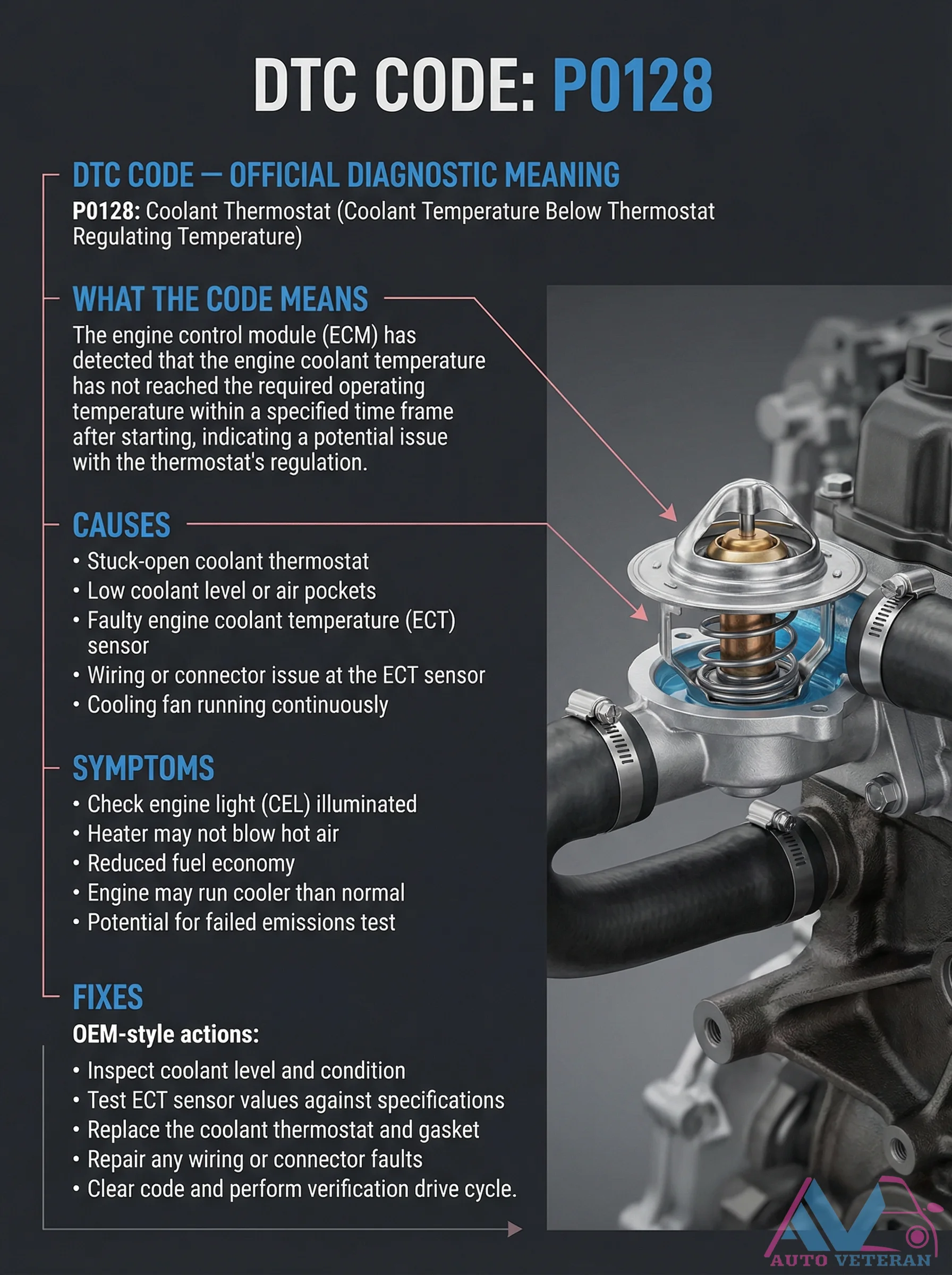
P0128 Coolant Thermostat DTC Diagnosis and Symptoms
Diagnostic Trouble Code P0128 indicates the engine coolant temperature remains below the thermostat's regulating threshold after startup, signaling a stuck open thermostat, low coolant level, faulty ECT sensor, or wiring issues. Common symptoms include an illuminated check engine light, insufficient heater output, reduced fuel economy, and potential emissions test failure. Proper diagnosis involves inspecting coolant levels, testing ECT sensor specifications, replacing the thermostat and gasket, and clearing the code with a verification drive cycle.
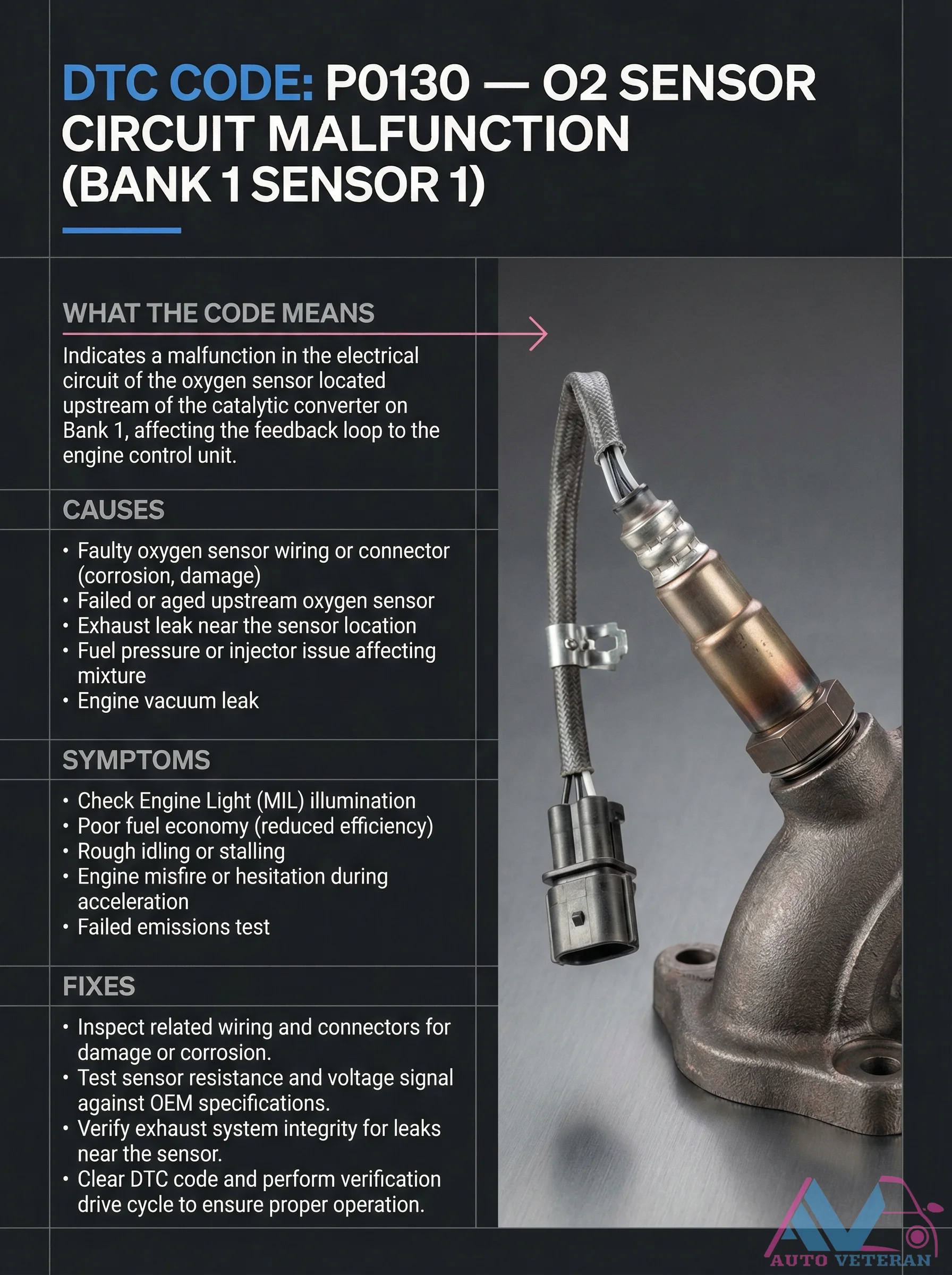
P0130 Code Bank 1 Sensor 1 Causes and Fixes
The P0130 diagnostic trouble code specifically indicates an electrical circuit malfunction in the upstream oxygen sensor on Bank 1, disrupting the critical feedback loop to your engine control unit. This circuit failure can stem from multiple sources including corroded or damaged wiring connectors, an aged or failed oxygen sensor itself, exhaust leaks near the sensor location, fuel pressure irregularities, injector issues affecting air-fuel mixture, or engine vacuum leaks. Common symptoms triggered by this circuit malfunction include immediate illumination of the Check Engine Light, noticeably poor fuel economy with reduced efficiency, rough engine stalling, misfires or hesitation during acceleration, and potential failure during emissions testing. To resolve P0130, systematically inspect all related wiring and connectors for visible damage or corrosion, test the sensor's resistance and voltage signal against original equipment manufacturer specifications, verify exhaust system integrity for leaks near the sensor location, then clear the code and perform a proper verification drive cycle to confirm restoration of normal operation.
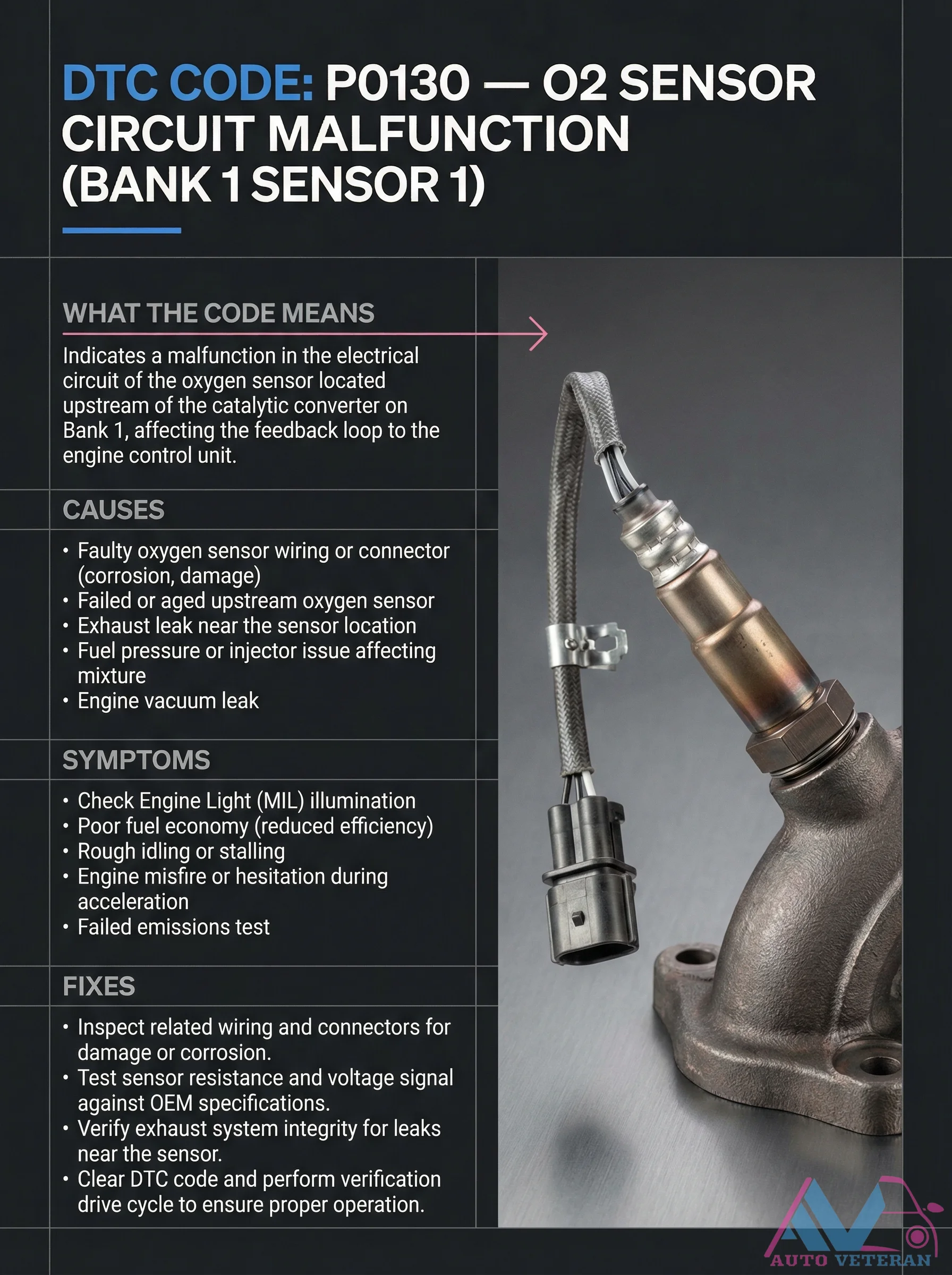
P0130 O2 Sensor Circuit Malfunction Bank 1 Sensor 1
Diagnostic Trouble Code P0130 specifically indicates an electrical circuit malfunction in the upstream oxygen sensor on Bank 1, disrupting the critical feedback loop to the engine control unit. This fault triggers the Check Engine Light while causing noticeable symptoms like poor fuel economy, rough idling, engine misfires during acceleration, and potential emissions test failures. Common causes include faulty sensor wiring or connectors with corrosion or damage, a failed upstream oxygen sensor, exhaust leaks near the sensor location, fuel pressure or injector issues affecting mixture, or engine vacuum leaks. To resolve this, inspect all related wiring and connectors for damage, test sensor resistance and voltage signals against OEM specifications, verify exhaust system integrity for leaks, then clear the DTC and perform a verification drive cycle to ensure proper operation.
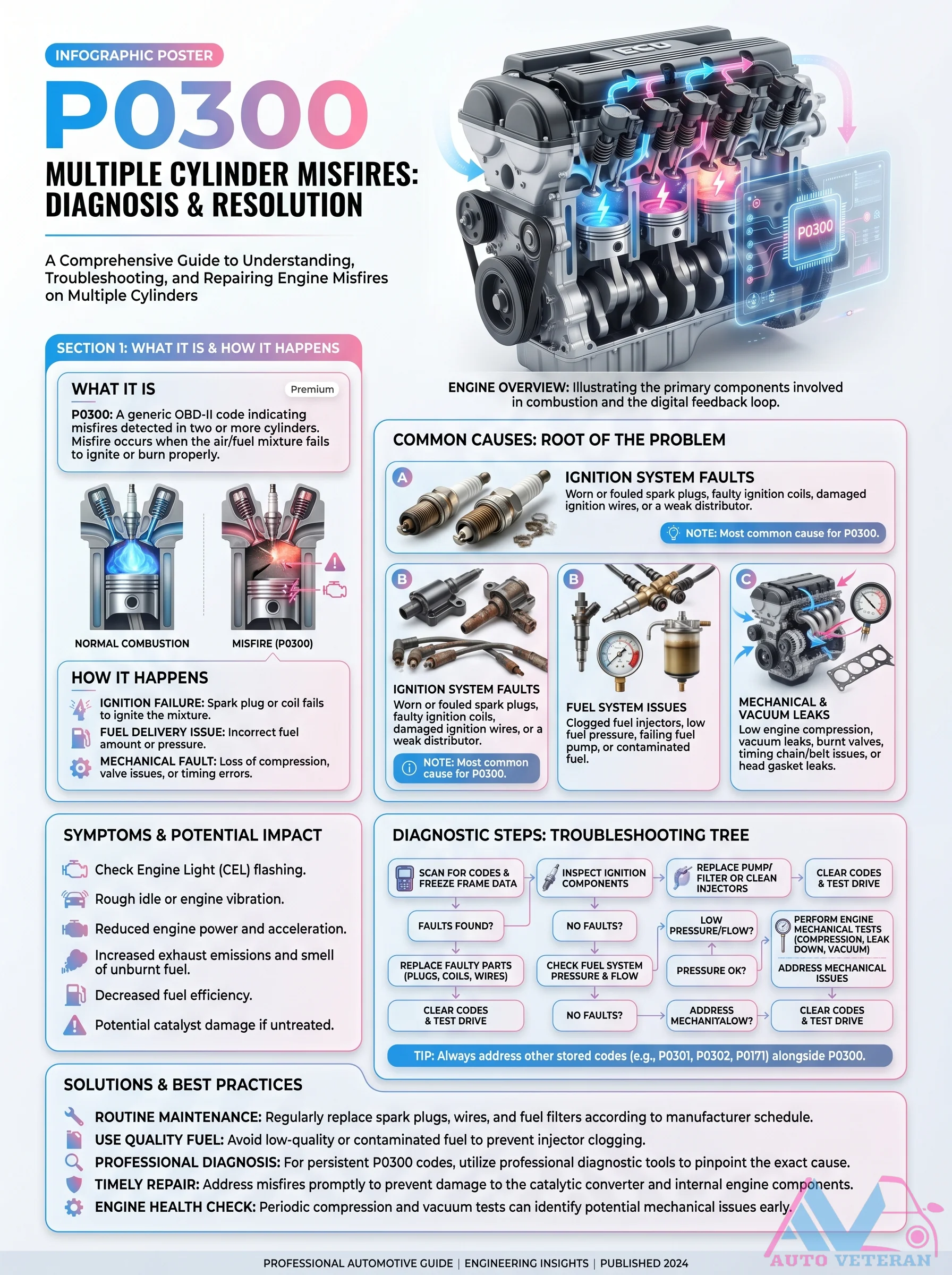
P0300 Multiple Cylinder Misfires Diagnosis Guide
This comprehensive infographic poster breaks down the P0300 code covering multiple cylinder misfires. It explains what the code means, how misfires happen when the air fuel mixture fails to ignite properly, and outlines common causes such as ignition system faults like worn spark plugs or faulty coils, fuel system issues like clogged injectors or low pressure, vacuum leaks, and mechanical faults like low compression or burnt valves. The diagnostic tree guides you through checking for codes, inspecting components, testing fuel pressure and mechanical integrity, and clearing codes after repairs. Symptoms include a flashing check engine light, rough idle, reduced power, increased emissions, and potential catalyst damage if left unaddressed.
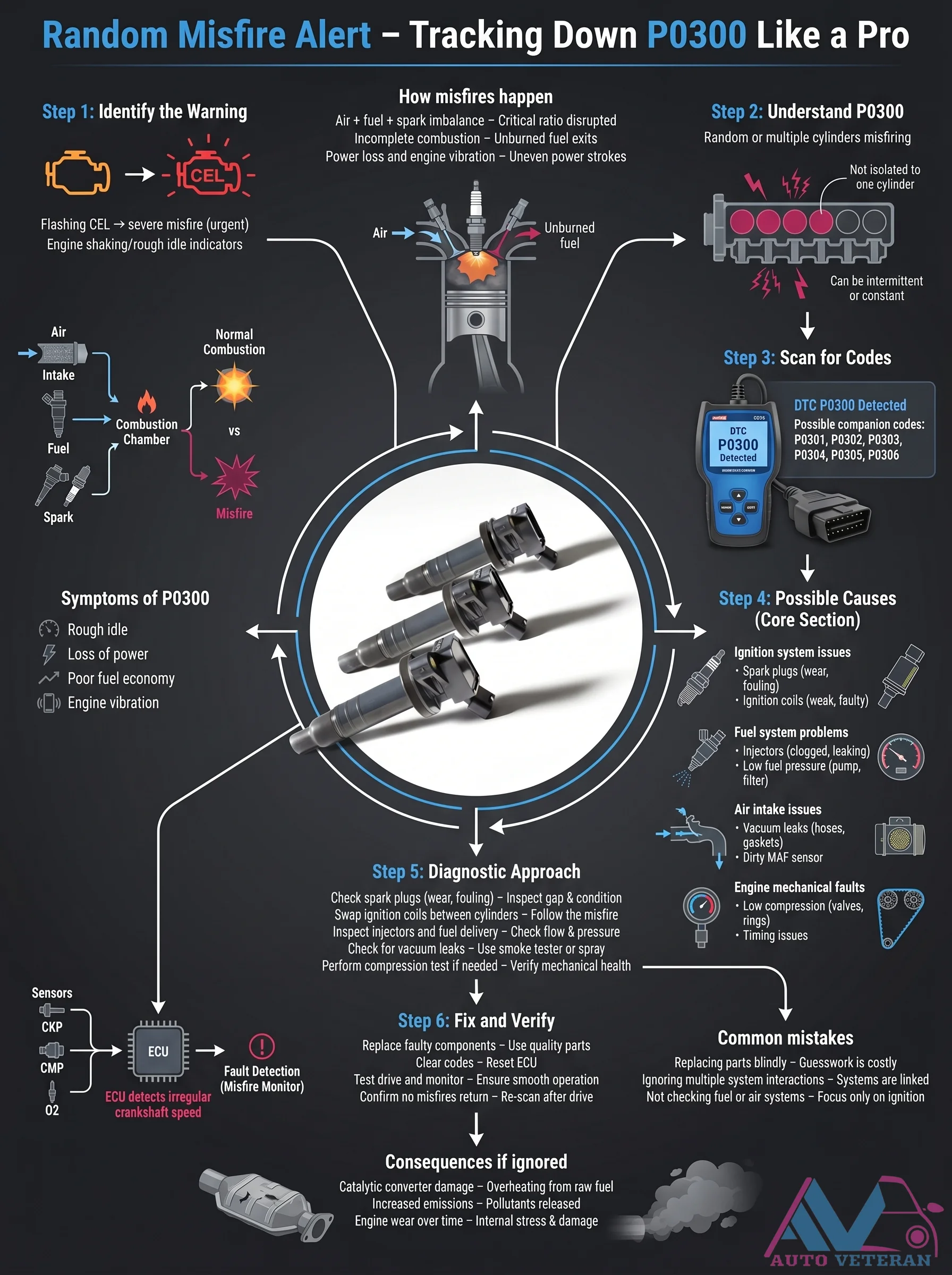
P0300 Random Misfire Diagnostic Steps and Causes
A comprehensive diagnostic guide for addressing random misfire code P0300, covering the step by step process from initial warning signs to final verification. The guide explains how misfires occur due to air, fuel, or spark imbalances disrupting the critical combustion ratio. It details the symptoms including rough idle, power loss, engine vibration, and flashing check engine light for severe cases. The core section explores possible causes across ignition systems, fuel delivery, air intake issues, and engine mechanical faults. The diagnostic approach provides actionable steps like checking spark plugs, inspecting ignition coils, testing fuel pressure, and looking for vacuum leaks. The guide emphasizes fixing with quality parts, clearing codes, and test driving to verify resolution, while warning against common mistakes like guesswork or ignoring interconnected systems.
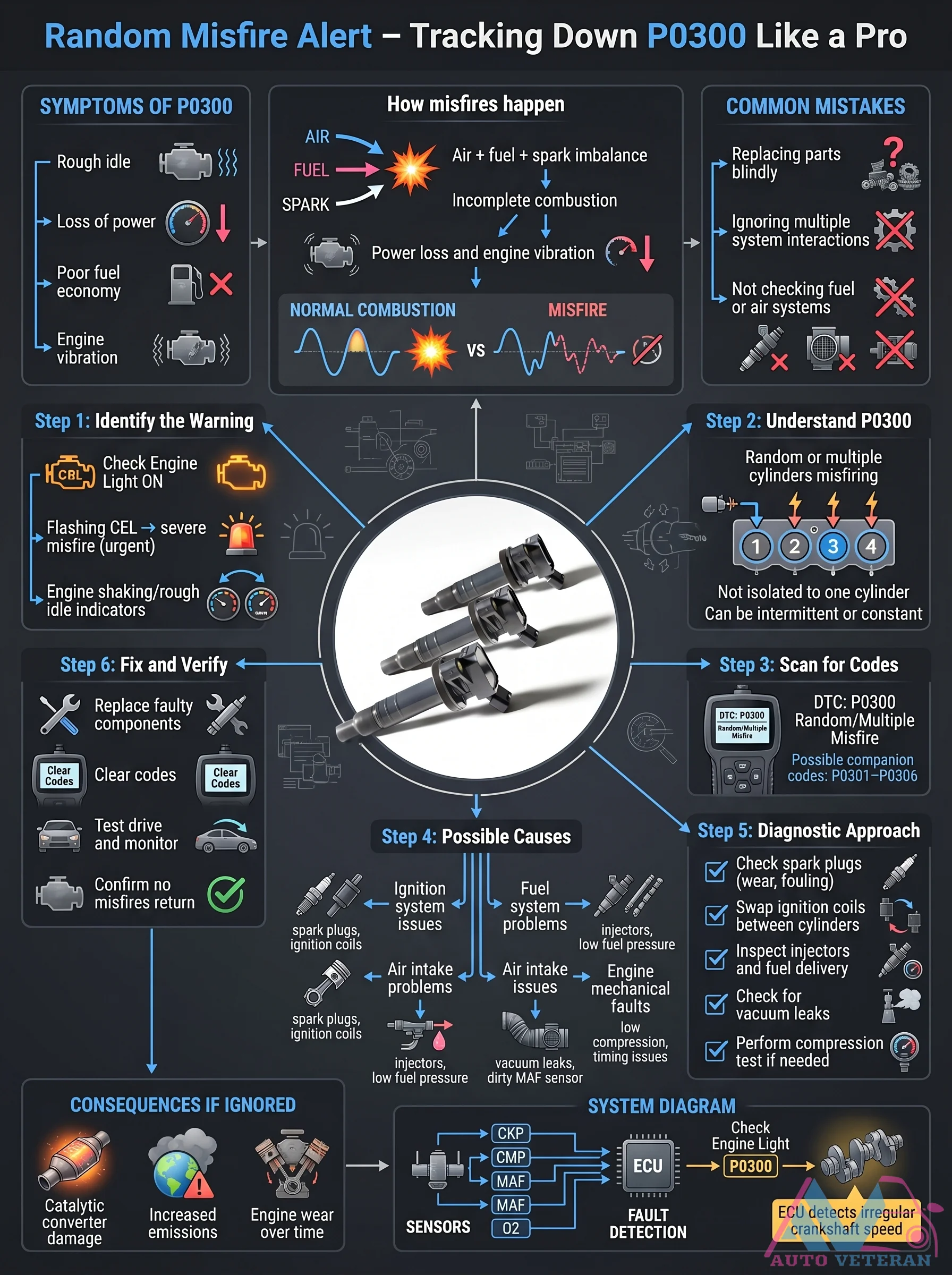
P0300 Random Misfire Diagnostic Symptoms and Steps
When your check engine light flashes with a P0300 code, it signals random or multiple cylinder misfires that demand immediate attention. Symptoms include rough idle, engine vibration, power loss, and poor fuel economy. The diagnostic approach involves scanning for codes, checking ignition components like spark plugs and coils, inspecting fuel system components including injectors and pressure, examining air intake systems for vacuum leaks or dirty MAF sensors, and performing compression tests. Ignoring these misfires can lead to catalytic converter damage, increased emissions, and accelerated engine wear over time.
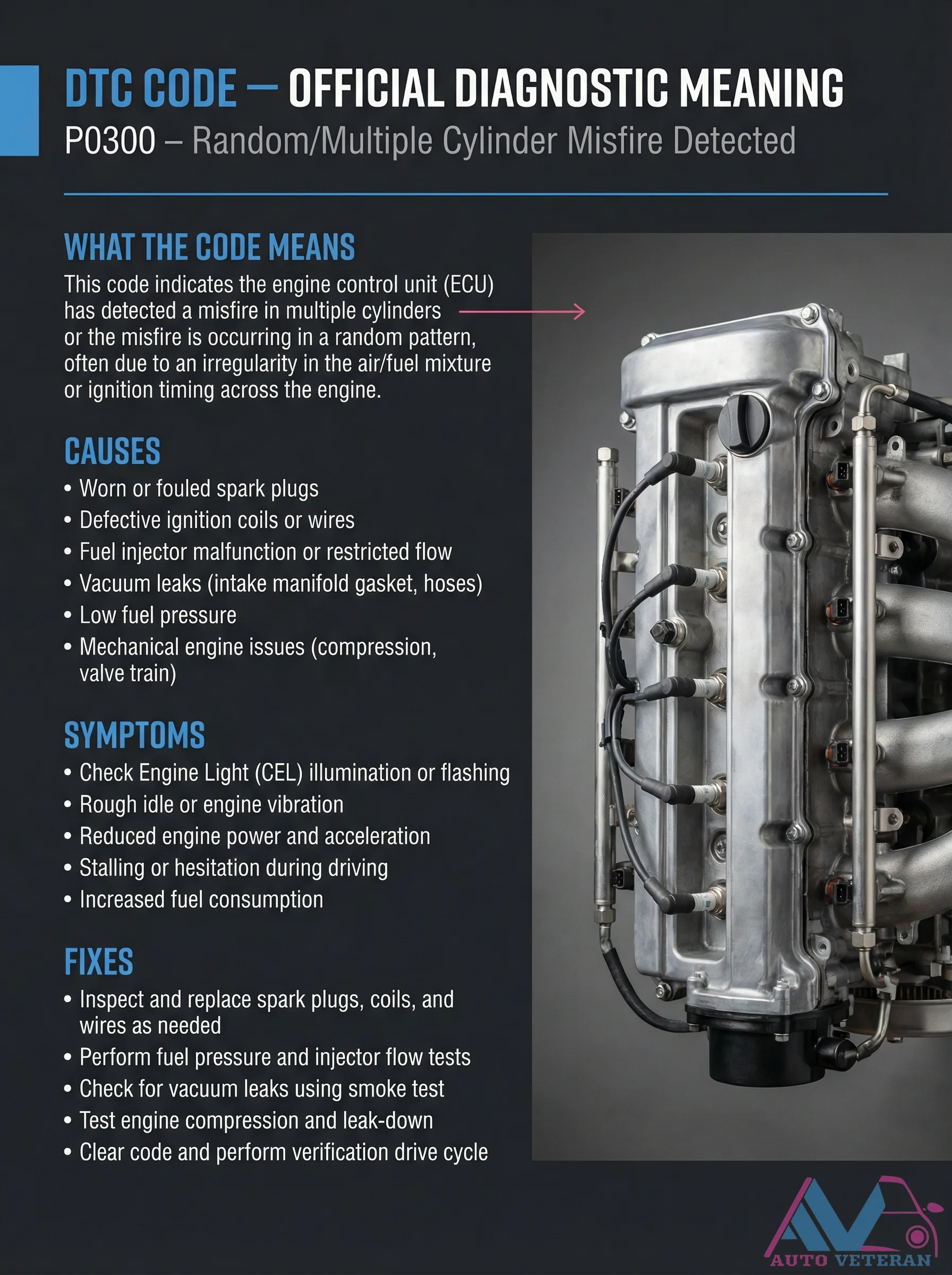
P0300 Random Multiple Cylinder Misfire Code
The P0300 diagnostic trouble code signals that your engine control unit has detected misfires occurring randomly across multiple cylinders, typically caused by irregularities in air/fuel mixture or ignition timing. Common symptoms include a flashing check engine light, rough idle with noticeable vibration, reduced power during acceleration, stalling or hesitation while driving, and increased fuel consumption. Potential causes range from worn spark plugs and defective ignition components to fuel injector issues, vacuum leaks, low fuel pressure, or underlying mechanical problems like compression loss. Diagnosis involves inspecting ignition systems, performing fuel pressure tests, checking for vacuum leaks with smoke testing, and conducting compression leak down tests before clearing the code and verifying repairs through a proper drive cycle.
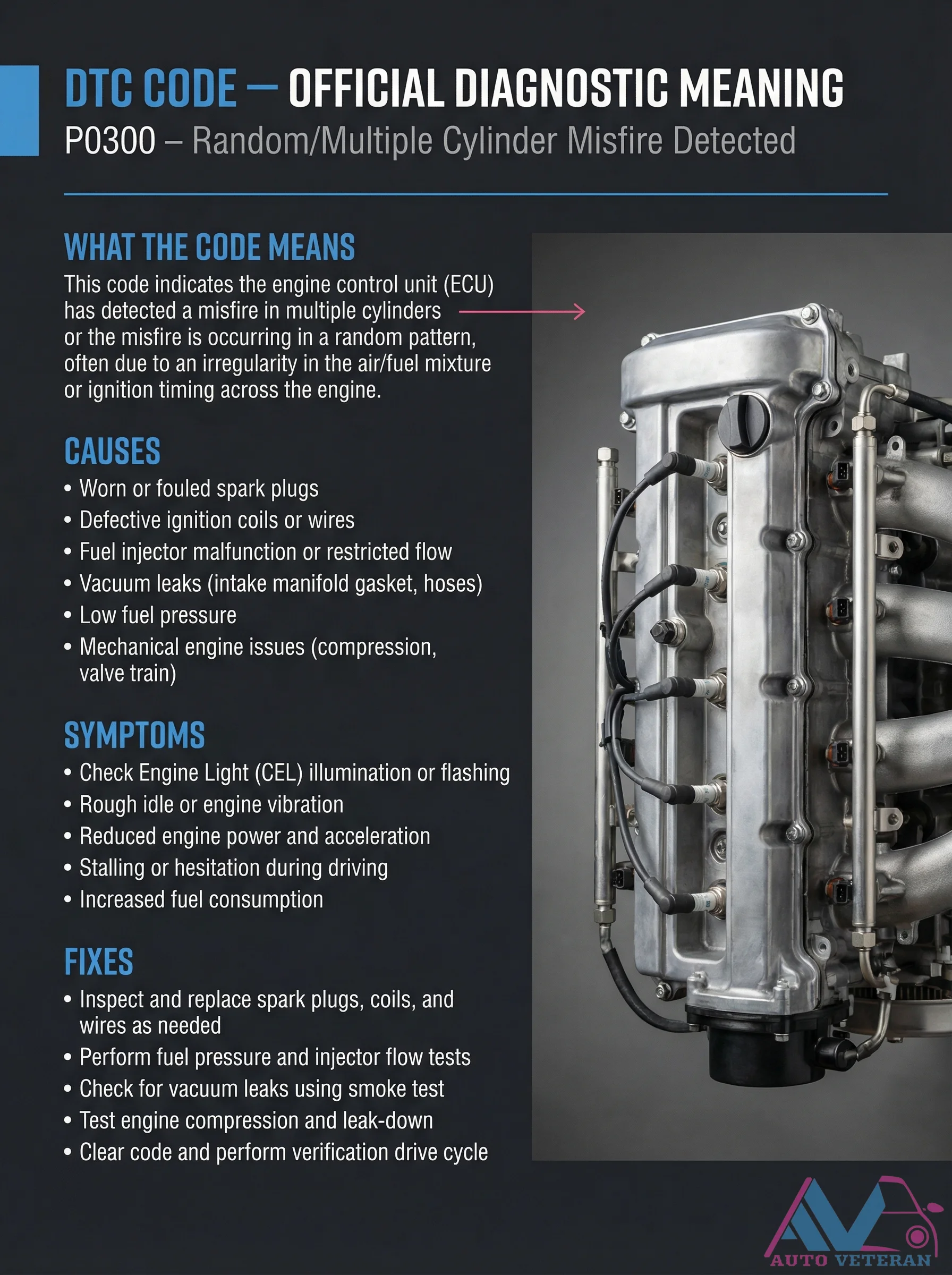
P0300 Random Multiple Cylinder Misfire DTC
The P0300 diagnostic trouble code signals that your engine control unit has detected misfires occurring across multiple cylinders or in a random pattern, typically caused by irregularities in the air/fuel mixture or ignition timing. Common symptoms include a flashing check engine light, rough idle with noticeable vibration, reduced power during acceleration, stalling or hesitation while driving, and increased fuel consumption. Potential causes range from worn spark plugs and defective ignition components to fuel injector issues, vacuum leaks, low fuel pressure, or underlying mechanical problems like compression loss. Proper diagnosis involves inspecting ignition components, performing fuel system tests, checking for vacuum leaks, and testing engine compression before clearing the code and completing a verification drive cycle.
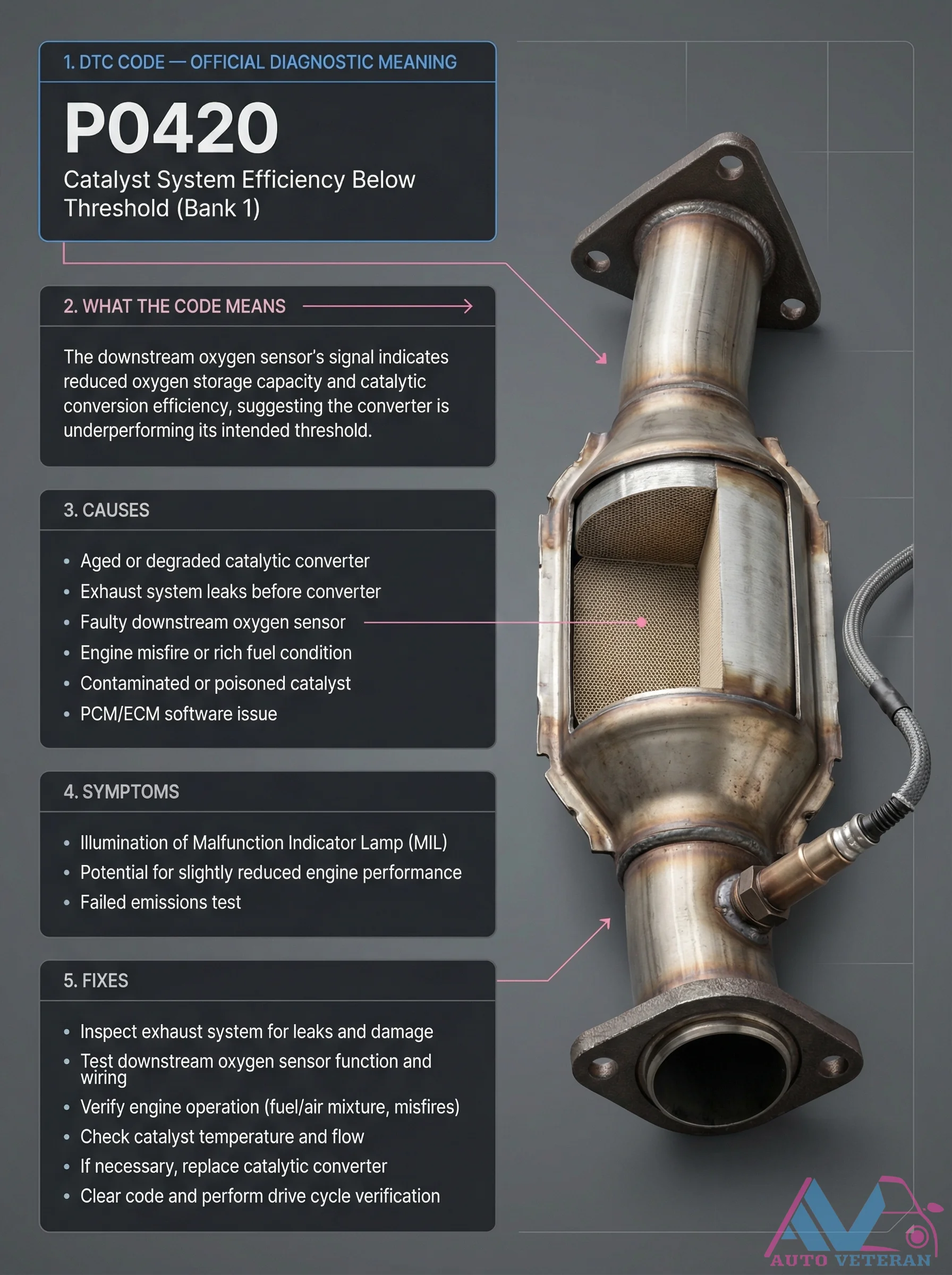
P0420 Catalyst Efficiency Code Diagnosis and Fixes
When your vehicle's diagnostic system triggers code P0420, it indicates the catalytic converter's oxygen storage capacity has degraded below acceptable thresholds, specifically affecting Bank 1. This condition typically manifests through an illuminated check engine light, potential minor performance reductions, and emissions test failures. Common underlying causes include an aged catalytic converter, exhaust leaks upstream of the converter, faulty downstream oxygen sensors, engine misfires, rich fuel conditions, catalyst contamination, or PCM/ECM software issues. Effective troubleshooting involves inspecting the exhaust system for leaks and damage, testing downstream oxygen sensor functionality and wiring, verifying proper engine operation including fuel/air mixture and misfire detection, checking catalyst temperature flow patterns, and if necessary, replacing the catalytic converter before clearing codes and performing drive cycle verification.
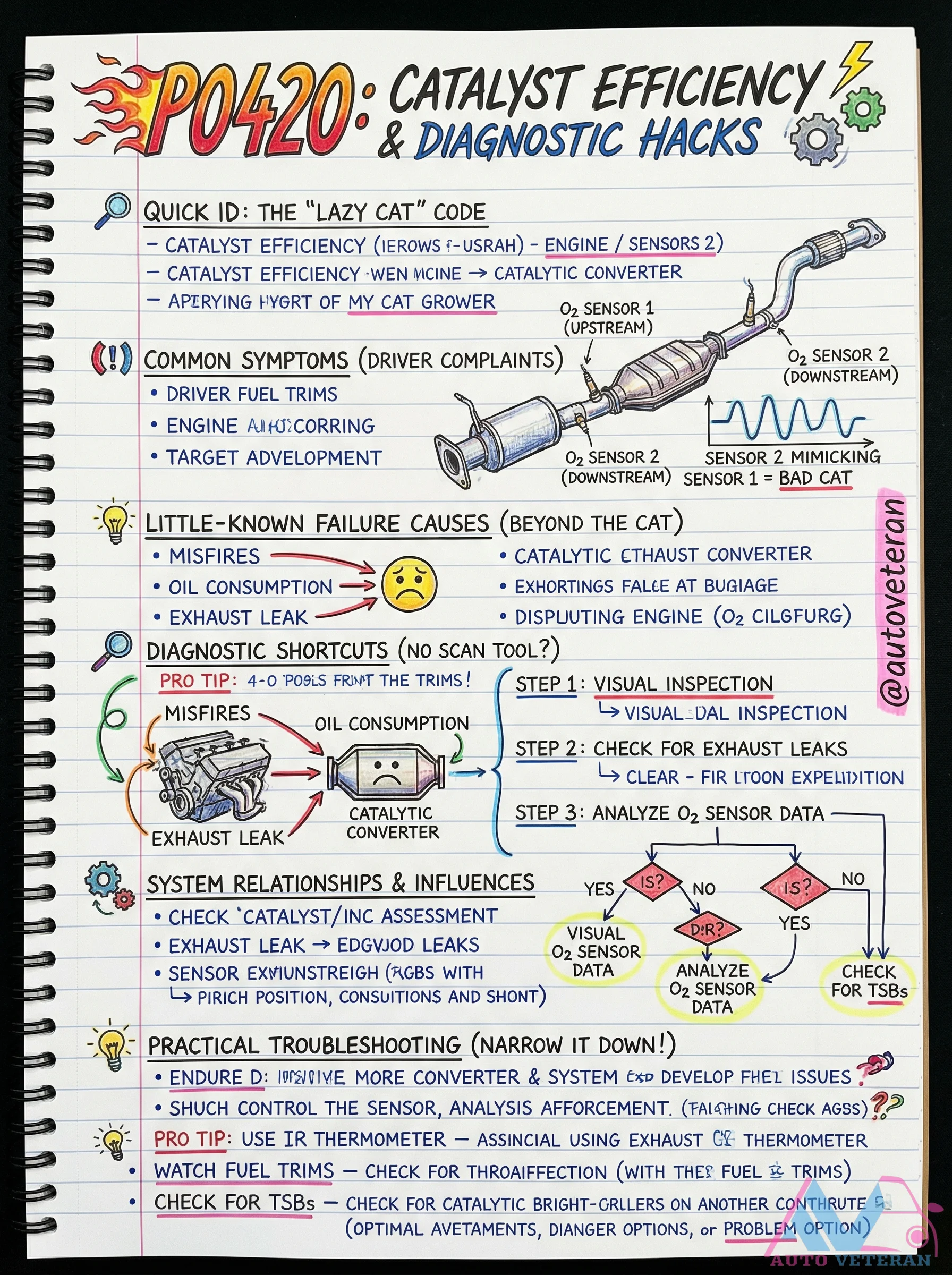
P0420 Catalyst Efficiency Diagnostic Hacks
When your check engine light flashes with code P0420, indicating catalyst efficiency below threshold, the problem might not be your catalytic converter itself. This guide reveals diagnostic shortcuts that bypass expensive scan tools, including analyzing fuel trims, checking for exhaust leaks, and using an IR thermometer to compare upstream and downstream temperatures. Learn how to identify common failure causes like misfires, oil consumption, and faulty oxygen sensors that mimic converter problems, plus practical steps for visual inspection and TSB verification to pinpoint the real issue before replacing parts.
P0420 Catalyst Efficiency Low Diagnosis
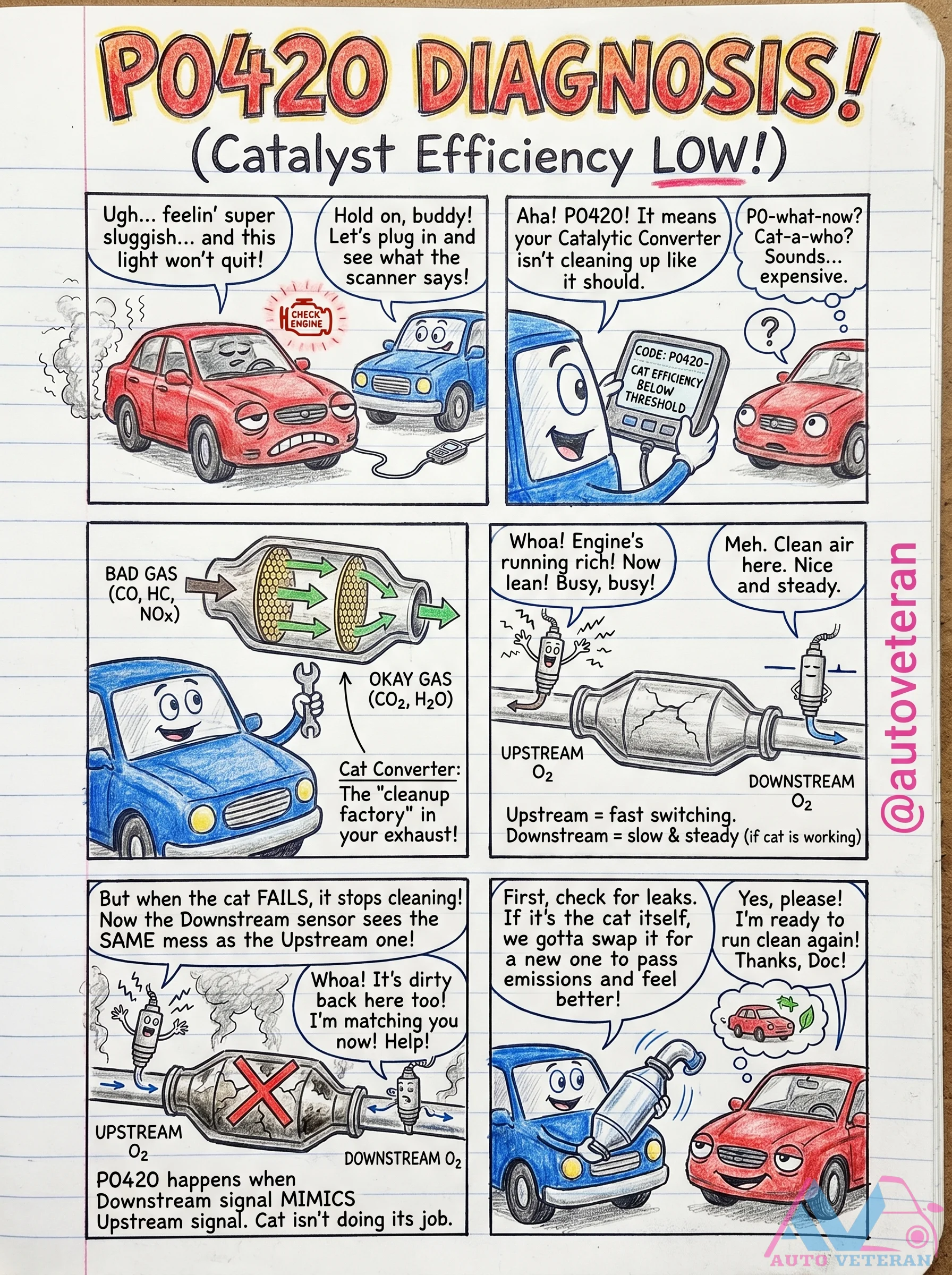
When your vehicle's catalytic converter fails to clean exhaust gases properly, the P0420 trouble code appears, indicating catalyst efficiency below threshold. This diagnostic scenario shows how a failing catalytic converter causes the downstream oxygen sensor to mimic the upstream sensor's readings, revealing the converter's inability to reduce harmful emissions like CO, HC, and NOx. The process involves checking for exhaust leaks, monitoring oxygen sensor patterns, and ultimately replacing the converter if it's confirmed faulty, helping your engine run cleaner and pass emissions tests.
P0420 Catalyst System Efficiency Below Threshold
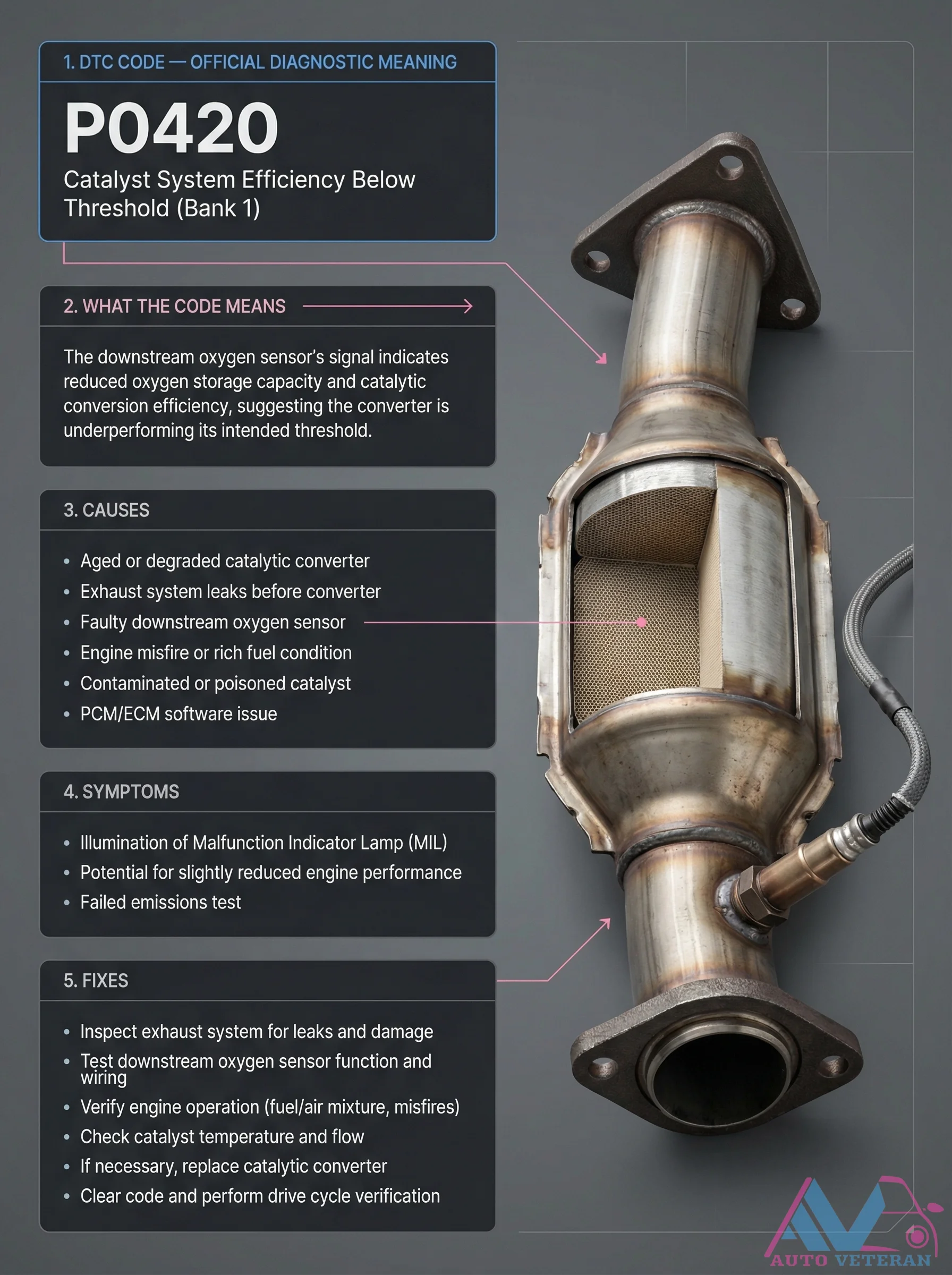
Diagnostic Trouble Code P0420 signals that your vehicle's catalytic converter on Bank 1 is operating below its designed efficiency threshold, as detected by the downstream oxygen sensor. This code specifically indicates reduced oxygen storage capacity and diminished catalytic conversion performance. Common causes include an aged or degraded catalytic converter, exhaust leaks upstream of the converter, a faulty downstream oxygen sensor, engine misfires, rich fuel conditions, contaminated catalyst material, or PCM/ECM software issues. Symptoms typically involve illumination of the Malfunction Indicator Lamp, potentially slightly reduced engine performance, and failure during emissions testing. Recommended fixes involve inspecting the exhaust system for leaks and damage, testing downstream oxygen sensor function and wiring, verifying proper engine operation including fuel/air mixture and misfire detection, checking catalyst temperature and flow patterns, and if necessary, replacing the catalytic converter before clearing the code and performing drive cycle verification.
P0420 Catalytic Converter Efficiency Diagnosis Guide
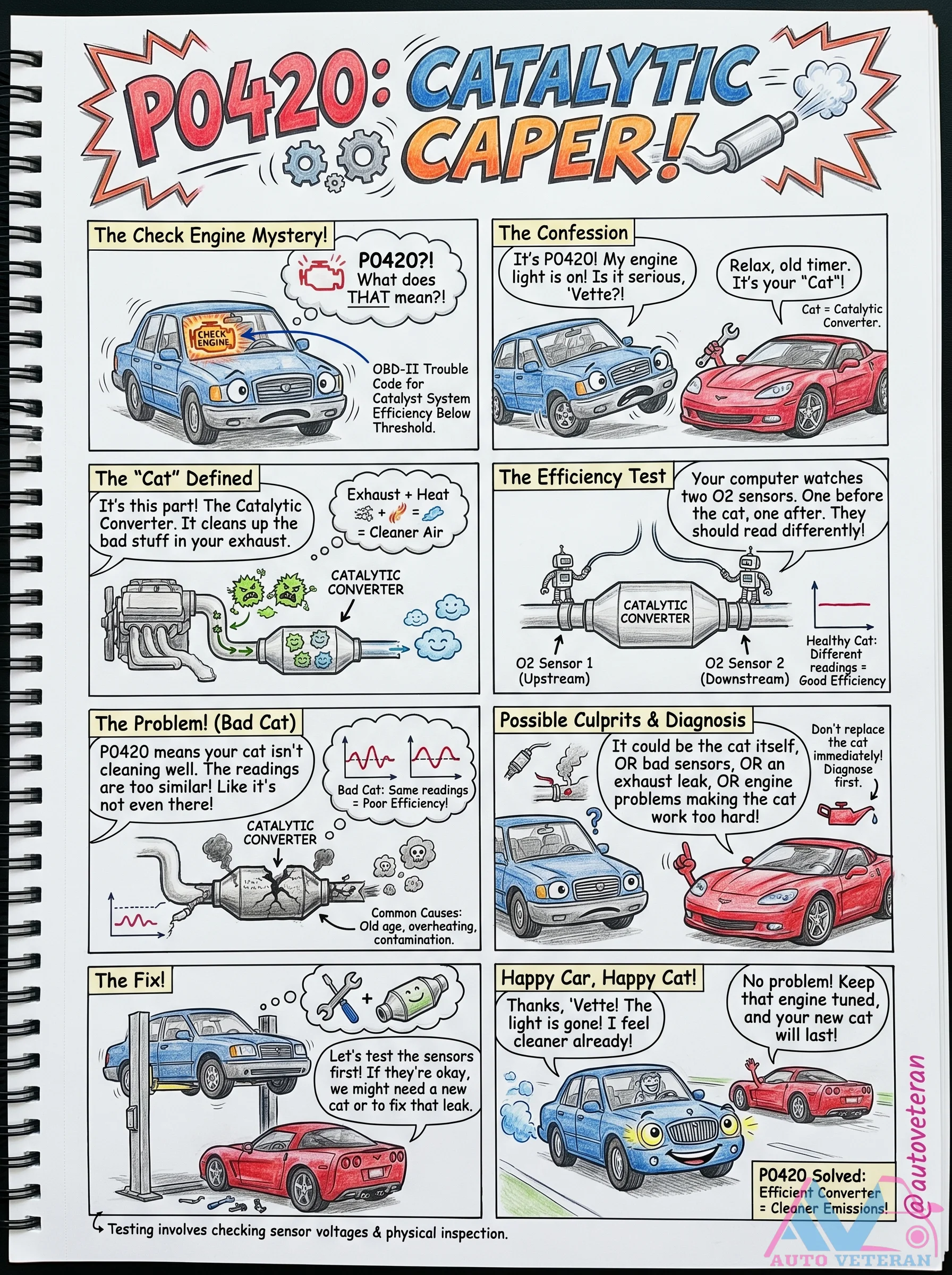
When your check engine light illuminates with code P0420, it signals that your catalytic converter's efficiency has dropped below the required threshold. This occurs because the upstream and downstream oxygen sensors are reading too similarly, indicating the converter isn't properly cleaning exhaust gases. Before replacing the converter, you should test both oxygen sensors for proper voltage readings, inspect for exhaust leaks, and ensure your engine isn't running too rich or lean, which can overwork the catalytic converter. Common causes include age, overheating from misfires, or contamination from oil or coolant entering the exhaust system. A properly functioning catalytic converter will show different readings between the two sensors, while a failing one shows similar readings. Once diagnosed and fixed, your engine light will clear, emissions will improve, and your vehicle will run cleaner and more efficiently.
P0420 DTC Code Catalyst System Efficiency Explained
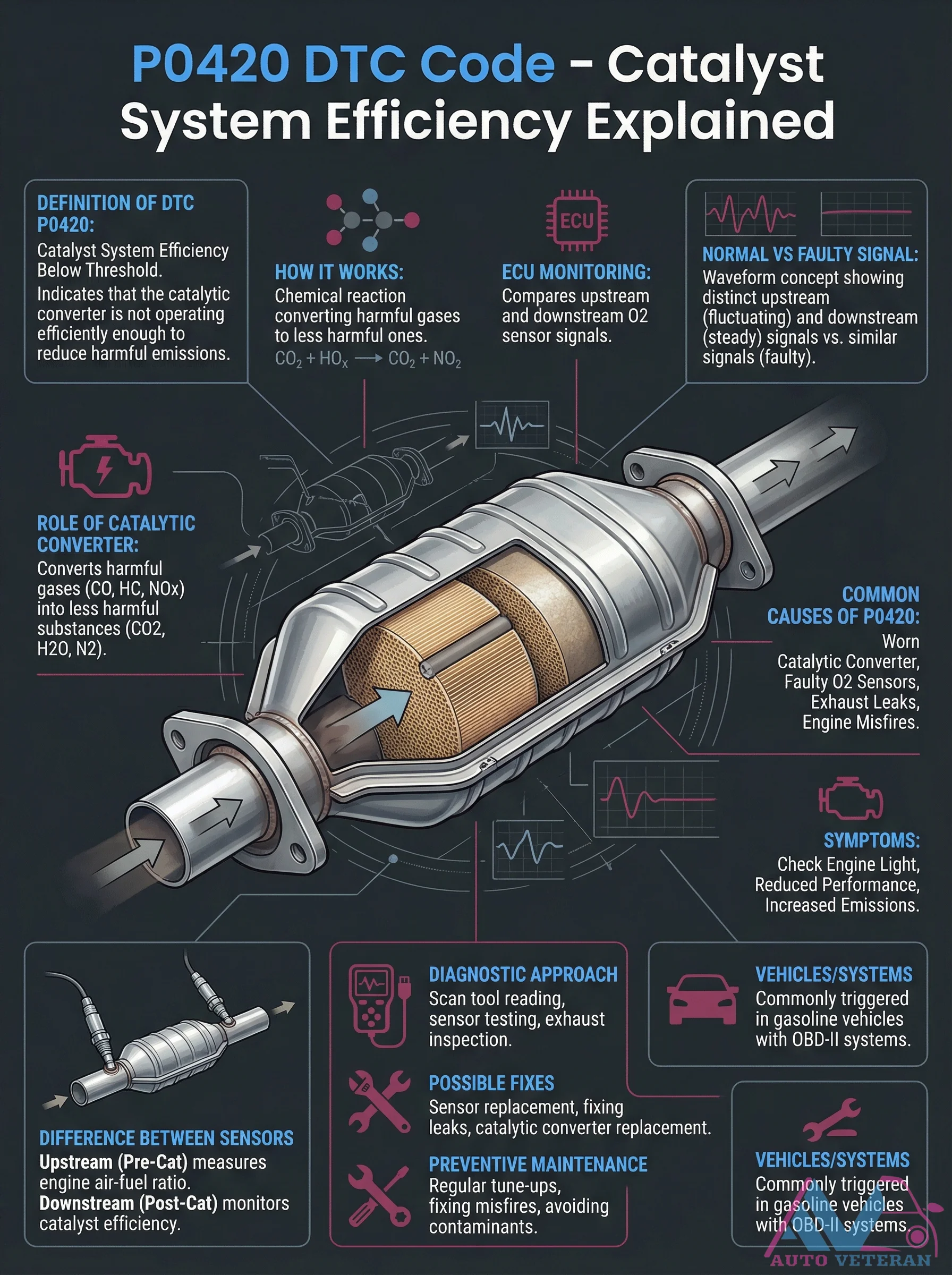
The P0420 diagnostic trouble code indicates that your vehicle's catalytic converter is operating below its efficiency threshold, failing to properly convert harmful exhaust gases like CO, HC, and NOx into less harmful substances such as CO2, H2O, and N2. This occurs when the engine control unit detects insufficient difference between the fluctuating upstream oxygen sensor signal and the steady downstream sensor signal, signaling reduced catalyst performance. Common causes include a worn catalytic converter, faulty oxygen sensors, exhaust leaks, or engine misfires, leading to symptoms like illuminated check engine lights, reduced engine performance, and increased emissions. Diagnostic approaches involve using scan tools to monitor sensor waveforms, testing oxygen sensors, and inspecting the exhaust system, with possible fixes ranging from sensor replacement to catalytic converter replacement. Preventive maintenance through regular tune ups, addressing misfires promptly, and avoiding contaminants can help prevent this code from triggering in gasoline vehicles with OBD II systems.
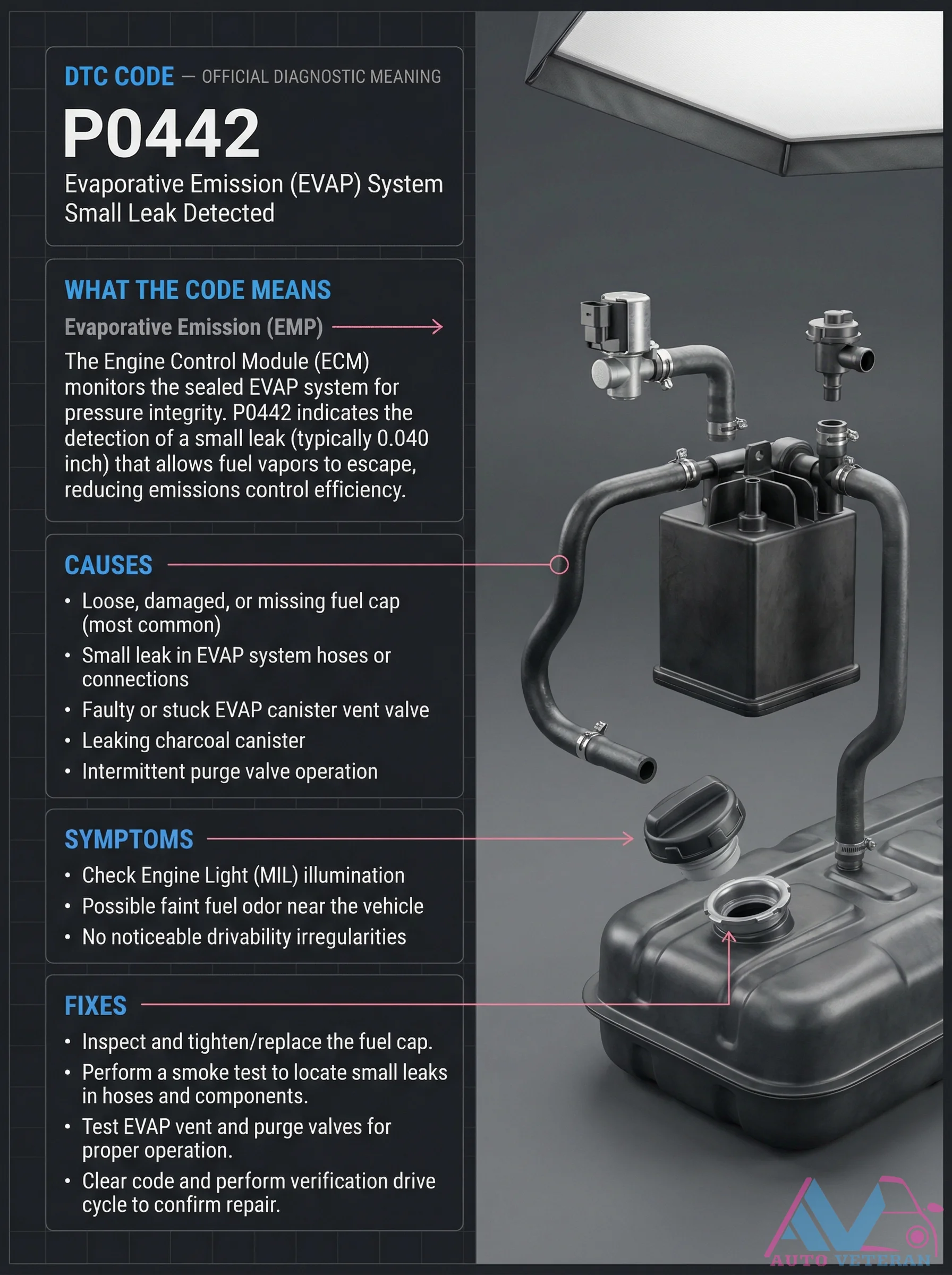
P0442 EVAP System Small Leak Diagnosis
Diagnostic trouble code P0442 indicates the Engine Control Module has detected a small leak in the evaporative emission system, typically around 0.040 inches in size. This leak allows fuel vapors to escape, compromising emissions control efficiency. Common causes include loose or damaged fuel caps, small leaks in EVAP hoses or connections, faulty vent or purge valves, or leaking charcoal canisters. Symptoms primarily involve Check Engine Light illumination with possible faint fuel odors, though drivability usually remains unaffected. Diagnosis involves inspecting and tightening the fuel cap, performing smoke tests to locate leaks, testing vent and purge valve operation, then clearing codes and completing verification drive cycles.
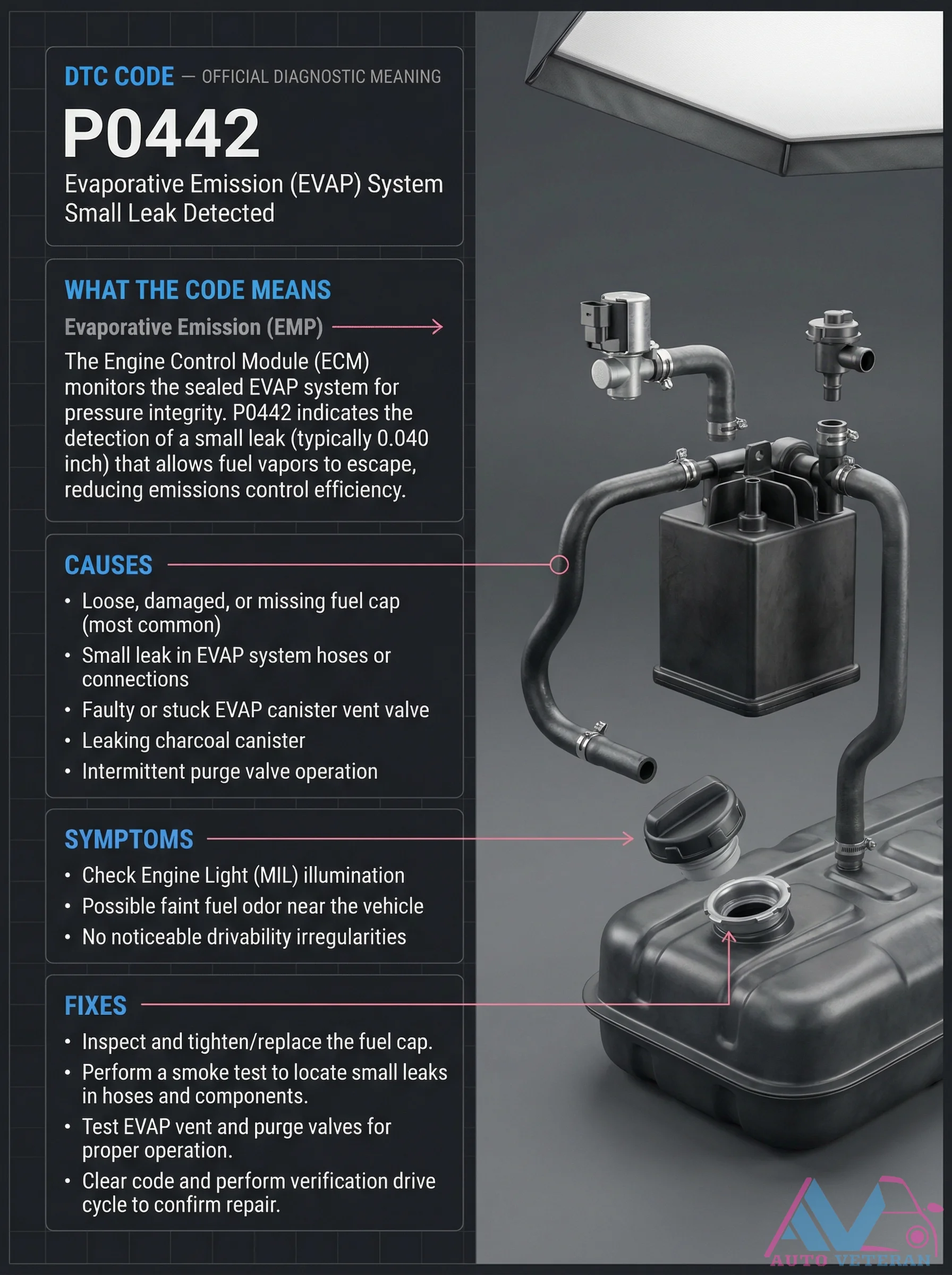
P0442 EVAP System Small Leak DTC Diagnosis
The P0442 diagnostic trouble code specifically indicates a small leak in the vehicle's evaporative emission system, typically around 0.040 inch in size, that allows fuel vapors to escape and reduces emissions control efficiency. This code triggers when the Engine Control Module detects pressure integrity issues in the sealed EVAP system, most commonly caused by a loose, damaged, or missing fuel cap, small leaks in hoses or connections, faulty vent or purge valves, or a leaking charcoal canister. Symptoms include Check Engine Light illumination, possible faint fuel odor near the vehicle, but typically no noticeable drivability irregularities. Proper diagnosis involves inspecting and tightening or replacing the fuel cap, performing a smoke test to locate small leaks, testing EVAP vent and purge valves for proper operation, then clearing the code and performing a verification drive cycle to confirm the repair.
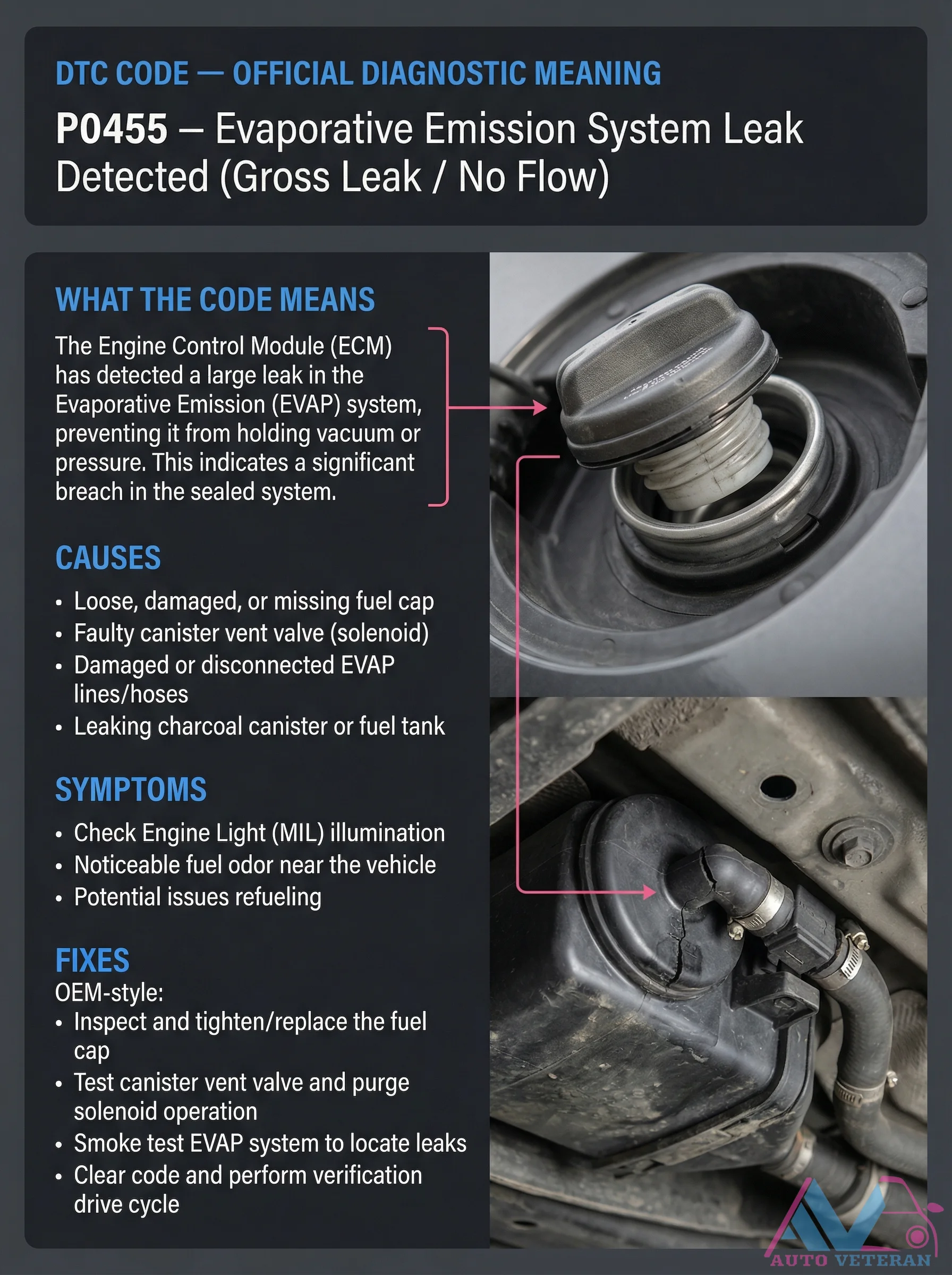
P0455 EVAP System Gross Leak Diagnostic Code
Diagnostic Trouble Code P0455 signals a major leak in your vehicle's Evaporative Emission system, where the Engine Control Module detects an inability to maintain vacuum or pressure due to a significant breach. Common causes include a loose or damaged fuel cap, faulty canister vent valve, damaged EVAP lines, or leaks in the charcoal canister or fuel tank. Symptoms typically involve an illuminated Check Engine Light, noticeable fuel odors near the vehicle, and potential refueling issues. Fixes involve inspecting and tightening or replacing the fuel cap, testing the canister vent valve and purge solenoid, performing a smoke test to locate leaks, and clearing the code with a verification drive cycle.
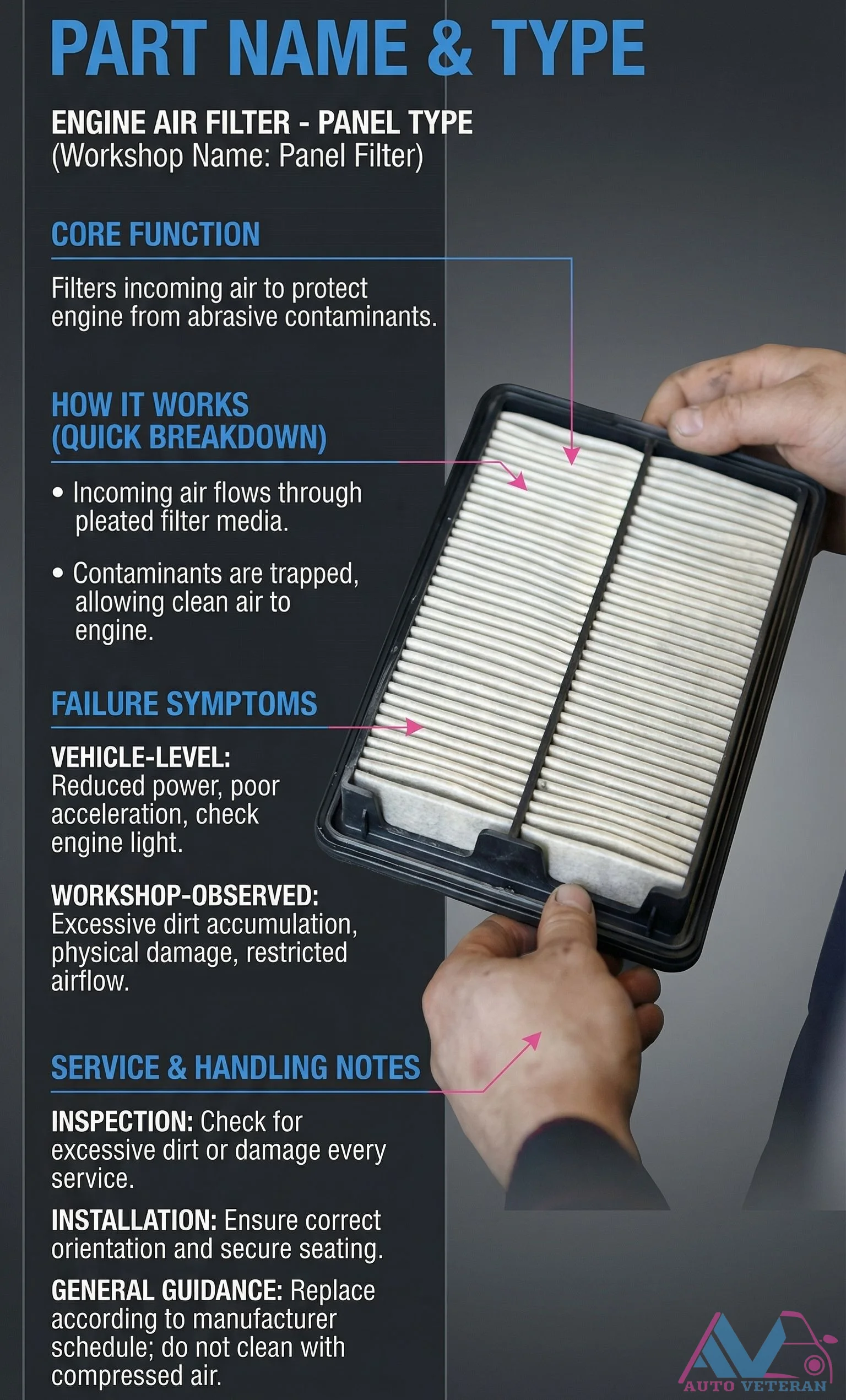
Panel Type Engine Air Filter Failure Symptoms and Service
The panel type engine air filter, also known as a panel filter, serves the critical function of filtering incoming air to protect the engine from abrasive contaminants. It operates by directing air through pleated media that traps contaminants while allowing clean air to flow to the engine. When this filter fails, vehicle level symptoms include reduced power, poor acceleration, and illumination of the check engine light. In the workshop, technicians observe excessive dirt accumulation, physical damage, and restricted airflow. Proper service involves inspecting for excessive dirt or damage during each service interval, ensuring correct orientation and secure seating during installation, and replacing according to the manufacturer's schedule. It is important to note that cleaning with compressed air is not recommended.