Interactive Explorer
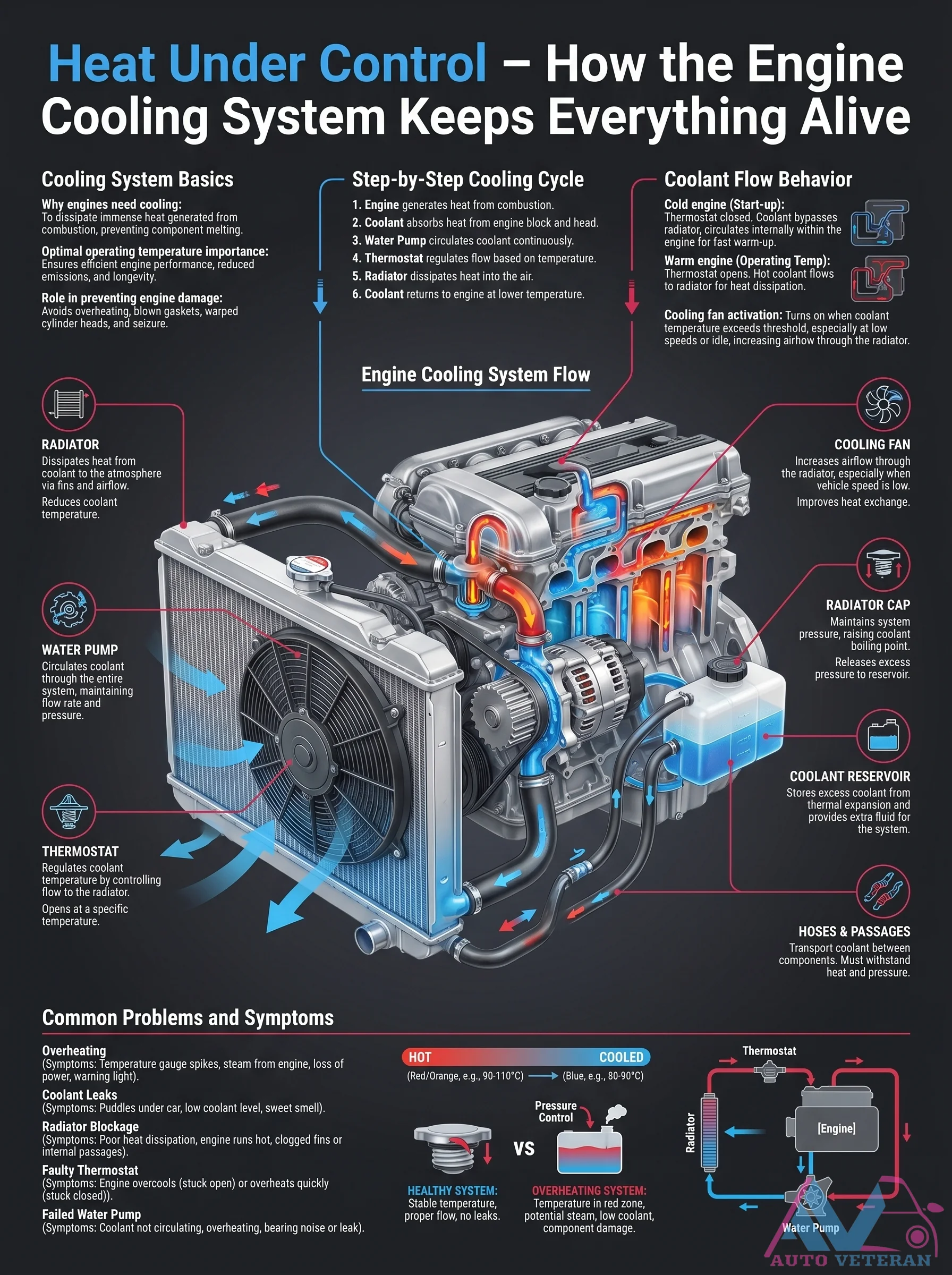
Cooling System Step-by-Step Flow Cycle
The engine cooling system operates in a continuous cycle: coolant absorbs heat from the block and head, then flows to the radiator where the cooling fan and airflow dissipate that heat. The thermostat regulates flow based on temperature; during cold start it remains closed to warm the engine quickly, then opens to allow full circulation once operating temperature is reached. The water pump drives coolant through passages and hoses, while the radiator cap maintains system pressure to raise the boiling point and prevents boilover. Understanding this flow helps diagnose overheating, leaks, and thermostat failures.
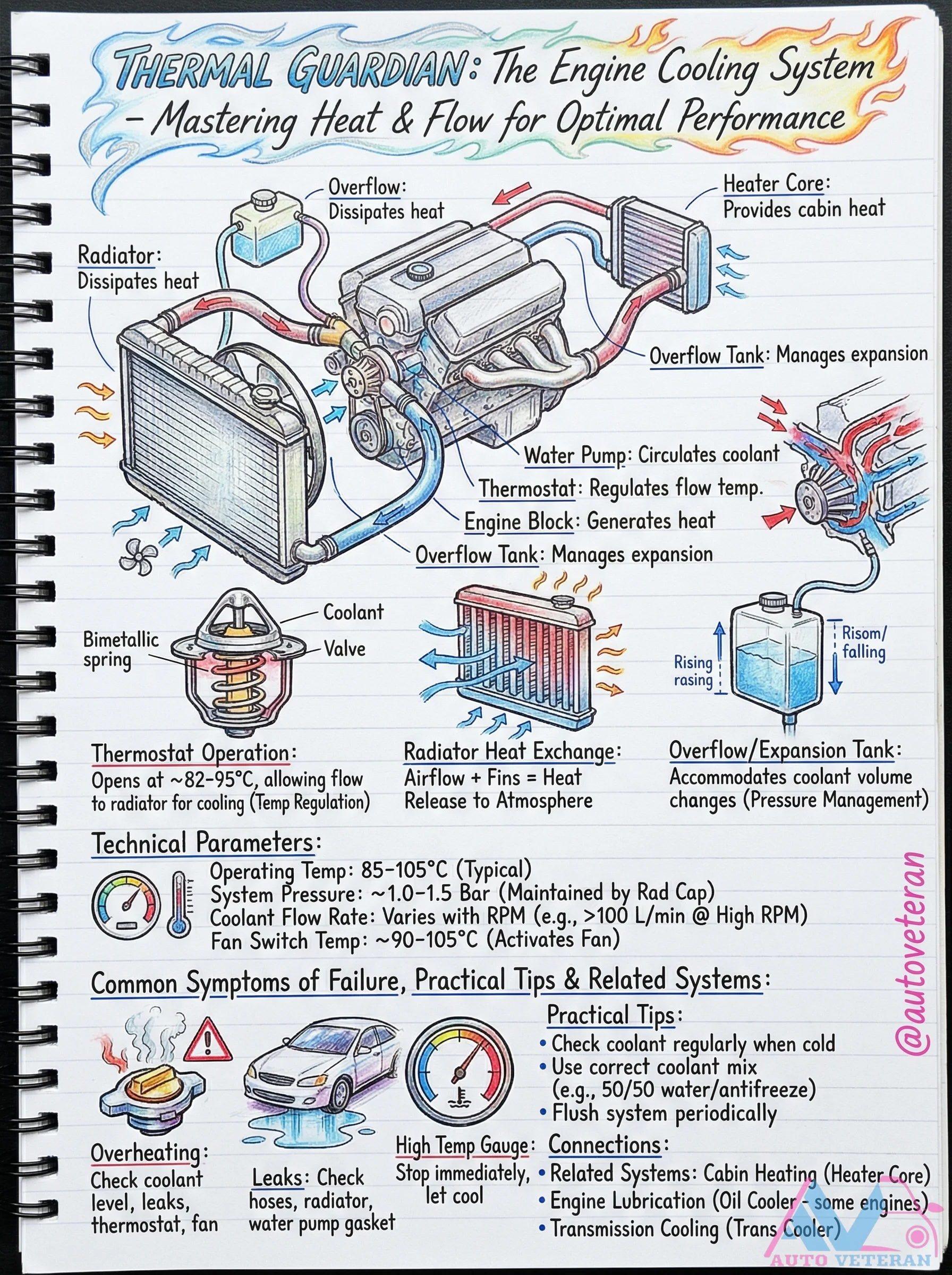
Cooling System Thermal Guardian Operation and Parameters
The engine's thermal guardian system expertly manages heat and flow through coordinated components like the radiator, water pump, and thermostat, which opens at 82-95°C to regulate coolant flow. Operating within 85-105°C at 1.0-1.5 bar pressure, with flow rates up to 2100 L/min at high RPM, it prevents overheating while supporting cabin heating and related systems. Common failure symptoms include leaks and overheating, emphasizing the need for regular coolant checks and proper 50/50 antifreeze mixtures.
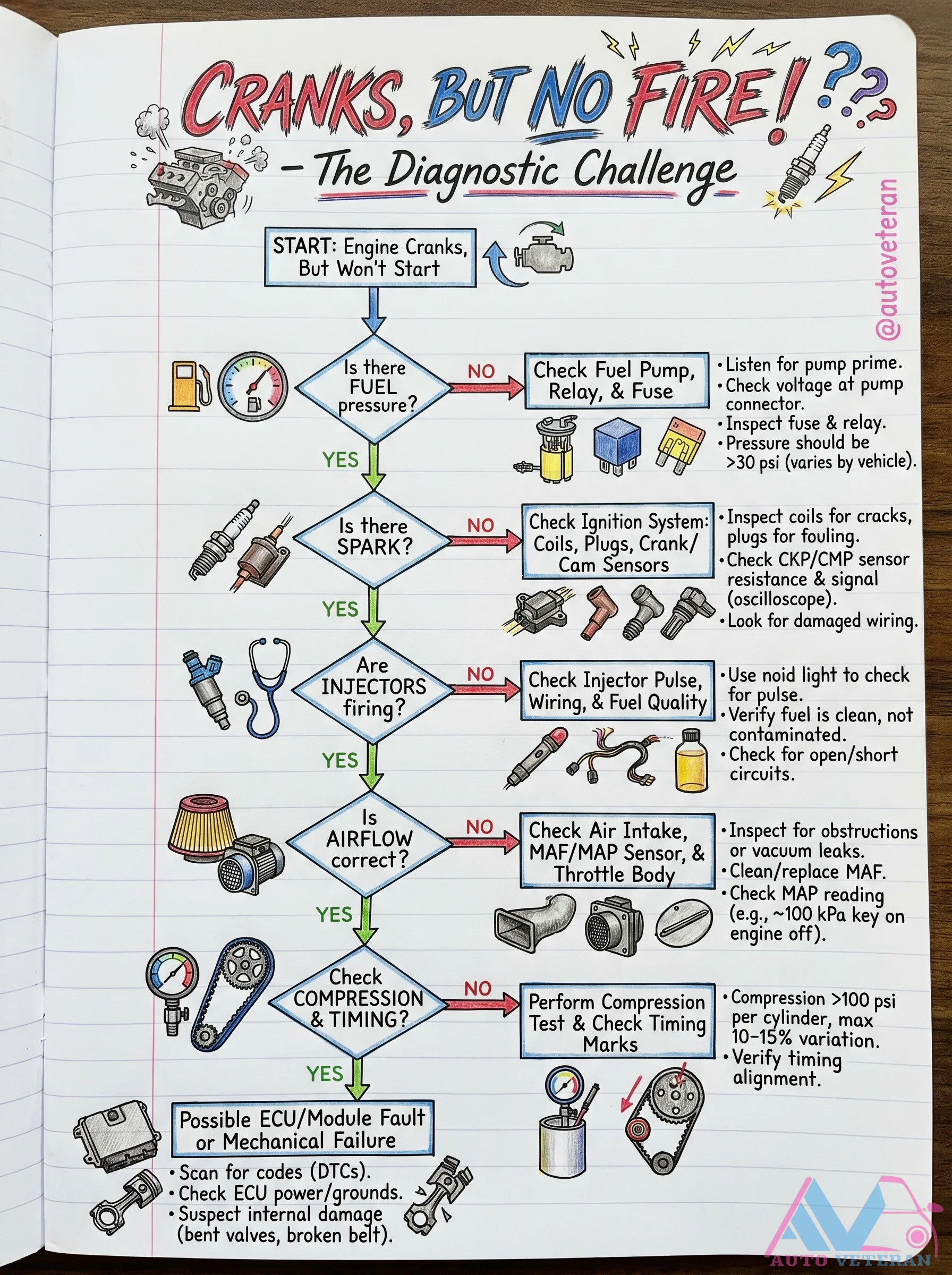
Cranks No Fire Diagnostic Flowchart
This troubleshooting guide walks through the systematic process for an engine that cranks but refuses to start. Starting with verifying no fuel pump prime and no spark, each branch tests fuel pressure, ignition system components like coils and crank/cam sensors, injector pulse with a noid light, and air intake integrity including MAF/MAP sensor readings. The chart ends with compression and timing checks to rule out mechanical failures or ECU faults, covering every angle from simple fuses to internal engine damage.
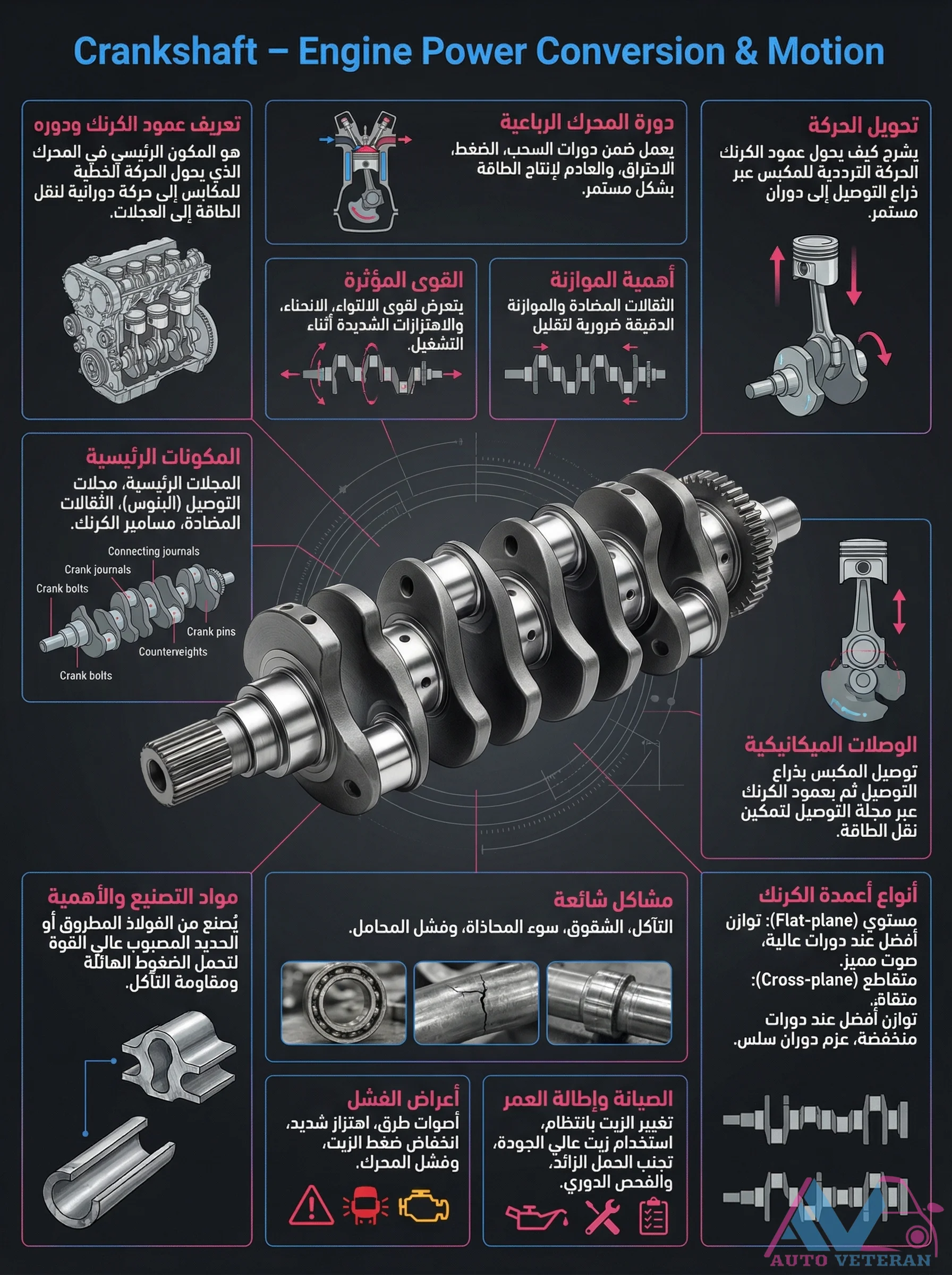
Crankshaft Cross-Plane vs Flat-Plane Designs
The crankshaft converts piston motion into rotational power, with two primary designs offering distinct characteristics. Cross-plane crankshafts provide superior balance and smooth operation, making them ideal for street vehicles and torque-focused applications. Flat-plane crankshafts deliver higher revving capability and quicker throttle response, favored in high-performance racing engines. Understanding these differences helps in selecting the right configuration for specific engine requirements, balancing factors like vibration, power delivery, and application needs.
Crankshaft Journal Types and Failure Modes
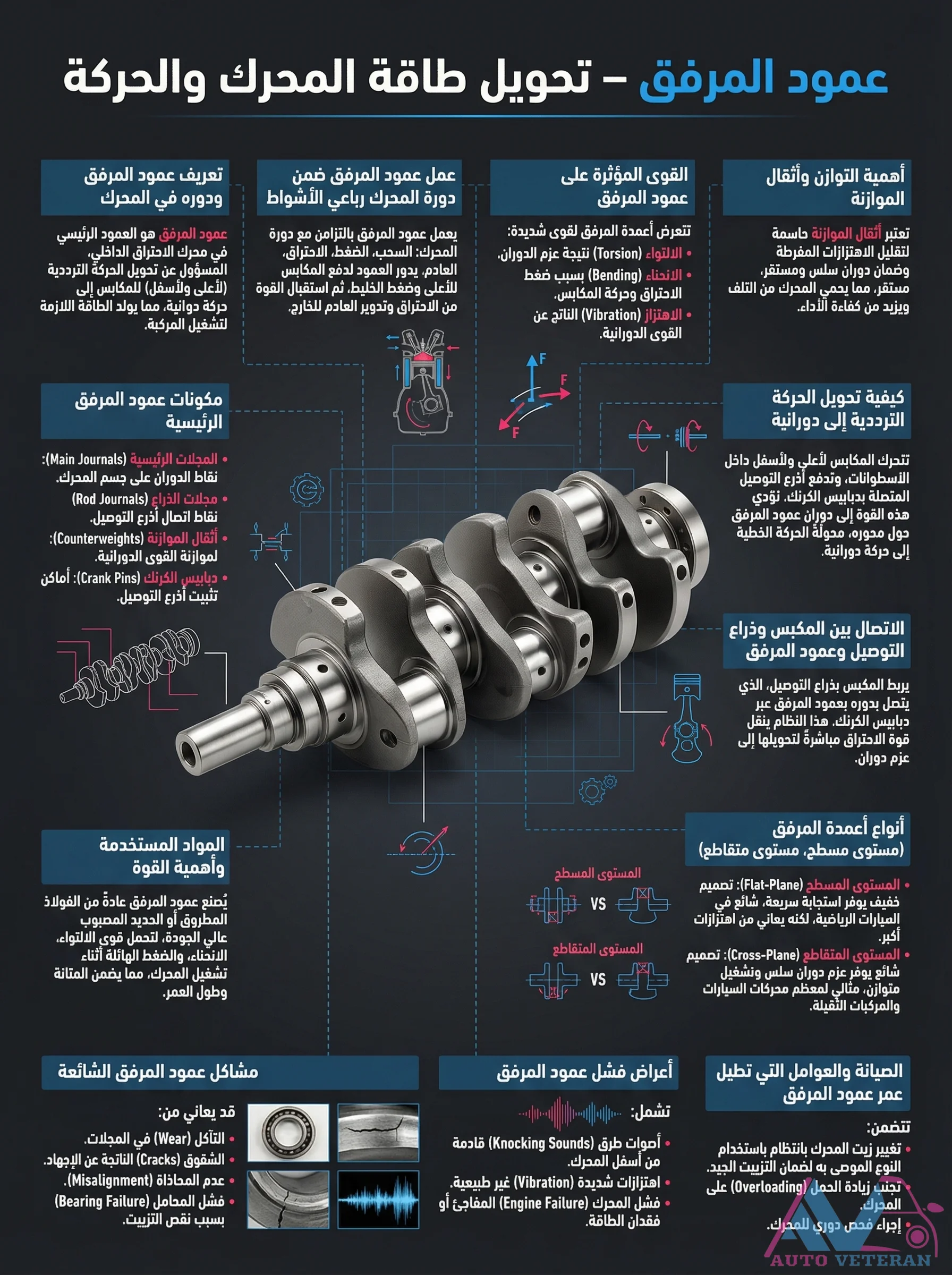
Crankshafts feature main journals and rod journals that connect to engine bearings, with counterweights balancing rotational forces. Common failure modes include wear on journals leading to knocking sounds, cracks from stress, misalignment causing vibration, overloading, bearing failure, and eventual engine failure. Flat plane and cross plane crankshaft designs differ in journal arrangement and performance characteristics.
Crankshaft Operation Forces Balancing and Failure Symptoms
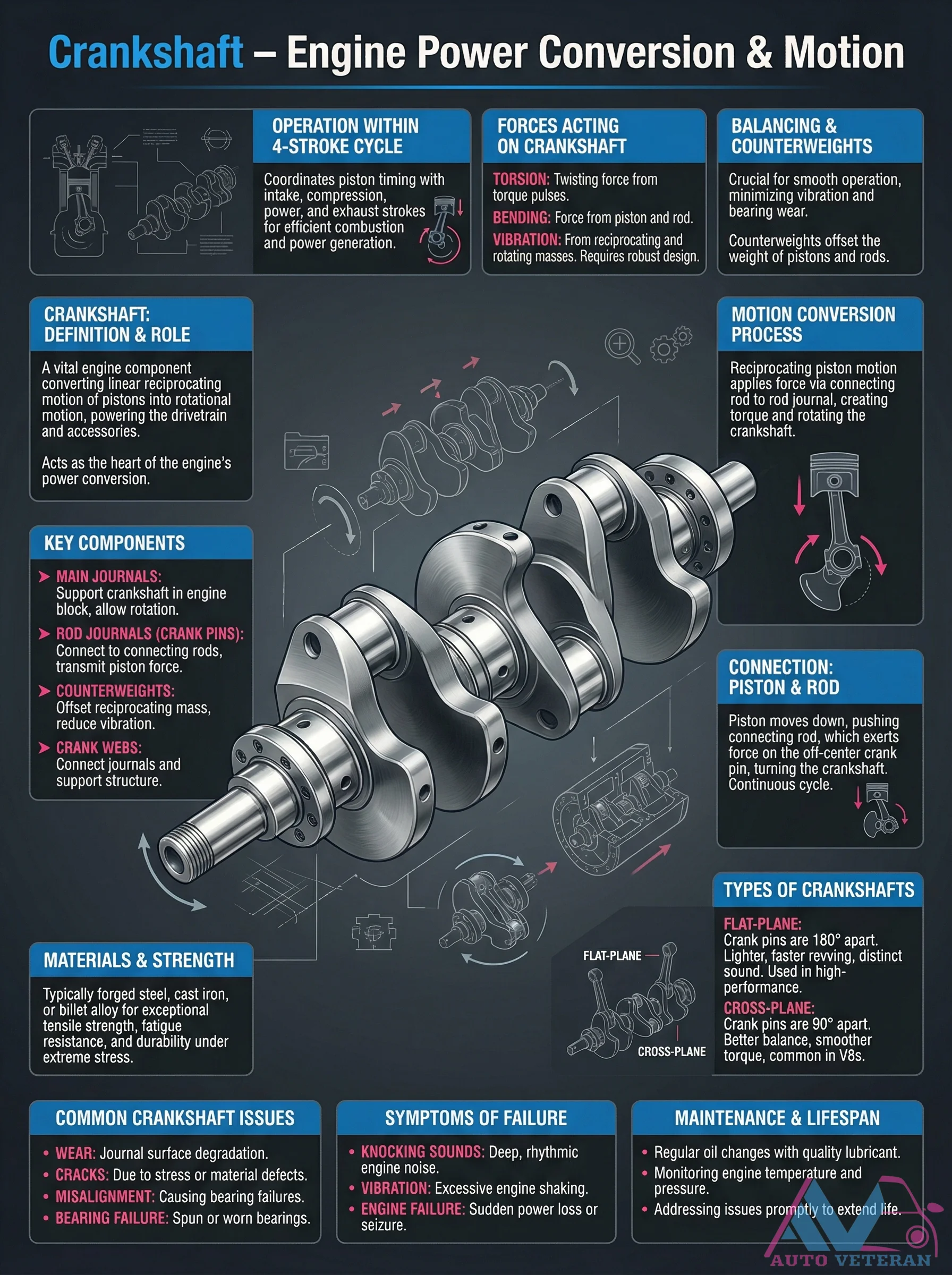
The crankshaft serves as the heart of an engine's power conversion system, transforming the linear reciprocating motion of pistons into rotational energy that drives the drivetrain and accessories. This complex component must withstand multiple forces including torsion from torque pulses, bending from piston and rod forces, and vibration from reciprocating masses. Counterweights strategically offset piston and rod weight to minimize vibration and bearing wear, while robust materials like forged steel or billet alloy provide exceptional tensile strength and fatigue resistance. Common failure symptoms include deep rhythmic knocking sounds, excessive engine vibration, and sudden power loss or seizure, often resulting from journal wear, cracks due to stress, misalignment, or bearing failure. Proper maintenance with regular oil changes and prompt issue resolution can significantly extend crankshaft lifespan.
Crankshaft Operation Forces Balancing and Types
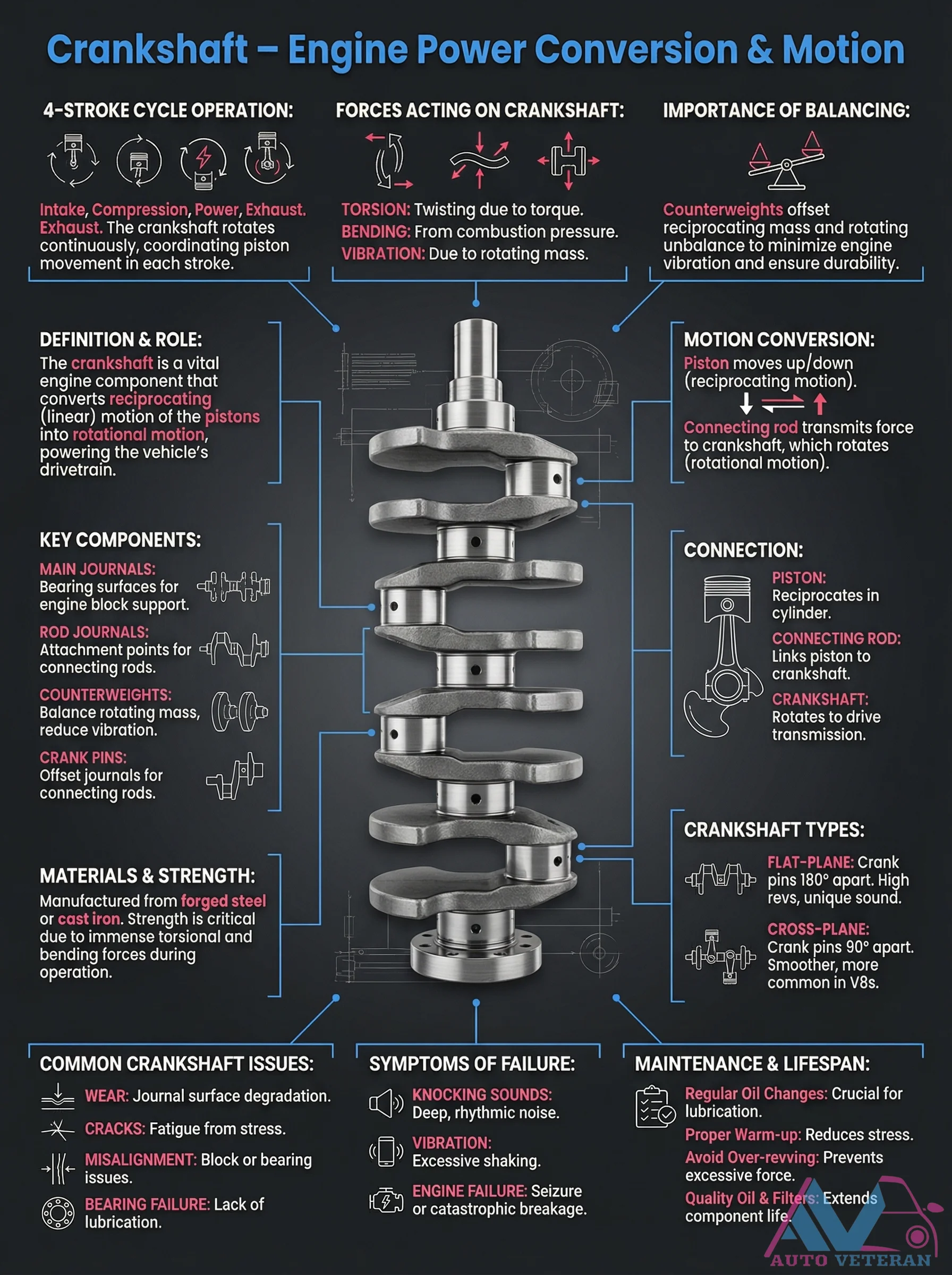
The crankshaft serves as the heart of engine power conversion, transforming the reciprocating motion of pistons into rotational force that drives the vehicle. This intricate component faces immense torsional and bending forces during the four stroke cycle operation, requiring precise balancing through counterweights to minimize vibration and ensure durability. Key elements include main journals for block support, rod journals for connecting rod attachment, and crank pins with specific offset designs. Two primary crankshaft types exist: flat plane configurations with crank pins 180 degrees apart for high revving performance and distinctive sound, and cross plane designs with 90 degree spacing for smoother operation commonly found in V8 engines. Common issues include journal wear, cracks from stress fatigue, bearing failure from inadequate lubrication, and misalignment problems, with symptoms manifesting as deep knocking sounds, excessive vibration, or catastrophic engine seizure. Proper maintenance through regular oil changes, quality lubrication, proper warm up procedures, and avoiding over revving are critical for extending the crankshaft's lifespan and preventing premature failure.
Critical Engine Sensors Failure Symptoms Guide
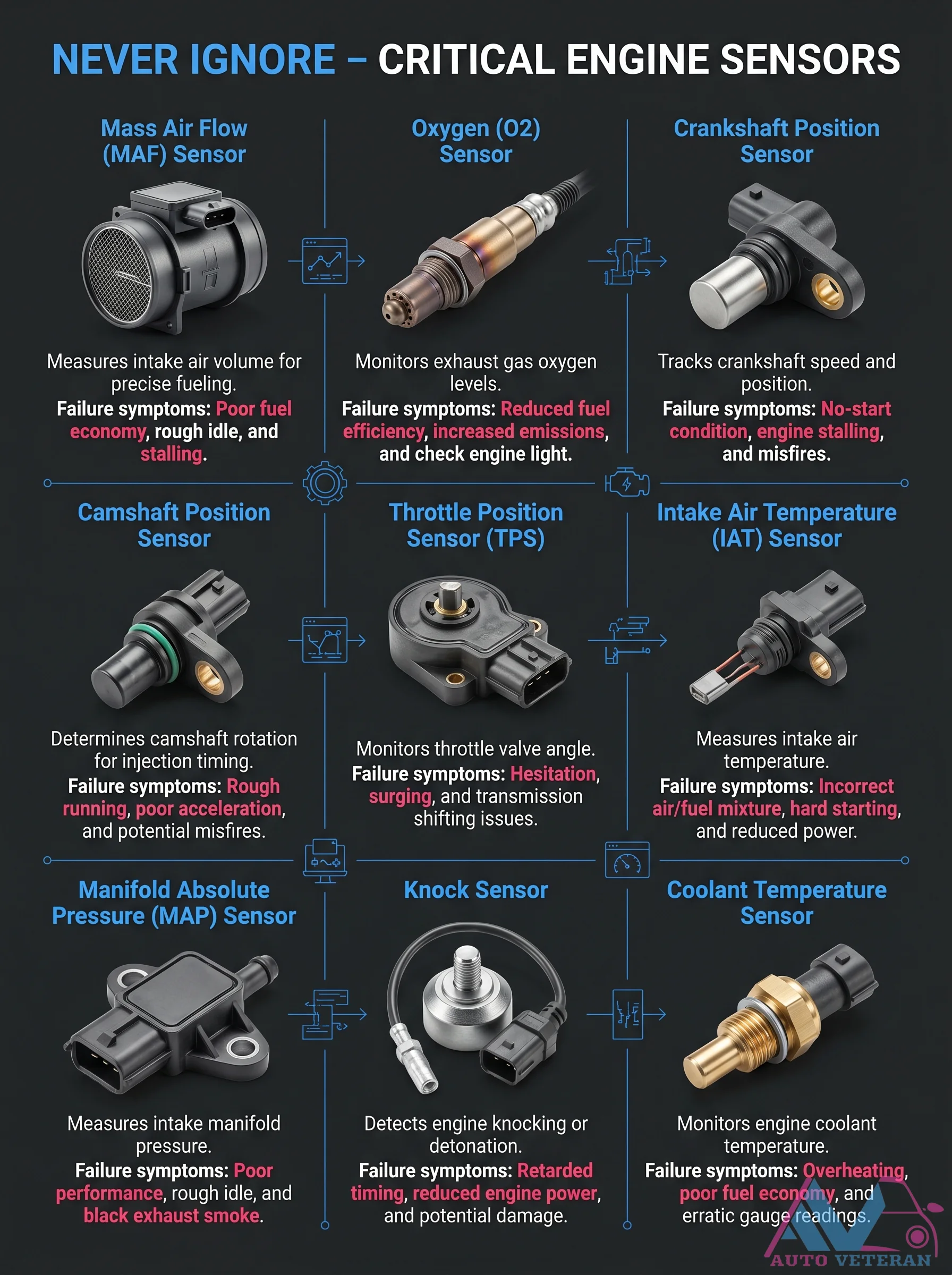
This comprehensive guide details the specific failure symptoms for six essential engine sensors: the Mass Air Flow sensor causing poor fuel economy, rough idle, and stalling; the Oxygen sensor leading to reduced fuel efficiency and increased emissions; the Crankshaft Position sensor resulting in no start conditions and engine stalling; the Camshaft Position sensor causing hesitation, surging, and transmission shifting issues; the Throttle Position sensor creating rough running and poor acceleration; and the Knock sensor triggering retarded timing and reduced engine power. Understanding these distinct symptoms helps diagnose common engine performance problems accurately.
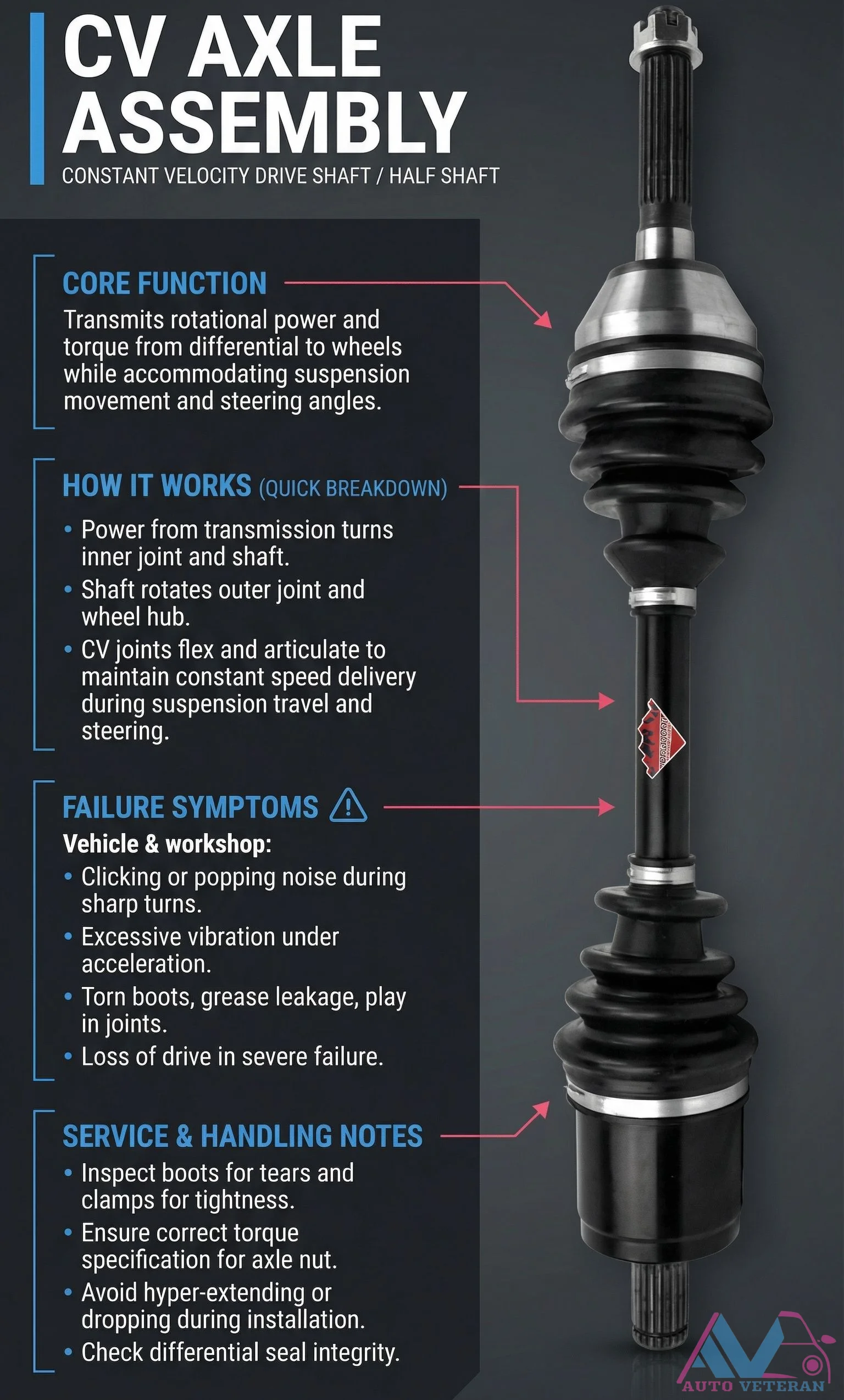
CV Axle Assembly Failure Symptoms and Service Notes
A Constant Velocity Axle Assembly transmits rotational power from the differential to the wheels while accommodating suspension movement and steering angles. Common failure symptoms include clicking or popping noises during sharp turns, excessive vibration under acceleration, torn boots with grease leakage, and play in the joints. Proper service requires inspecting boots for tears and clamps for tightness, ensuring correct torque specifications for the axle nut, avoiding hyper-extending or dropping during installation, and checking differential seal integrity to prevent severe drive loss.
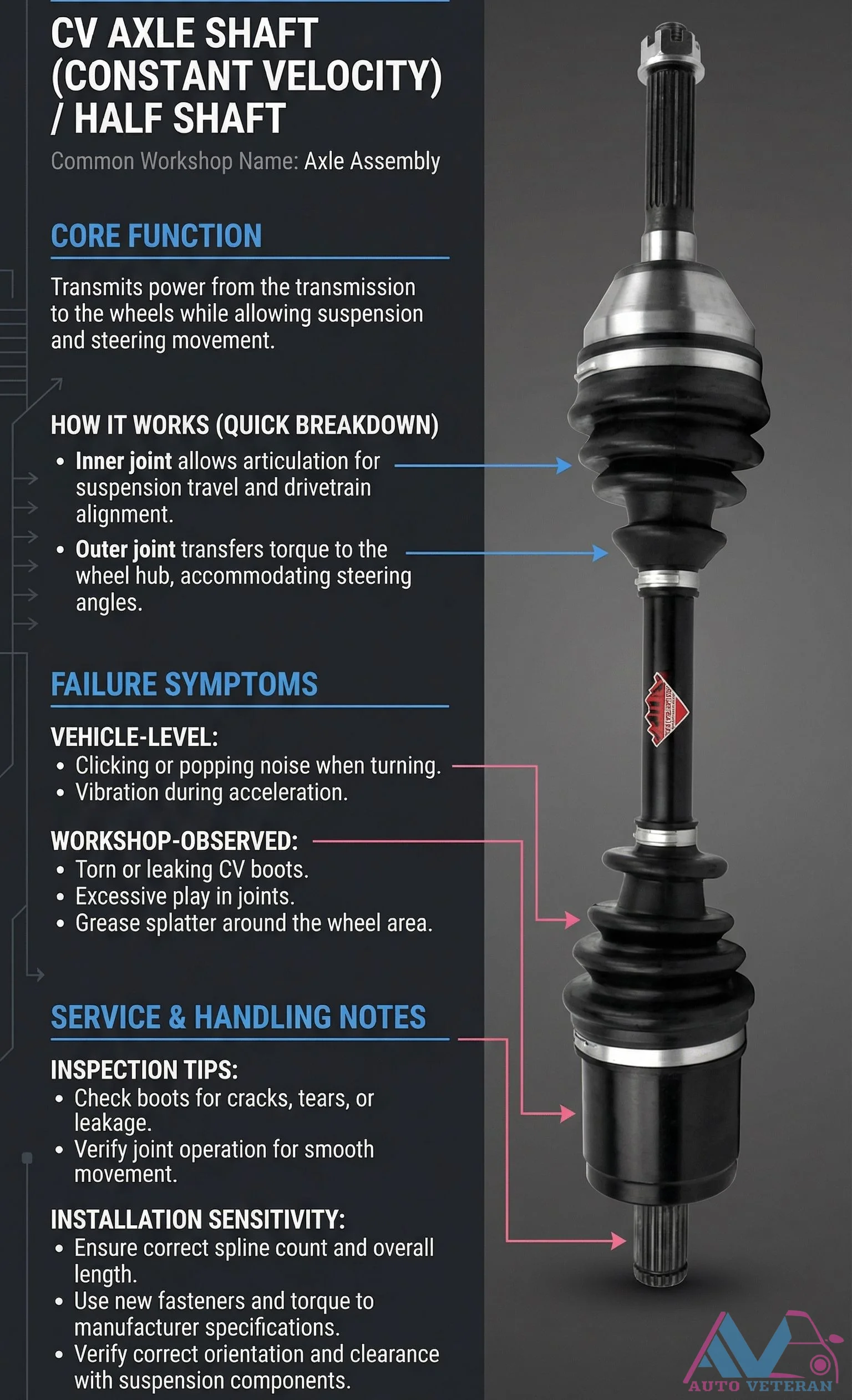
CV Axle Shaft Failure Symptoms and Inspection Tips
A CV axle shaft, also known as a half shaft or axle assembly, transmits power from the transmission to the wheels while accommodating suspension and steering movement. Common failure symptoms include clicking or popping noises when turning, vibration during acceleration, torn or leaking CV boots, excessive play in joints, and grease splatter around the wheel area. For inspection, check boots for cracks, tears, or leakage, and verify joint operation for smooth movement. Proper installation requires ensuring correct spline count and overall length, using new fasteners torqued to manufacturer specifications, and verifying correct orientation and clearance with suspension components.