Interactive Explorer
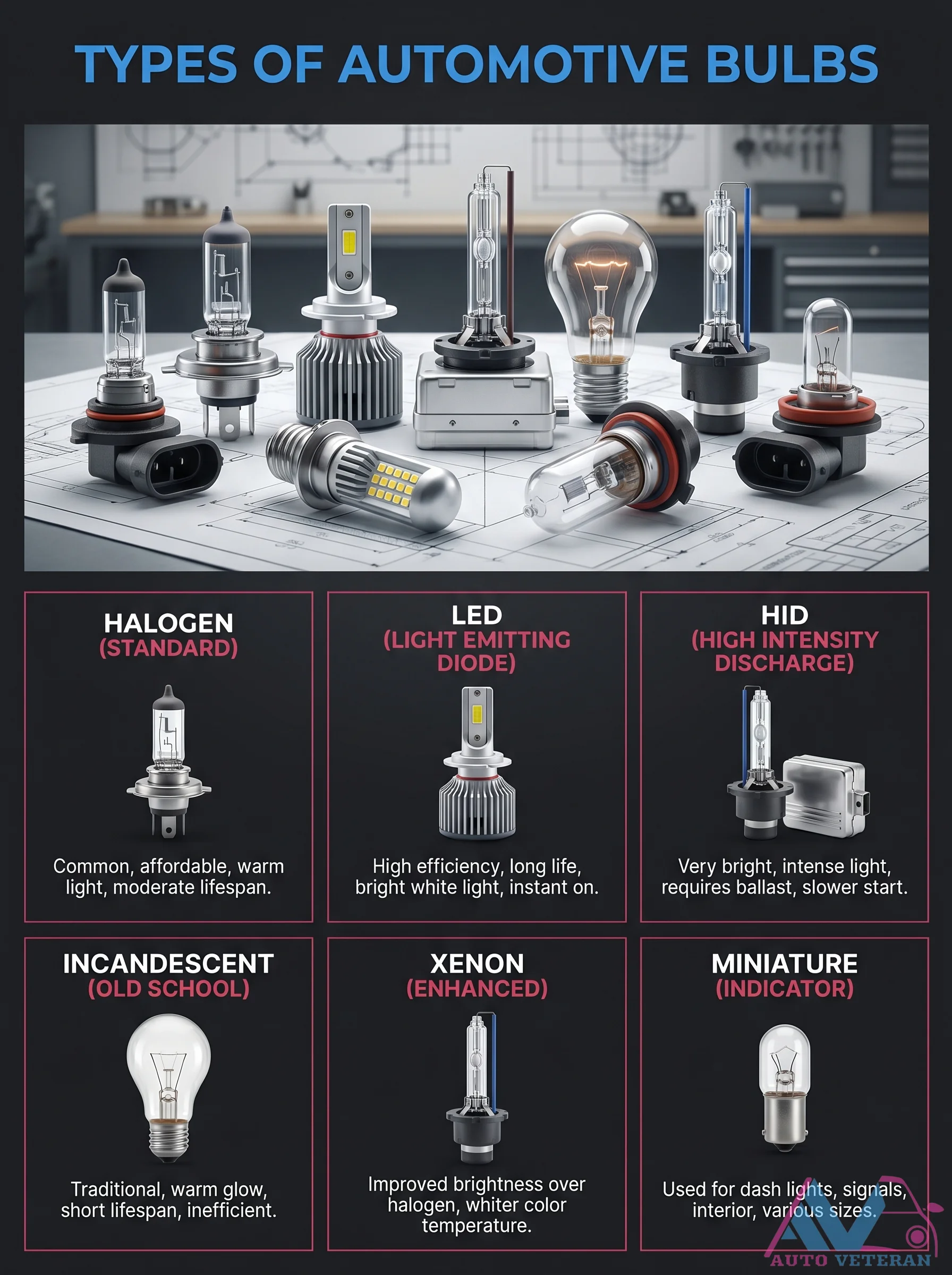
Automotive Bulb Types Comparison
Explore the four main types of automotive bulbs: Halogen, LED, HID, and Incandescent, plus Xenon and Miniature variants. Halogen bulbs offer common affordable warm light with moderate lifespan. LEDs provide high efficiency, long life, and bright white instant light. HIDs deliver intense bright light but require a ballast and have a slower start. Incandescent bulbs are traditional with warm light and short lifespan. Xenon enhances halogen with improved brightness and whiter color temperature. Miniature bulbs are used for dash lights, signals, and interior lighting in various sizes. Choose based on your needs for brightness, efficiency, and lifespan.
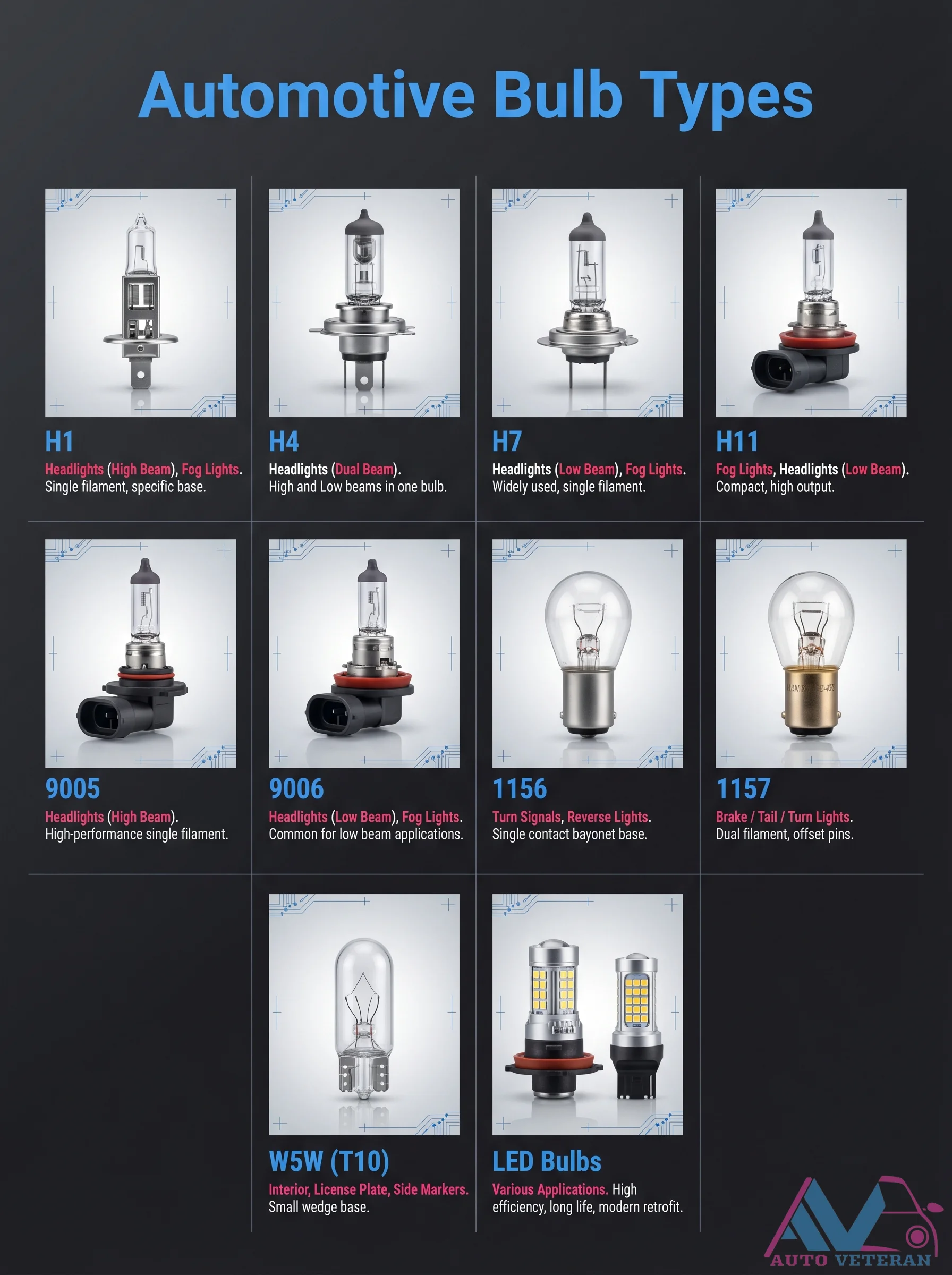
Automotive Bulb Types H1 H4 H7 H11 9005 9006
Understanding automotive bulb types is essential for proper vehicle lighting maintenance; this guide covers common headlight, fog light, and signal bulb specifications including H1, H4, H7, H11, 9005, and 9006 types, with details on single and dual filament designs, specific base configurations, and applications for high beam, low beam, fog lights, and various signal functions.
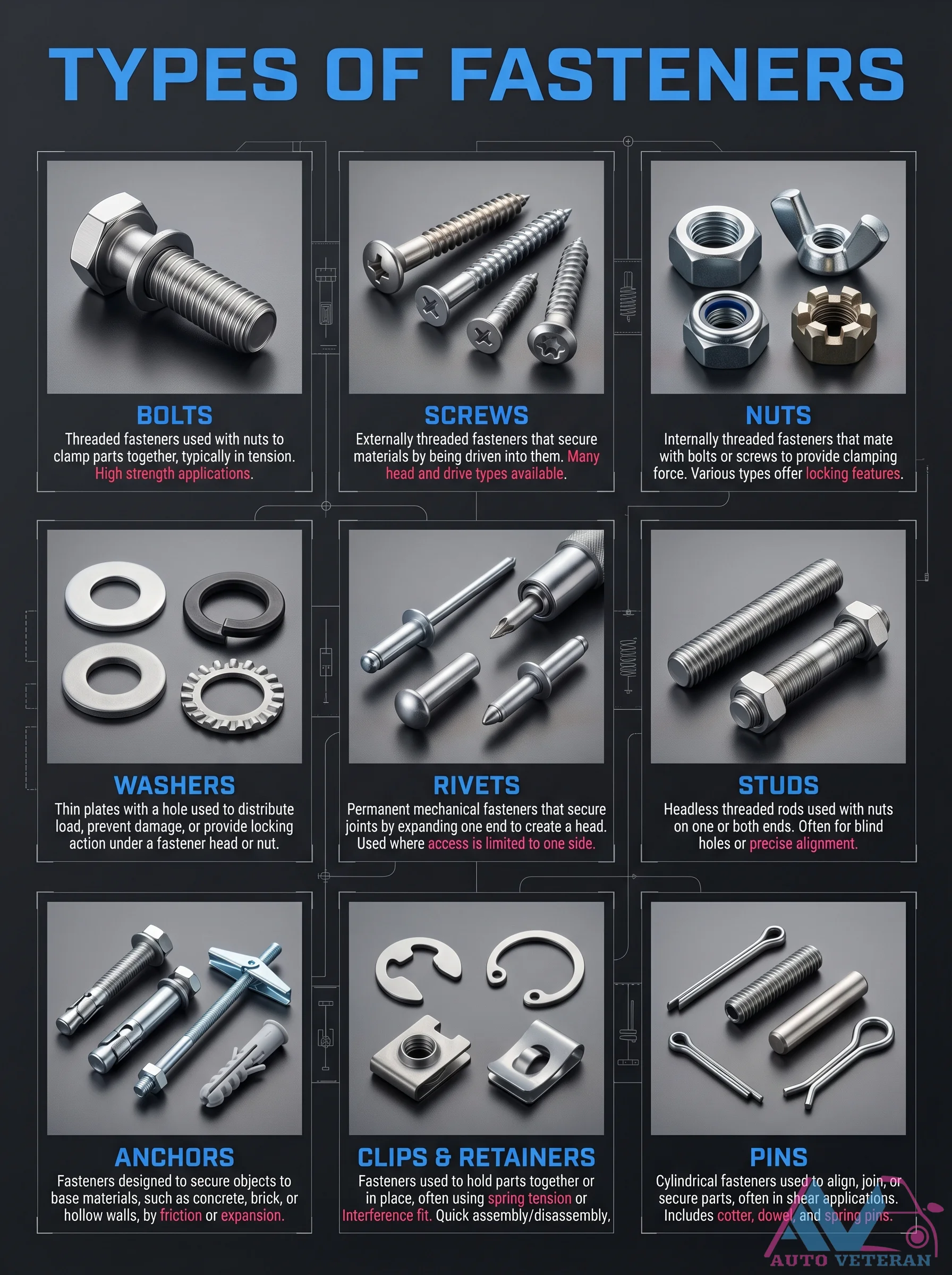
Automotive Fastener Types and Applications Guide
Automotive fasteners are essential for vehicle assembly and repair, each serving specific functions. Bolts work with nuts to clamp parts together under tension, ideal for high strength applications. Screws are externally threaded and driven into materials, available in various head and drive types. Nuts are internally threaded to mate with bolts or screws, often featuring locking mechanisms. Washers distribute loads and prevent damage under fastener heads. Rivets provide permanent joints by expanding one end, useful where access is limited. Studs are headless threaded rods used with nuts for precise alignment. Anchors secure objects to base materials like concrete through friction or expansion. Clips and retainers hold parts together using spring tension or interference fits. Pins, including cotter and dowel types, align, join, or secure parts for quick assembly and disassembly.
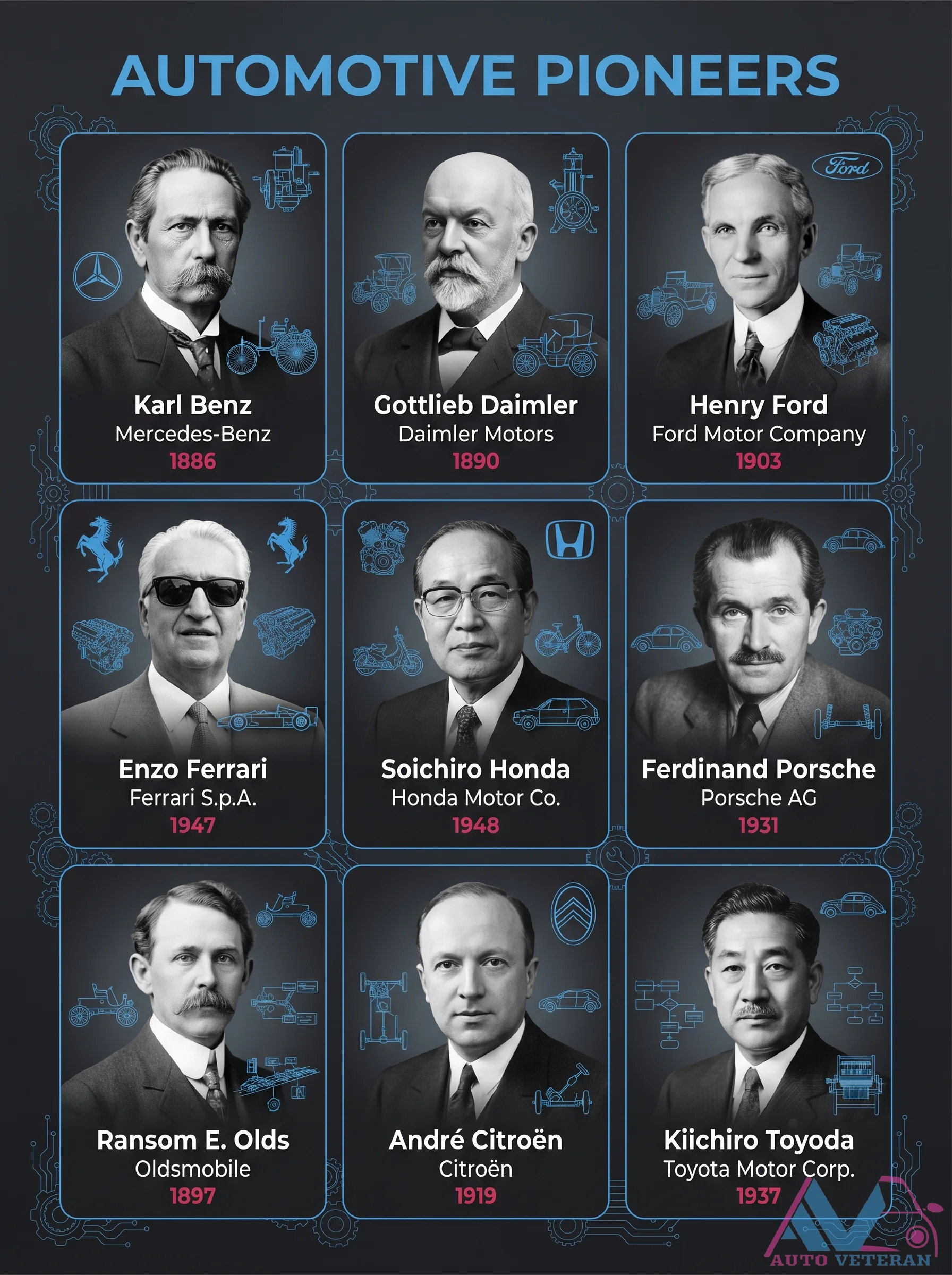
Automotive Pioneers and Their Company Founding Years
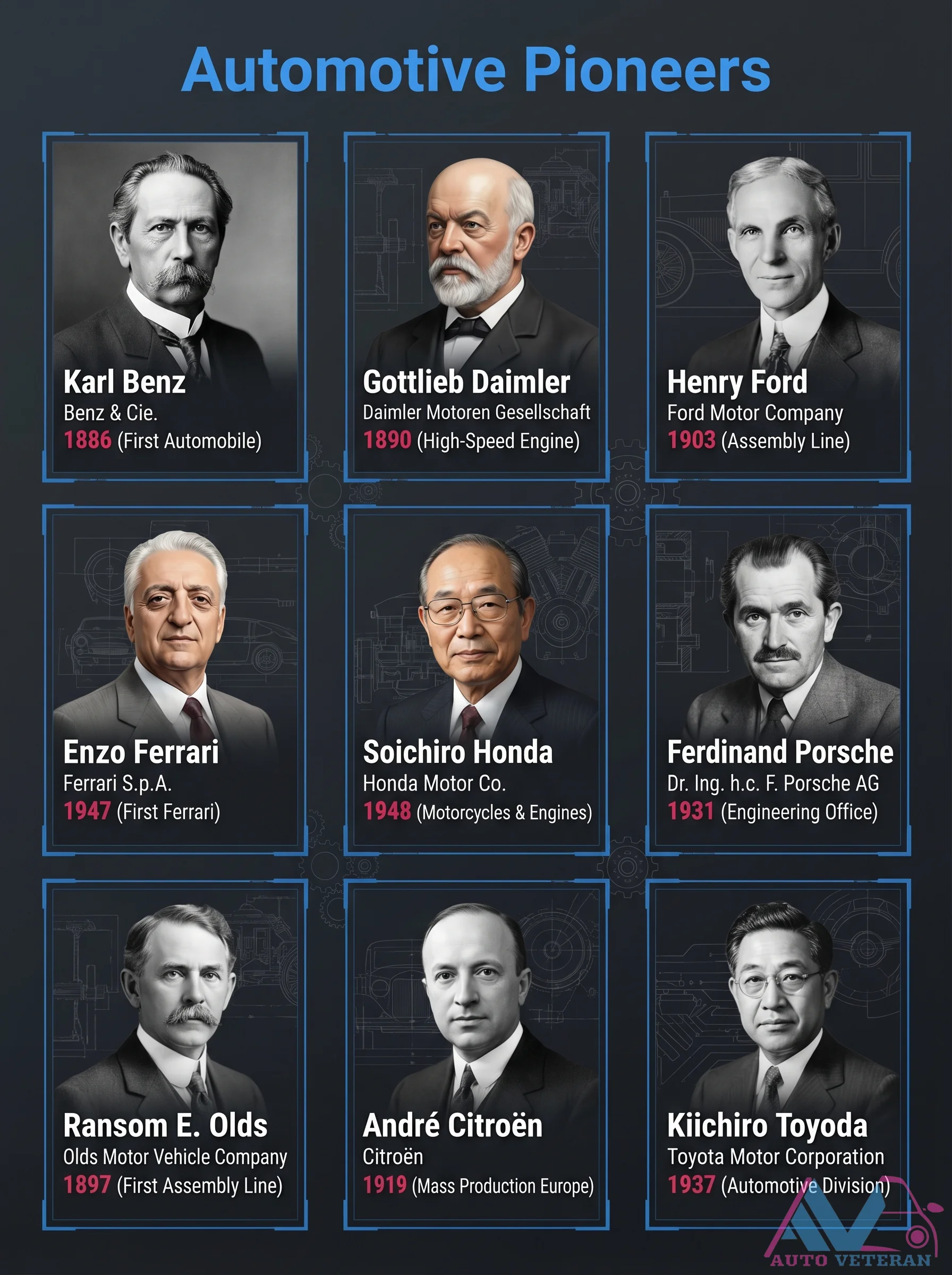
The timeline showcases key figures in automotive history alongside the founding years of their iconic companies, including Karl Benz with Mercedes-Benz in 1886, Gottlieb Daimler with Daimler Motors in 1890, Henry Ford with Ford Motor Company in 1903, Enzo Ferrari with Ferrari SpA in 1947, Soichiro Honda with Honda Motor Co. in 1948, Ferdinand Porsche with Porsche AG in 1931, Ransom E. Olds with Oldsmobile in 1897, Andre Citroen with Citroen in 1919, and Kiichiro Toyoda with Toyota Motor Corp in 1937.
Automotive Pioneers and Their Key Innovations Timeline
The timeline showcases groundbreaking automotive pioneers and their revolutionary contributions that shaped the industry. Karl Benz founded Benz & Cie. and created the first automobile in 1886. Gottlieb Daimler established Daimler Motoren Gesellschaft and developed the high-speed engine in 1890. Henry Ford founded Ford Motor Company and introduced the assembly line in 1903. Enzo Ferrari launched Ferrari S. with the first Ferrari in 1947. Soichiro Honda started Honda Motor Co. with motorcycles and engines in 1948. Ferdinand Porsche founded Dr. Ing. h.c. F Porsche AG from his engineering office in 1931. Ransom E. Olds created Olds Motor Vehicle Company and implemented the first assembly line in 1897. Andre Citroen established Citroen for mass production in Europe in 1919. Kiichiro Toyoda formed Toyota Motor Corporation's automotive division in 1937. Each pioneer brought distinct innovations that transformed transportation and manufacturing worldwide.
Automotive Soldering Basics, Process, and Common Mistakes
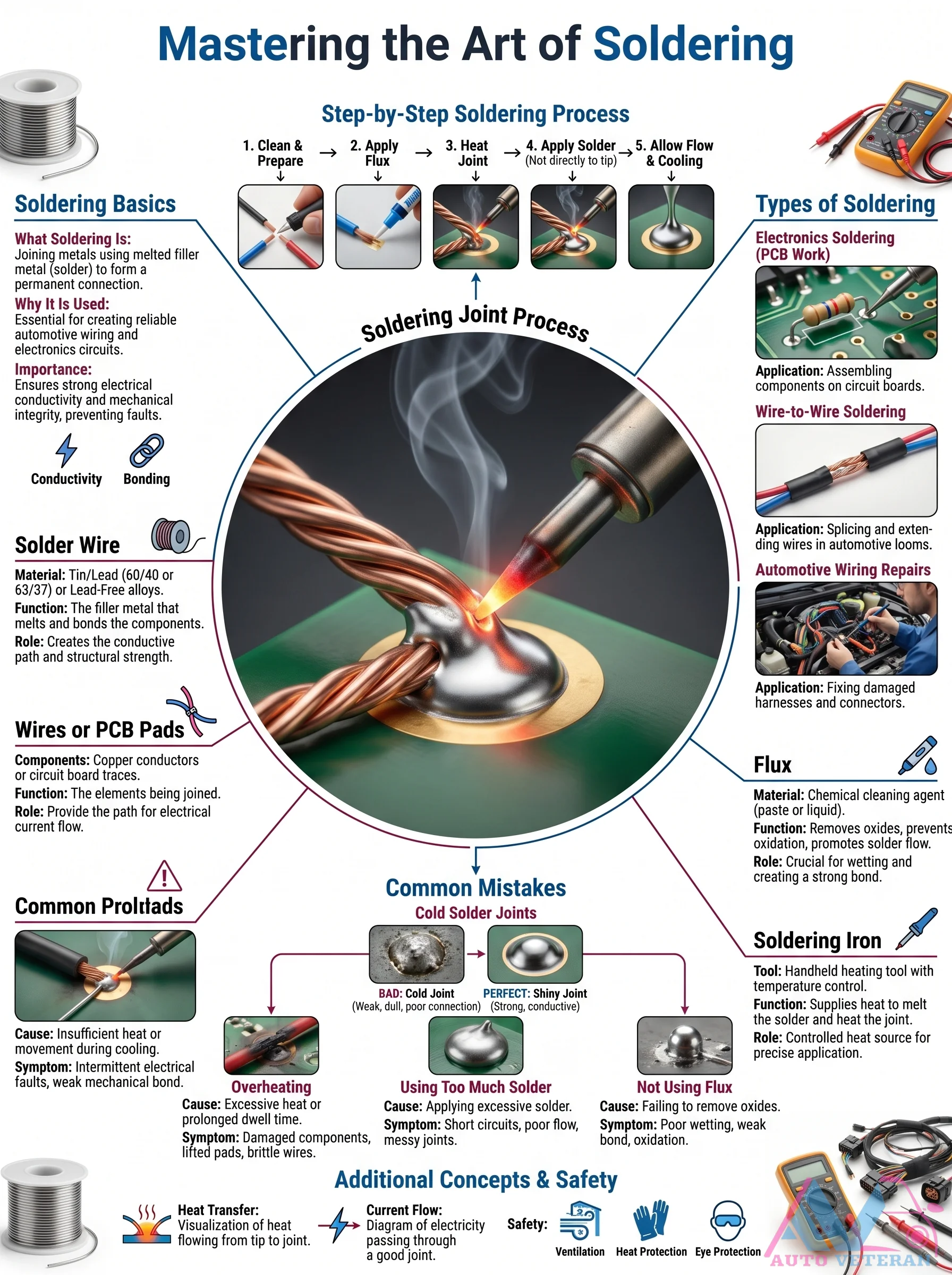
Soldering is essential for creating reliable electrical connections in automotive wiring and electronics, using melted filler metal to form permanent bonds. The step-by-step process involves cleaning the area, applying heat, allowing solder to flow, and proper cooling. Common mistakes include cold solder joints from insufficient heat, overheating components, using too much solder, and failing to use flux, which can lead to intermittent faults, short circuits, and weak bonds. Proper techniques ensure strong conductivity and mechanical integrity in repairs like splicing wires or fixing damaged harnesses.
Automotive Soldering Step-by-Step Process
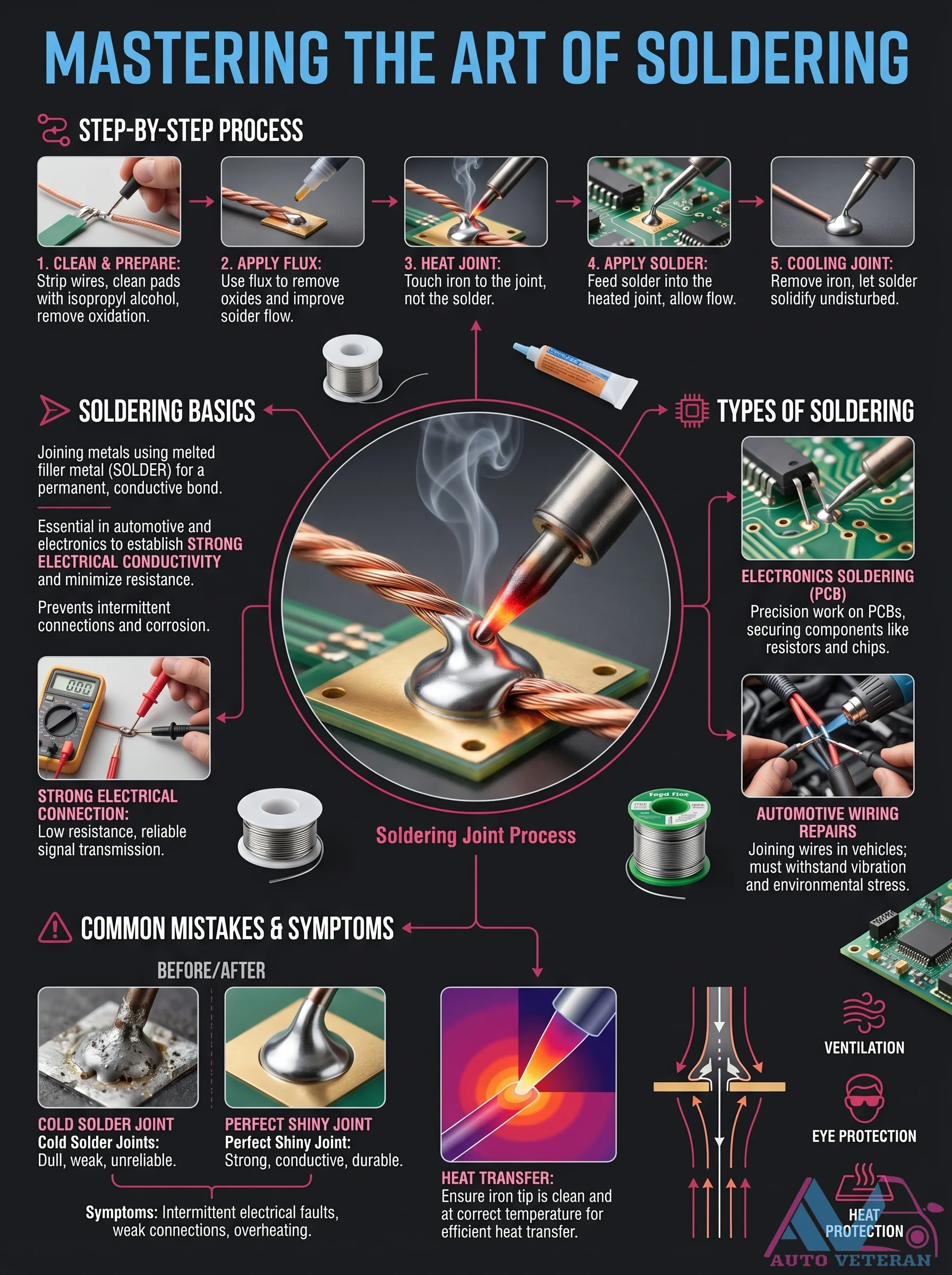
Mastering the art of soldering in automotive applications involves a precise five step sequence: clean and prepare surfaces with isopropyl alcohol, apply flux to remove oxides, heat the joint with the iron, feed solder into the heated joint, and allow it to cool undisturbed. This process ensures strong electrical conductivity, minimizes resistance, and creates durable connections that withstand vehicle vibration and environmental stress. Common mistakes like cold solder joints result in dull, unreliable connections with symptoms of intermittent faults and overheating, while proper technique yields perfect shiny joints for reliable signal transmission in wiring repairs.

Automotive Strategic Alliances and Partnerships Diagram
This detailed diagram illustrates the complex web of strategic alliances and partnerships that define today's global automotive industry. It shows how major groups like Renault-Nissan-Mitsubishi, Toyota, BMW, Volkswagen, Mercedes-Benz, General Motors, Hyundai, and Ford collaborate through technology sharing, platform development, and market access strategies. The visual highlights key benefits such as cost efficiency through shared purchasing, accelerated innovation, and global market reach, while also noting challenges like brand identity dilution, market overlap, and management complexity. Specific partnerships like Mercedes-AMG, Mercedes-EQ, and platform sharing between Volkswagen and Porsche are clearly mapped, demonstrating how these relationships shape everything from mass-market vehicles to premium performance brands.
Automotive Strategic Alliances and Partnerships Map
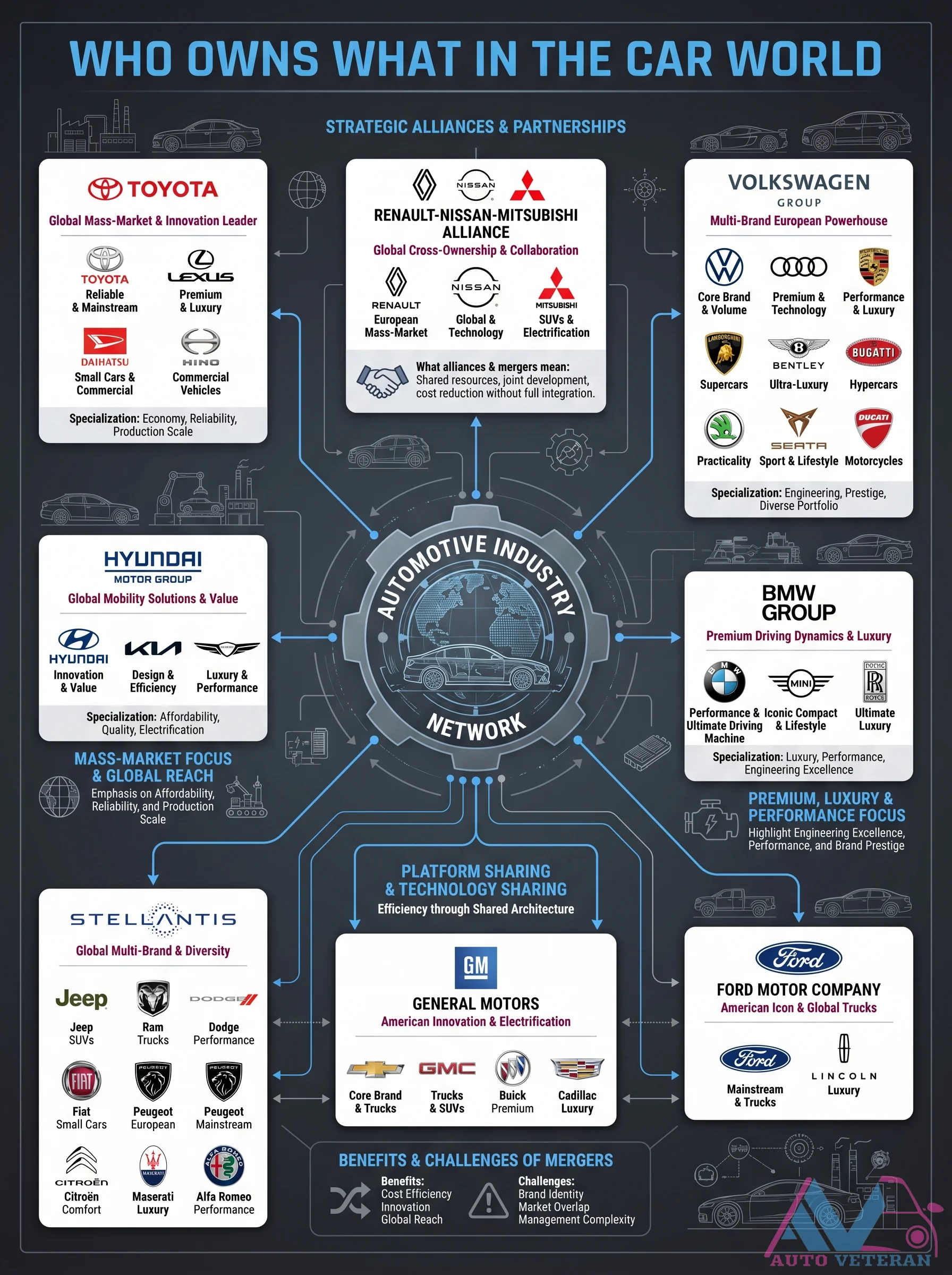
This detailed map illustrates the complex web of strategic alliances and partnerships that define the modern automotive industry. It shows how major groups like Toyota, Volkswagen, Renault-Nissan-Mitsubishi, and Stellantis collaborate through platform sharing, technology exchange, and global cross ownership. The visualization highlights specialization areas such as Toyota's reliability and production scale, Volkswagen's premium performance, and Renault's mass market technology. It also explains the benefits of these alliances, including cost reduction through shared resources and joint development, while acknowledging challenges like brand dilution and organizational complexity. The map categorizes companies by their focus areas, from mass market affordability to premium luxury performance, demonstrating how these relationships drive innovation in electrification, SUVs, and global mobility solutions.
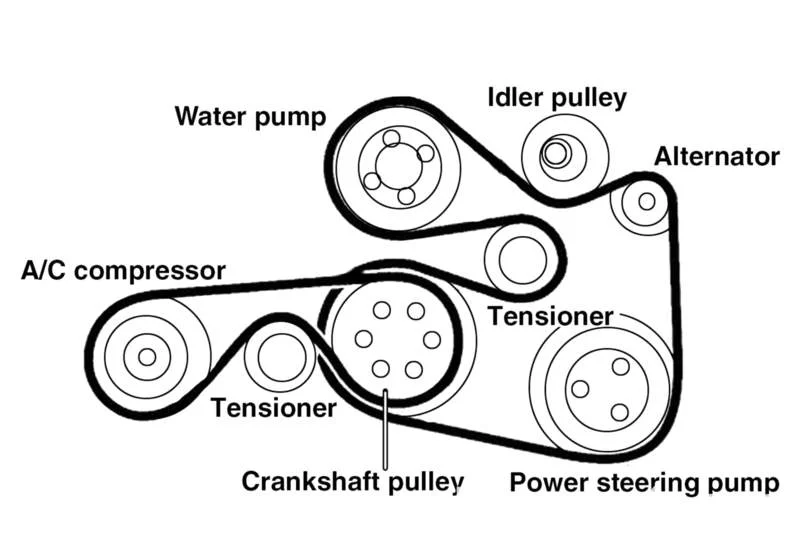
Auxiliary Belt (Serpentine Belt)
A single, continuous belt that drives multiple engine accessories such as the alternator, power steering pump, air conditioning compressor, and water pump. It's called "serpentine" because it winds through various pulleys in a snake-like pattern. Regular inspection and replacement are crucial as belt failure can disable multiple vehicle systems.
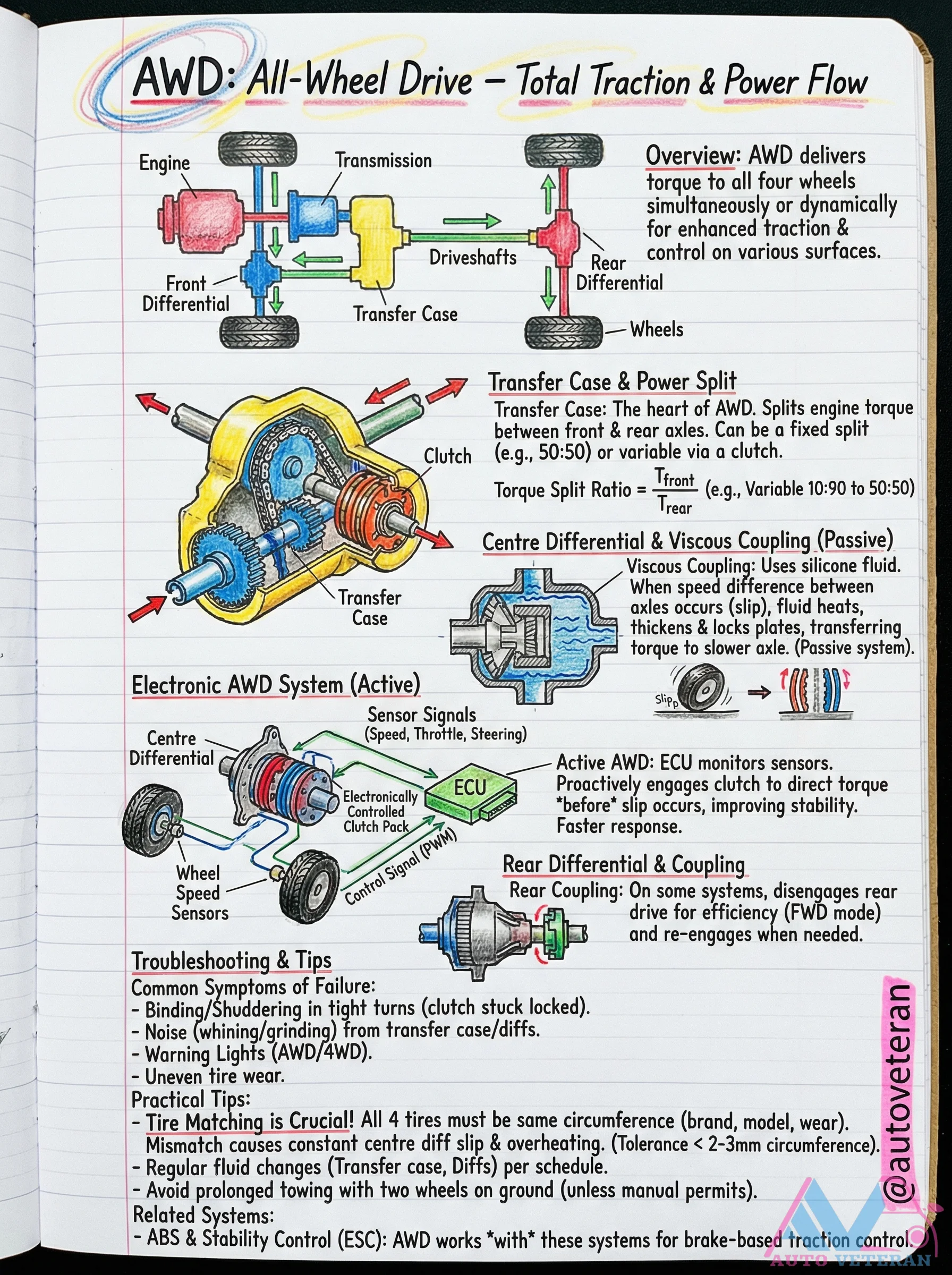
AWD Power Flow, Transfer Case Types, and Troubleshooting
All Wheel Drive systems deliver power to all four wheels simultaneously or dynamically through a transfer case that splits engine torque between front and rear axles. This can be a fixed 50:50 split or variable via clutch pack, ranging from 10:90 to 50:50 ratios. Passive systems use viscous couplings where fluid thickens and locks when axle speed differences occur, while active electronic AWD uses sensors and ECU control to engage clutches before wheel slip happens for improved stability. Common failure symptoms include binding during tight turns from stuck clutches, grinding noises from transfer cases or differentials, warning lights, and uneven tire wear. Proper maintenance requires all four tires to have matching circumference within 2-3mm tolerance to prevent center differential slip and overheating, along with regular fluid changes for transfer cases and differentials according to schedule.
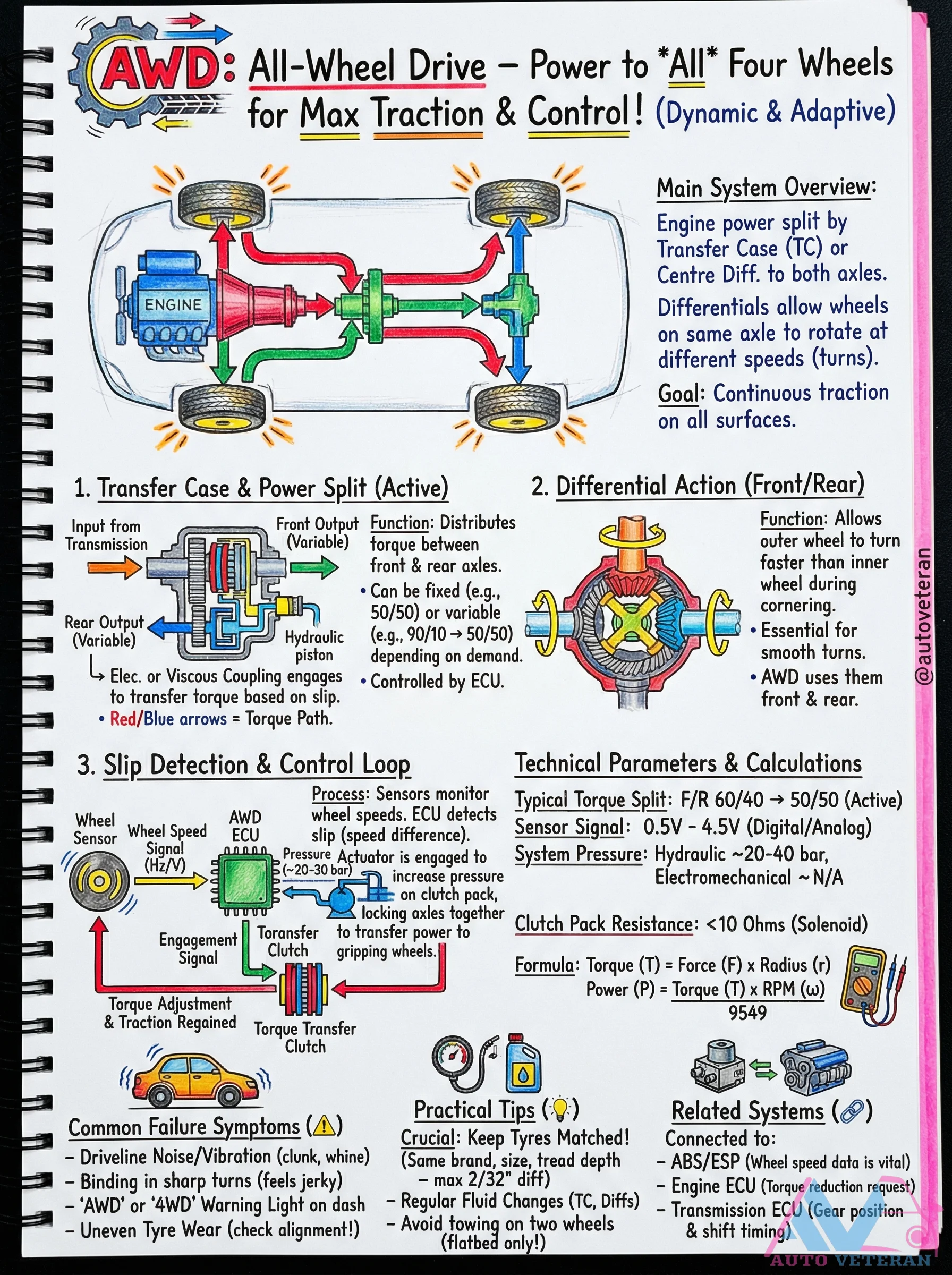
AWD System Overview with Torque Split Parameters
All Wheel Drive systems dynamically distribute engine power through a transfer case or center differential to both axles, with differentials allowing wheels on the same axle to rotate at different speeds for optimal traction. The system continuously monitors wheel speeds via sensors, with the ECU detecting slip and engaging hydraulic or electromechanical actuators to adjust torque distribution. Typical torque splits range from 60/40 to 50/50 front/rear, with hydraulic system pressures operating between 20 to 40 bar and clutch pack resistance maintained below 10 ohms. Proper maintenance includes keeping tires matched within 2/32 inch tread depth difference and performing regular fluid changes for the transfer case and differentials to prevent common symptoms like driveline noise, binding in turns, or warning lights.
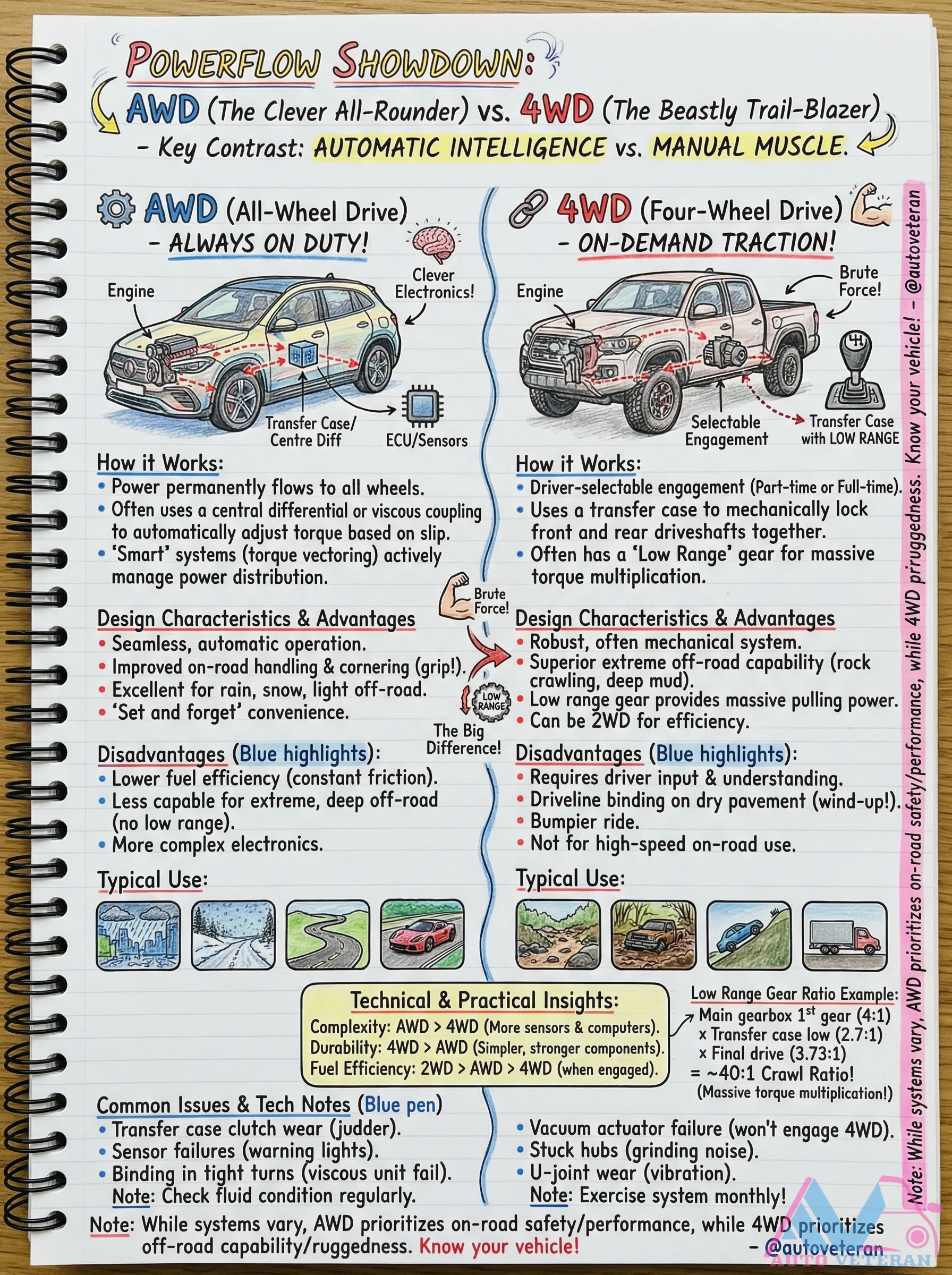
AWD vs 4WD Technical Comparison Guide
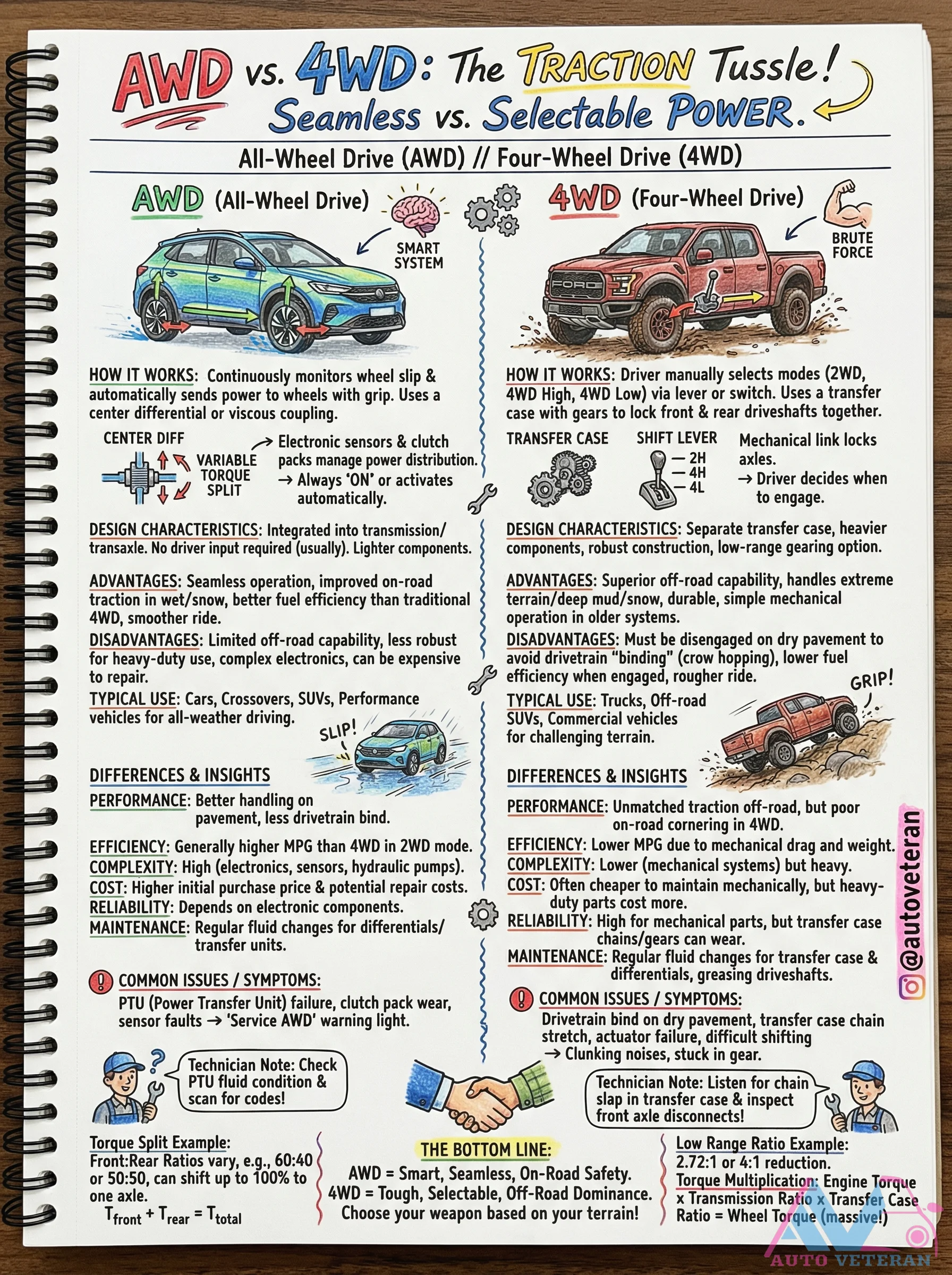
Understanding the fundamental differences between All Wheel Drive and Four Wheel Drive systems is crucial for vehicle selection and operation. AWD systems provide seamless, automatic power distribution to all wheels using electronic controls and center differentials, offering superior on road handling, cornering grip, and convenience in rain or light off road conditions. In contrast, 4WD systems feature mechanical transfer cases with selectable engagement, often including low range gearing for massive torque multiplication, making them ideal for extreme off road situations like rock crawling and deep mud. This comparison highlights key technical aspects including power flow mechanisms, transfer case designs, typical use cases, and practical considerations like fuel efficiency differences, durability factors, and common maintenance issues specific to each system type.
AWD vs 4WD Traction Systems Comparison
Understanding the fundamental differences between All Wheel Drive and Four Wheel Drive systems is crucial for vehicle selection. AWD operates automatically with electronic sensors and clutch packs that continuously monitor wheel slip, providing seamless power distribution to wheels with grip for improved on road safety and better fuel efficiency. In contrast, 4WD requires manual selection by the driver through a transfer case with gears that lock front and rear driveshafts, offering superior off road capability with low range gearing but must be disengaged on dry pavement to avoid drivetrain binding. Each system has distinct design characteristics, with AWD integrated into the transmission and 4WD using separate, heavier components. Performance varies significantly, with AWD excelling in pavement handling while 4WD dominates in extreme terrain. Maintenance considerations differ too, as AWD may experience PTU failure or sensor faults, whereas 4WD requires regular fluid changes for the transfer case and differentials. Ultimately, choosing between these systems depends on your driving needs, whether you prioritize seamless on road operation or selectable off road dominance.
Axle
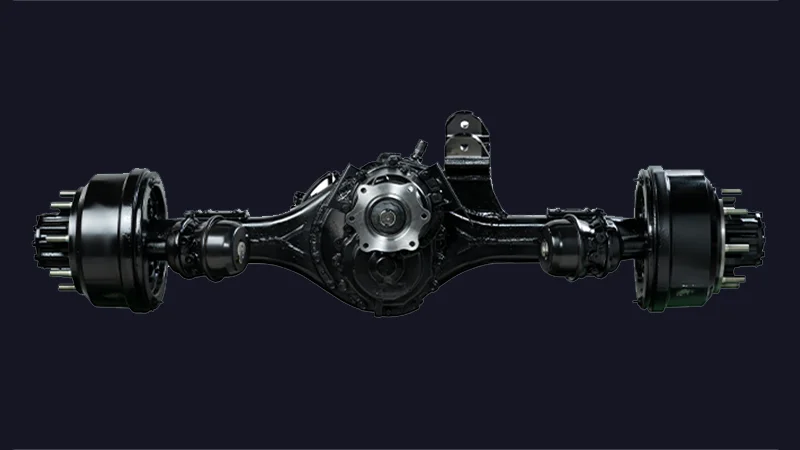
A central shaft or beam that supports the weight of the vehicle and allows wheels to rotate. There are two main types: drive axles that transmit power from the transmission to the wheels, and non-drive axles that simply support weight. Most vehicles have front and rear axles, with the drive axle(s) depending on whether the vehicle is front-wheel, rear-wheel, or all-wheel drive.
Axle Shaft Failure Symptoms and Service Notes
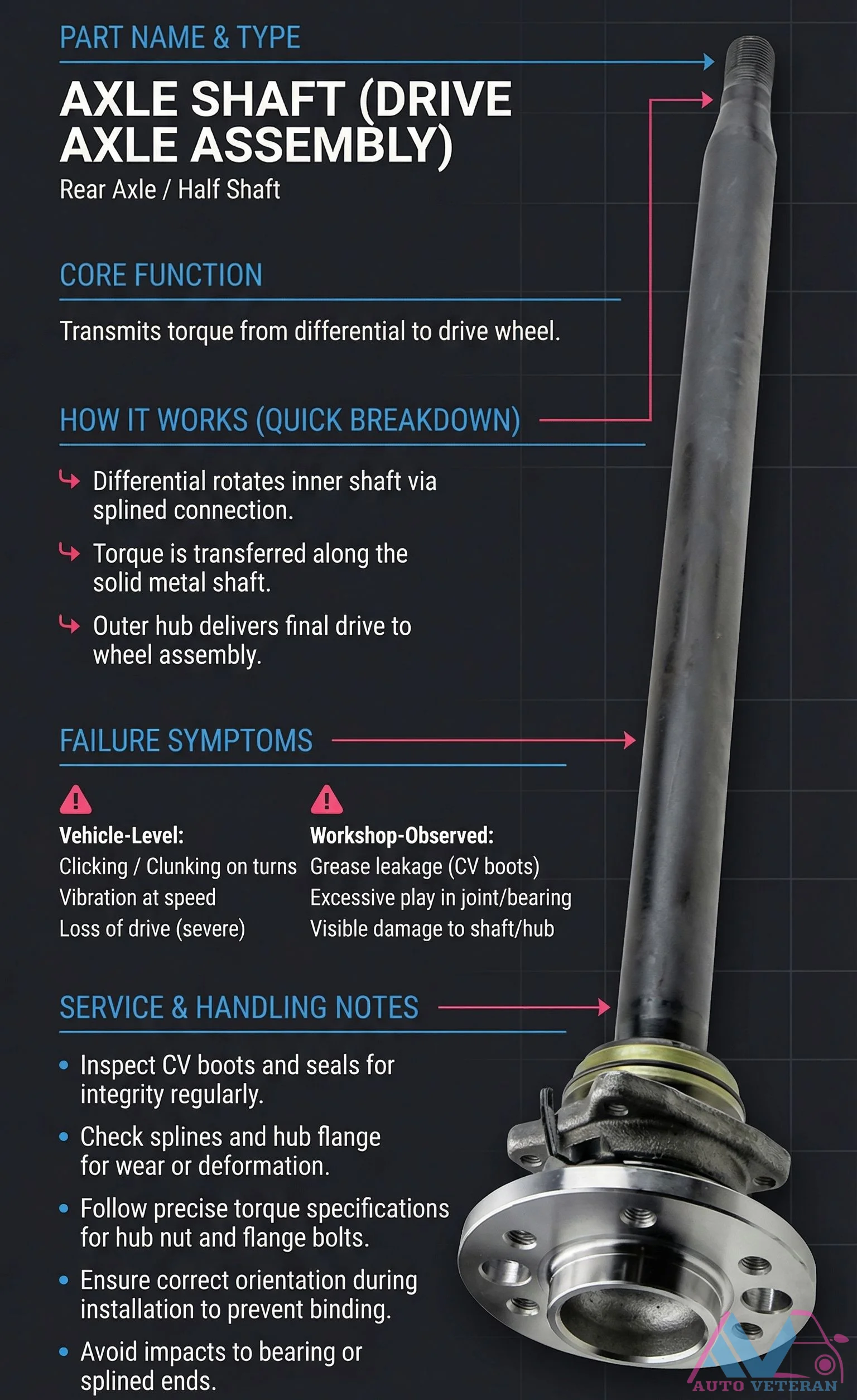
The axle shaft, also known as the drive axle assembly or half shaft, transmits torque from the differential to the drive wheel. When this critical component fails, you may notice clicking or clunking sounds during turns, grease leakage from damaged CV boots, vibration at higher speeds, excessive play in joints or bearings, or even complete loss of drive in severe cases. Regular inspection of CV boots and seals is essential for early detection. During service, always check splines and hubs for wear or deformation, follow precise torque specifications for hub nuts and flange bolts, ensure correct orientation during installation to prevent binding, and avoid impacts to bearing or splined ends to maintain proper function.