Interactive Explorer
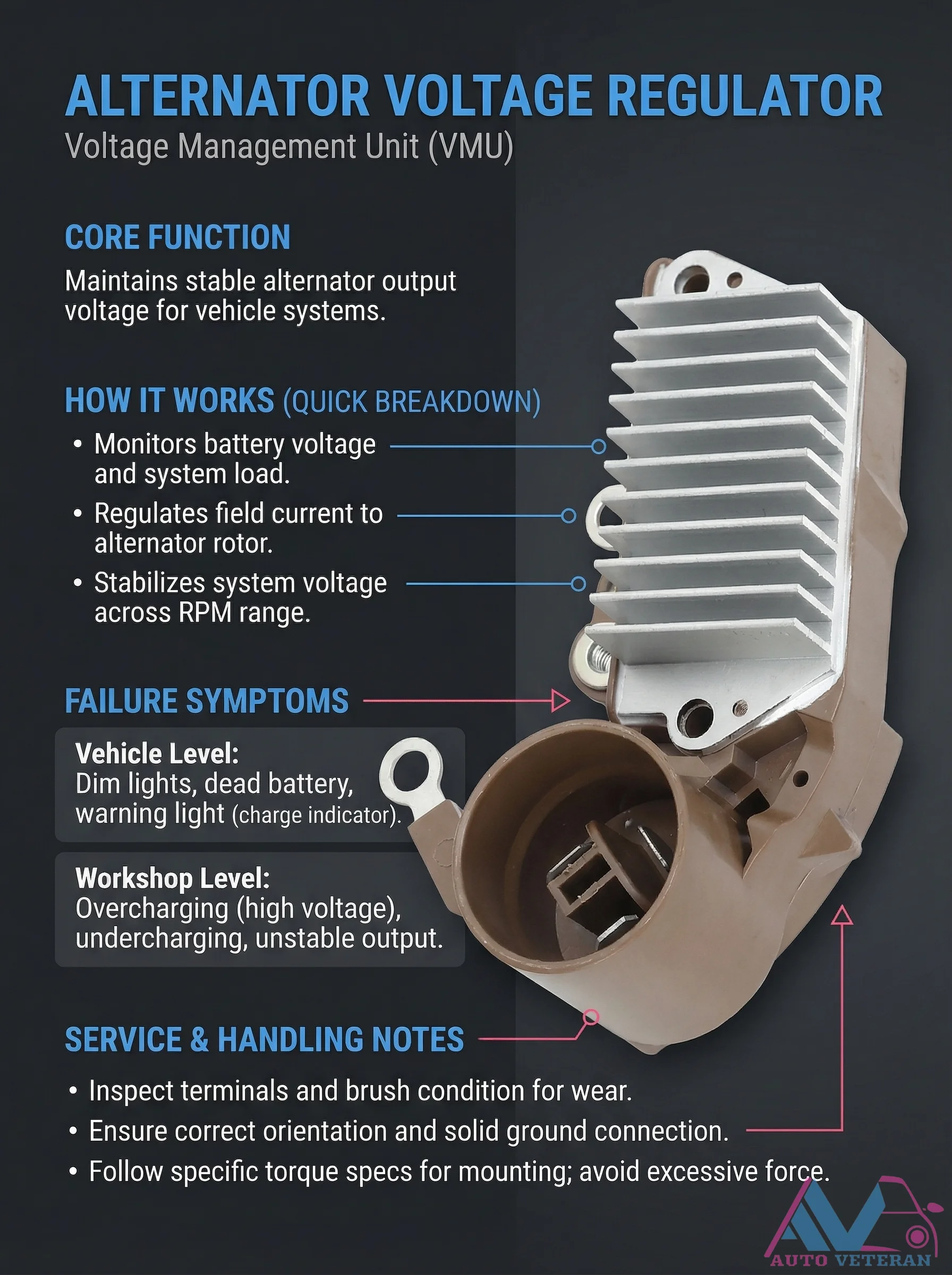
Alternator Voltage Regulator Failure Symptoms
When the Voltage Management Unit fails, it disrupts the critical balance of your vehicle's electrical system; causing dim lights, a dead battery, and warning lights at the vehicle level, while workshop diagnostics reveal overcharging, undercharging, or unstable output that can damage sensitive electronics.
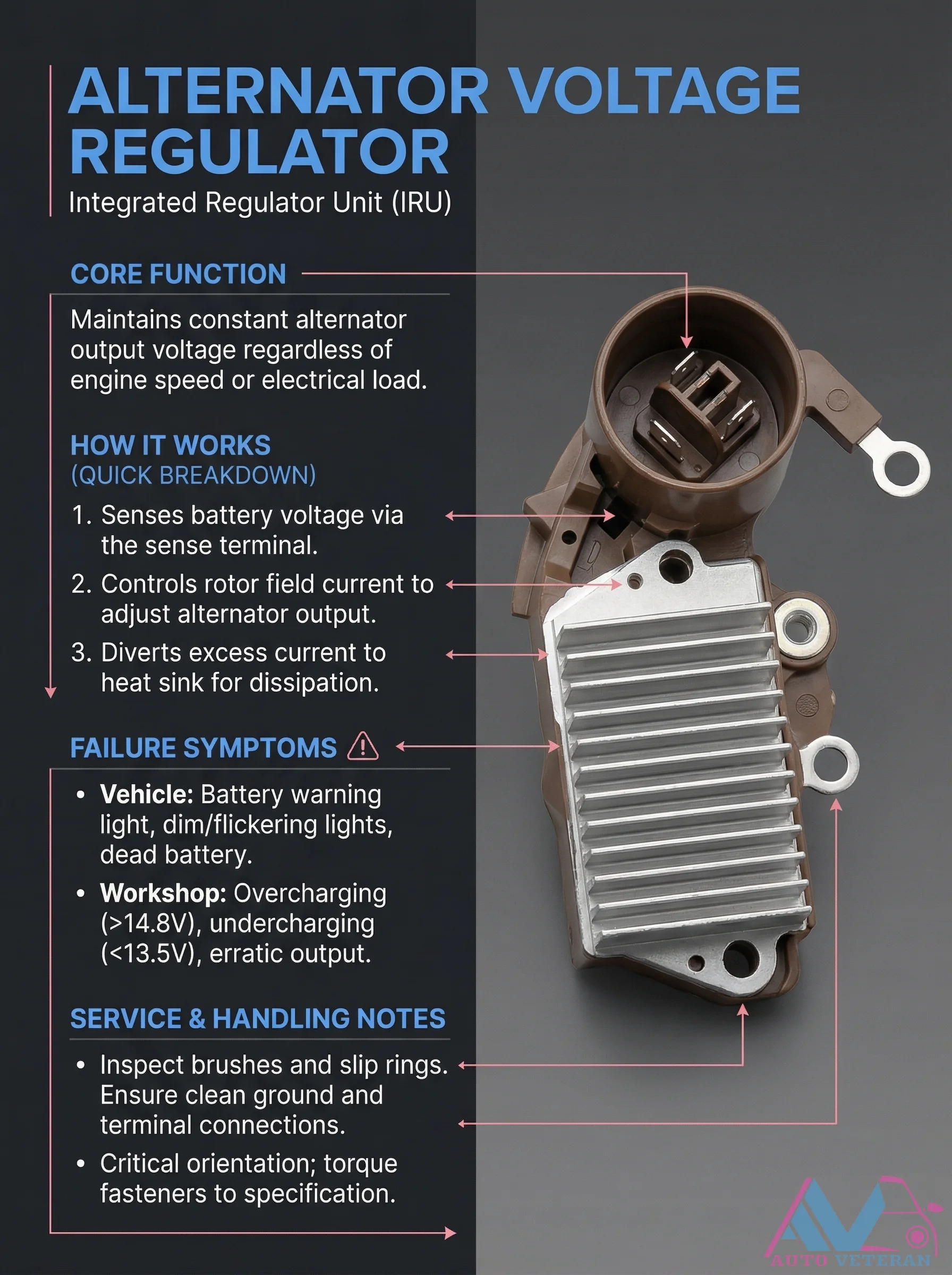
Alternator Voltage Regulator Failure Symptoms and Service
The integrated regulator unit maintains constant alternator output voltage by sensing battery voltage through its terminal, controlling rotor field current to adjust output, and diverting excess current to a heat sink for dissipation. When this critical component fails, drivers experience battery warning lights, dim or flickering headlights, and dead batteries, while technicians diagnose overcharging above 14.8 volts, undercharging below 13.5 volts, or erratic output. Proper service requires inspecting brushes and slip rings, ensuring clean ground and terminal connections, maintaining correct orientation, and torquing fasteners to exact specifications.
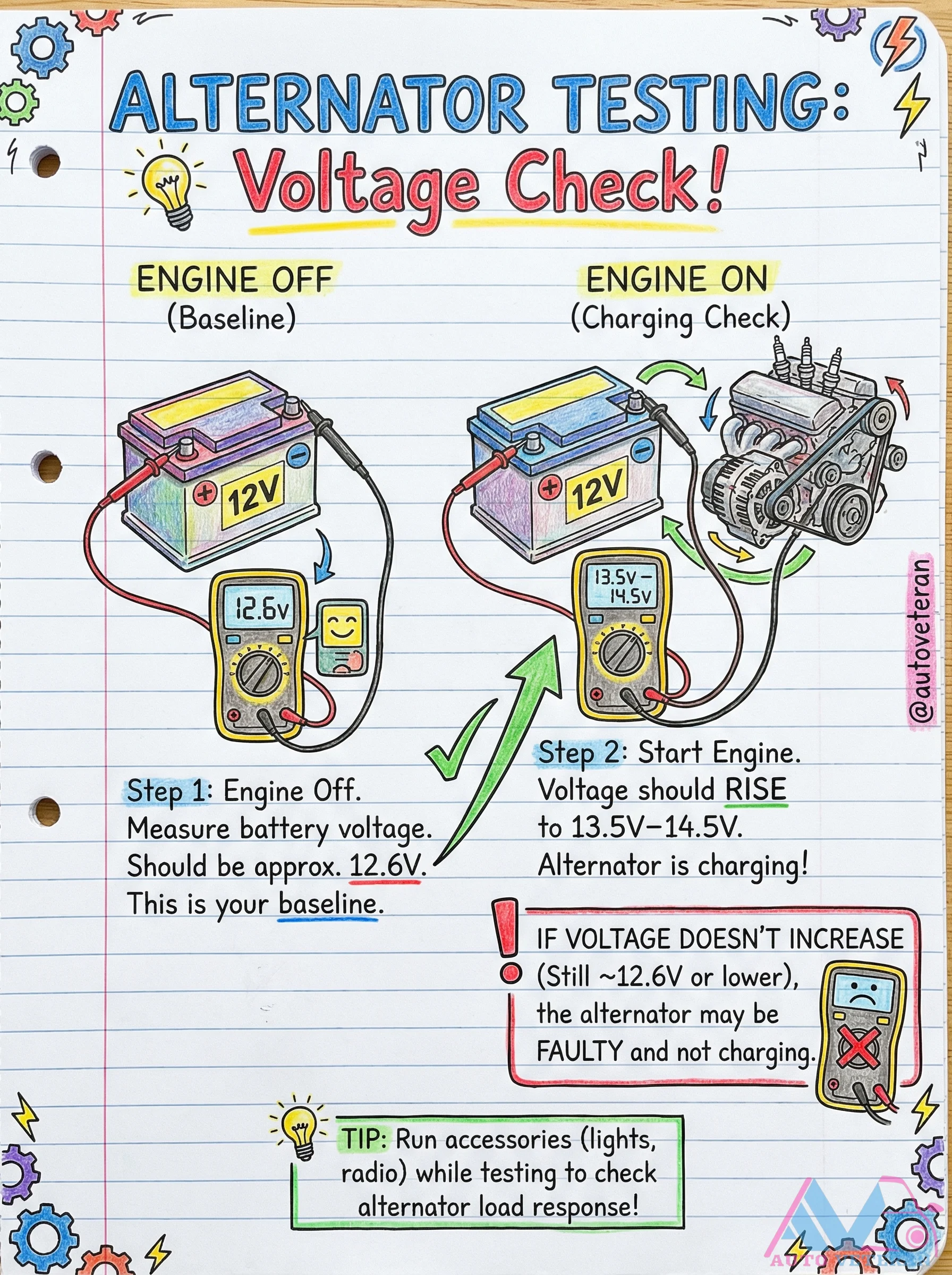
Alternator Voltage Testing Procedure with Engine Off and On
This detailed guide explains the proper two-step method for testing your alternator's charging function. First, with the engine off, establish a baseline battery voltage reading of approximately 12.6 volts. Then, start the engine and observe if the voltage rises to the critical charging range of 13.5 to 14.5 volts. The procedure includes a crucial troubleshooting tip: if the voltage fails to increase and remains around 12.6 volts or lower, this indicates a faulty alternator that is not charging the battery. For a comprehensive load test, the guide recommends running accessories like headlights and the radio during the engine-on phase to check the alternator's response under electrical demand.
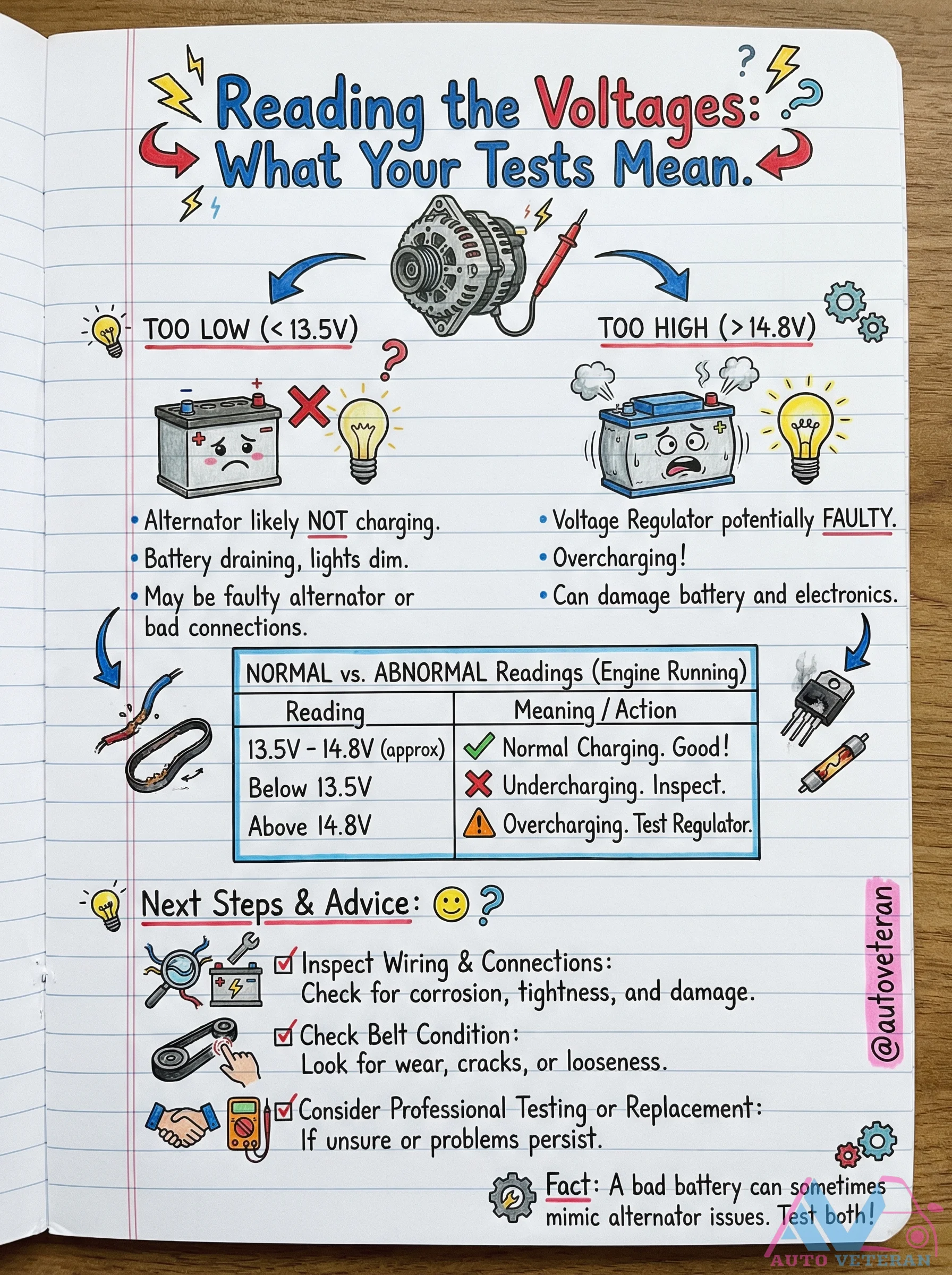
Alternator Voltage Testing Symptoms and Steps
Understanding alternator voltage readings is crucial for diagnosing charging system issues. Normal charging voltage typically ranges between 13.5V and 14.8V when the engine is running. Readings below 13.5V indicate undercharging, which can manifest as dim lights, battery draining, and potential starting problems. Readings above 14.8V signal dangerous overcharging that can damage both the battery and vehicle electronics. The testing procedure includes checking belt condition for wear, cracks, or looseness, inspecting all electrical connections, and considering that a bad battery can sometimes mimic alternator issues, so testing both components is recommended. If problems persist after these checks, professional diagnosis or component replacement may be necessary.
American Auto Giants Mergers and Legacy
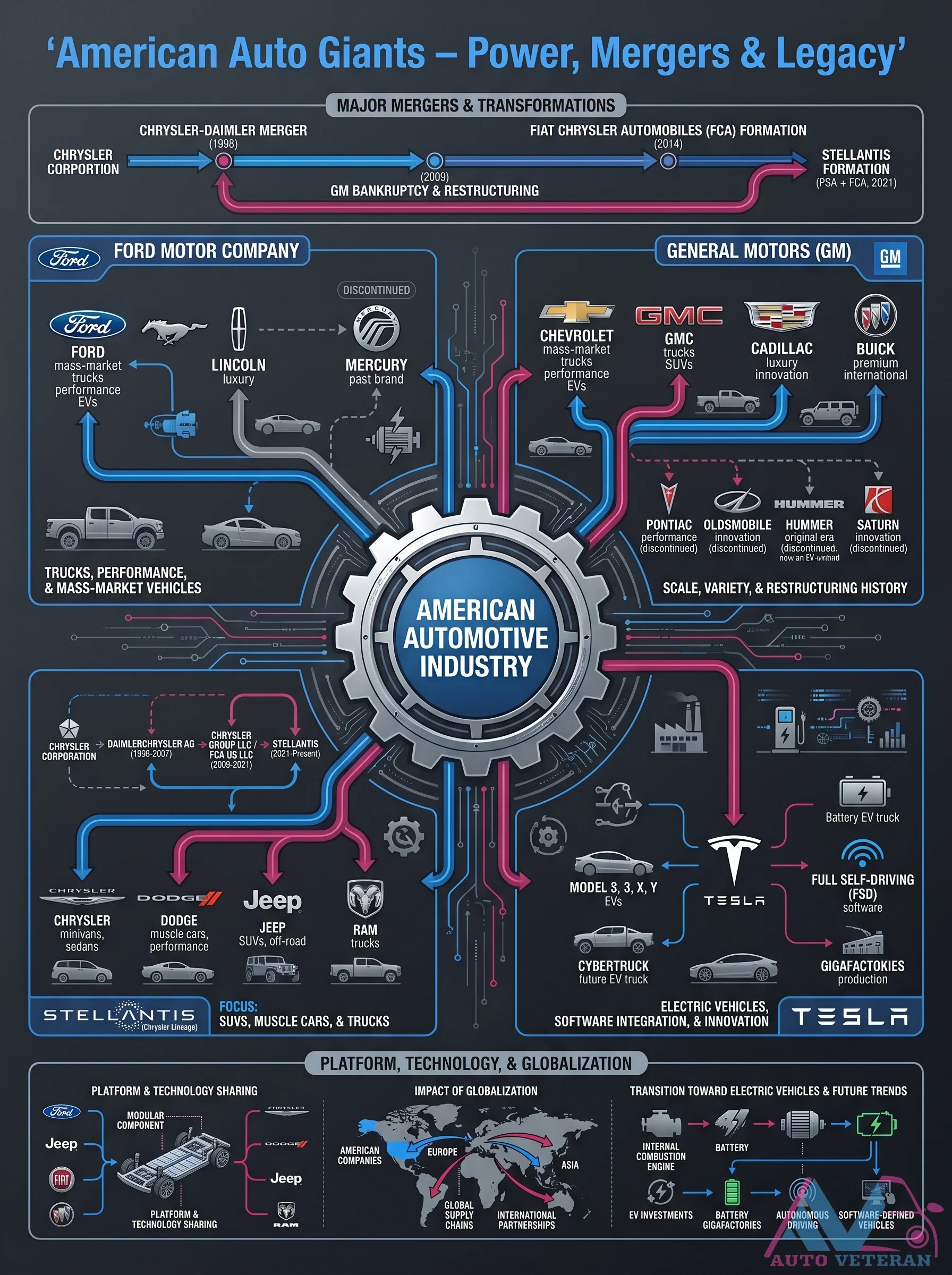
The American automotive industry has been shaped by major mergers and transformations, including the Chrysler Daimler merger, Fiat Chrysler Automobiles formation, and the creation of Stellantis Corporation in 2021. Key players like General Motors underwent bankruptcy restructuring, discontinuing brands such as Pontiac, Oldsmobile, Hummer, and Saturn, while focusing on core brands like Chevrolet, GMC, Cadillac, and Buick. Ford Motor Company maintains its mass market and performance vehicles, including the Lincoln luxury brand. The industry is now transitioning toward electric vehicles, with Tesla leading in technology, Gigafactories, and full self driving capabilities, while Stellantis focuses on SUVs, muscle cars, and trucks. Globalization impacts platform and technology sharing, driving innovation and modular production in the future trends of the automotive sector.
American Auto Mergers Timeline and Legacy
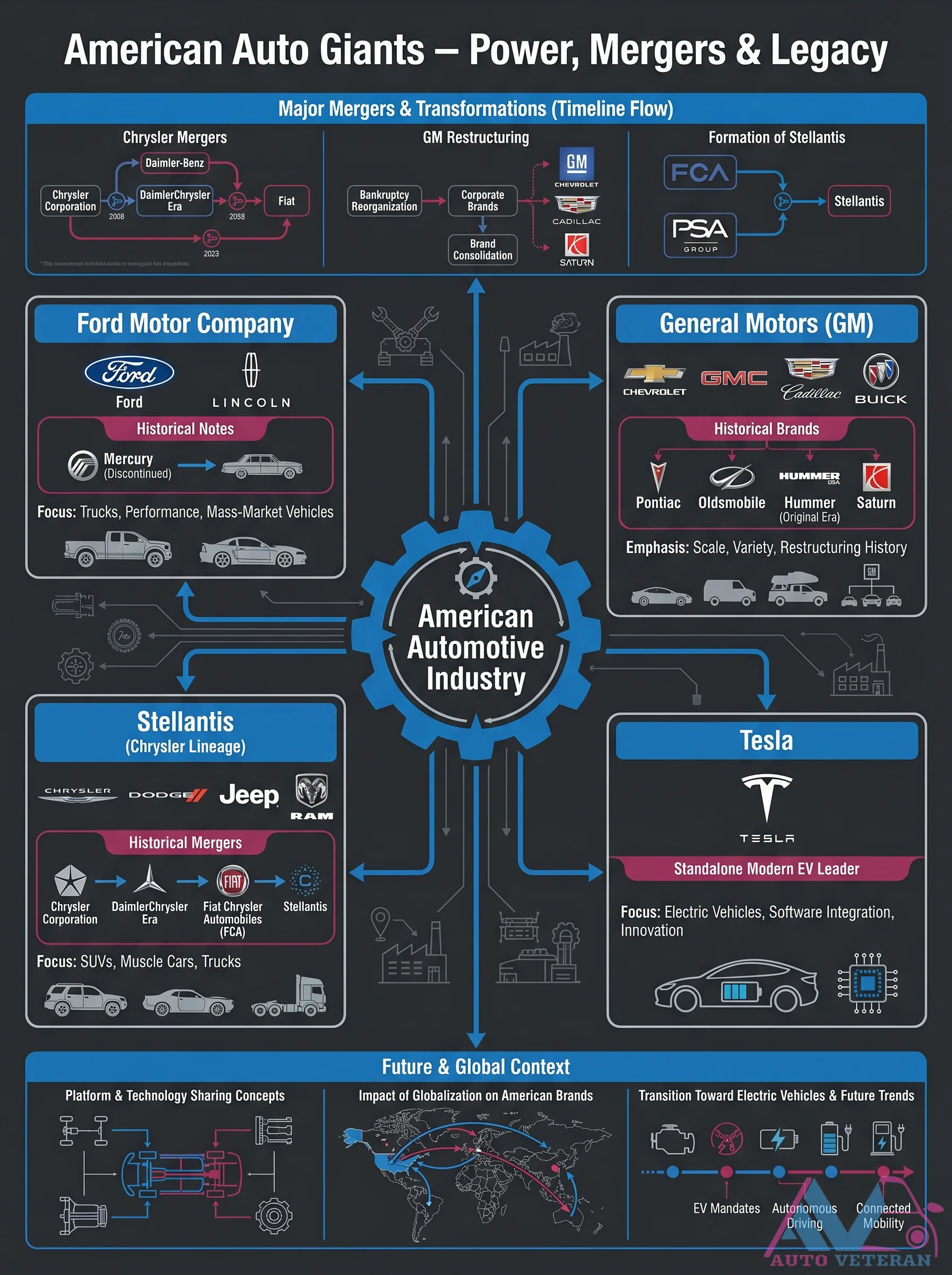
The American automotive industry has been shaped by major mergers and transformations, from Chrysler's historic partnerships to the formation of Stellantis and GM's restructuring efforts. Key events include the DaimlerChrysler merger, FCA's evolution, and the consolidation of brands like Pontiac and Oldsmobile. This timeline highlights the transition from traditional mass market vehicles to modern electric vehicle leadership, with companies like Tesla driving innovation in software integration and platform technology sharing. The industry's future focuses on EV mandates, autonomous mobility, and globalization trends that continue to redefine American automotive giants.
American Automaker Timeline and Innovation
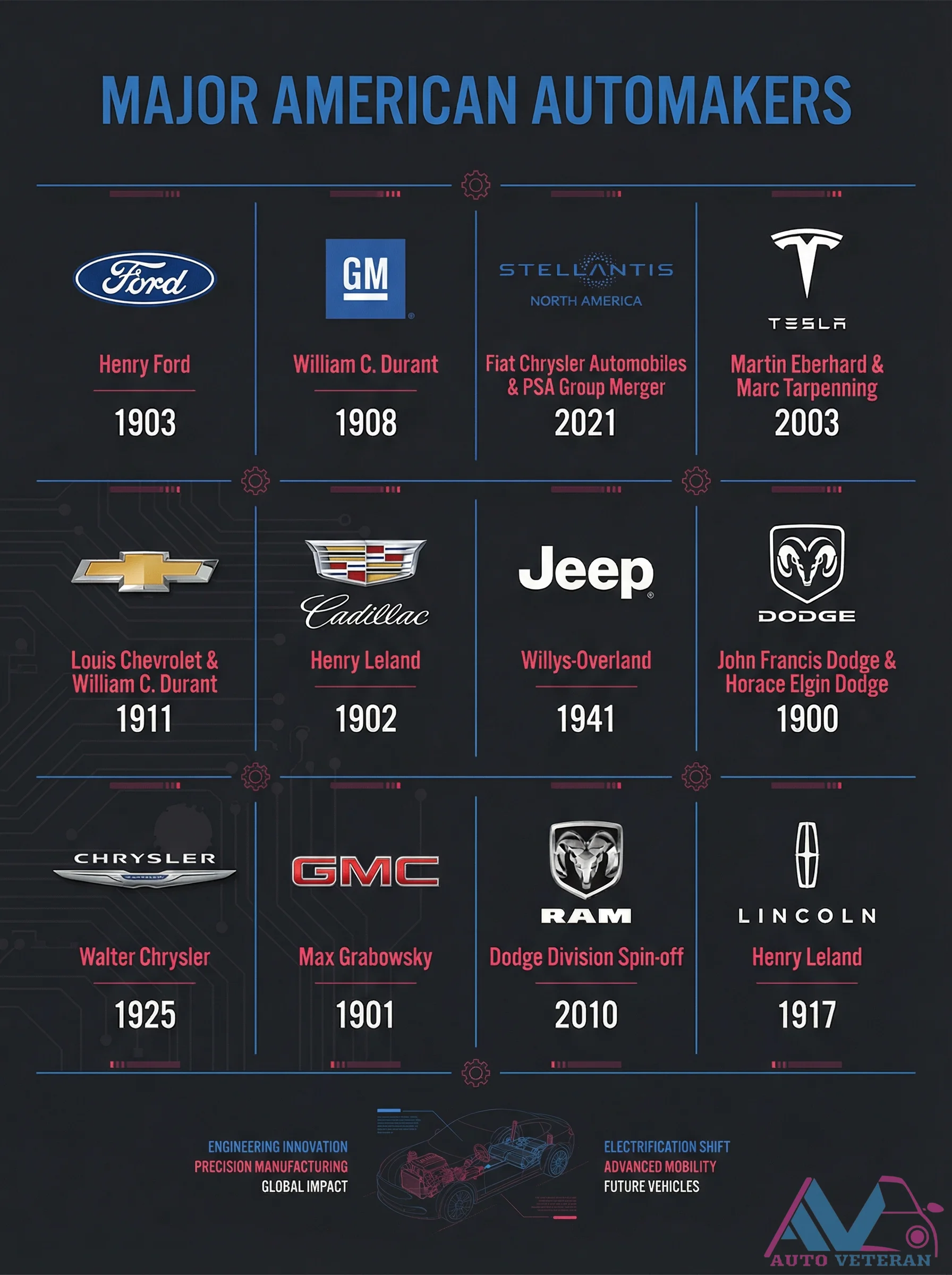
This timeline illustrates the founding years and key figures behind major American automakers, including GM, Stellantis, Tesla, Ford, and Chrysler. It highlights pivotal moments such as the 2021 PSA Group merger, the 1941 Willys Overland Jeep production, and the 2003 founding of Tesla. The graphic emphasizes core themes like engineering innovation, electrification, precision manufacturing, advanced mobility, and global impact, showcasing how these companies have shaped the automotive industry from 1900 to the present.
American Automotive Giants Brands History
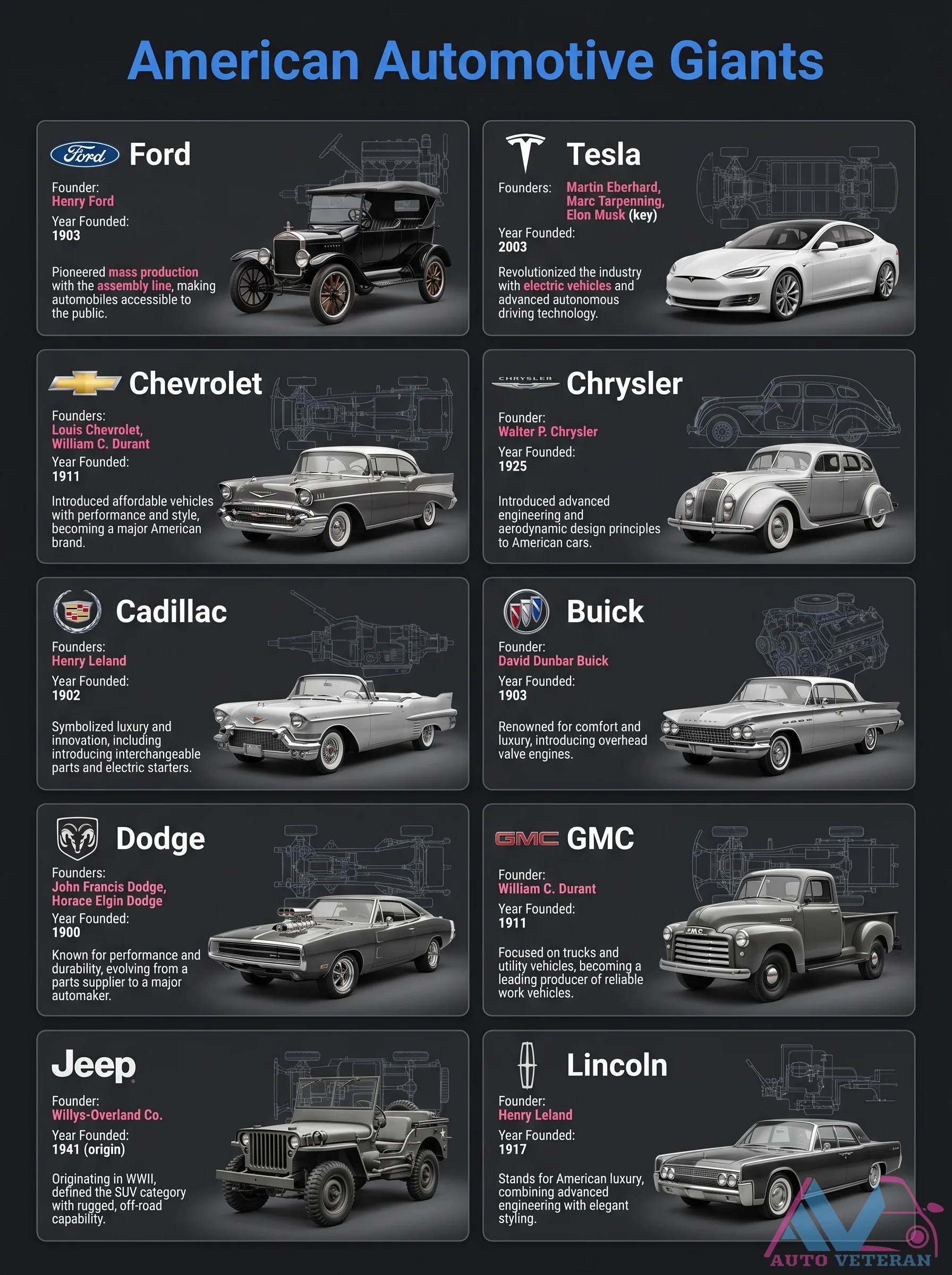
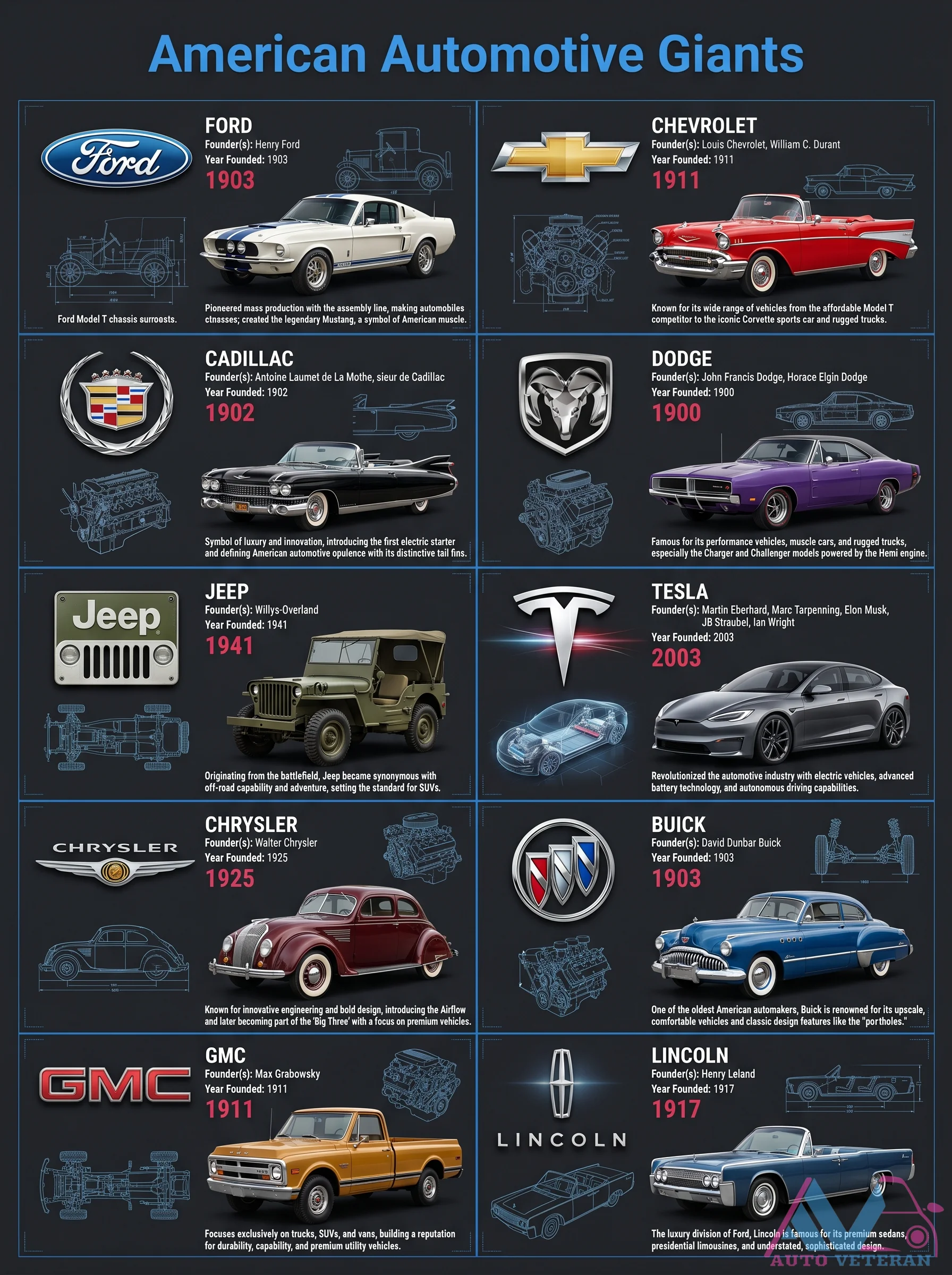
Explore the pioneering legacy of American automotive brands: Ford revolutionized mass production with the assembly line in 1903; Tesla, founded in 2003 by Martin Eberhard, Marc Tarpenning, and Elon Musk, leads electric vehicles and autonomous driving; Chevrolet, founded in 1911 by Louis Chevrolet and William Durant, delivered affordable performance and style; Chrysler, founded in 1925 by Walter Chrysler, introduced advanced engineering and aerodynamic design; Cadillac, founded in 1902 by Henry Leland, set standards for luxury with interchangeable parts and electric starters; Buick, founded in 1903 by David Dunbar Buick, pioneered overhead valve engines; Dodge, founded in 1900 by John and Horace Dodge, built performance and durability; GMC, founded in 1900 by William Durant, focused on trucks and utility vehicles; Jeep, originating in 1941 from Willys-Overland, defined the SUV category with off-road capability; Lincoln, founded in 1917 by Henry Leland, merged advanced engineering with elegant luxury.
American Automotive Giants Timeline
This infographic presents a timeline of major American automotive manufacturers including Ford, Chevrolet, Cadillac, Dodge, Jeep, Tesla, Chrysler, Buick, GMC, and Lincoln. Each entry lists the founder and year founded, highlighting the historical roots and evolution of these iconic brands from the early 1900s through the 21st century.
Anatomy of a Brake Pad
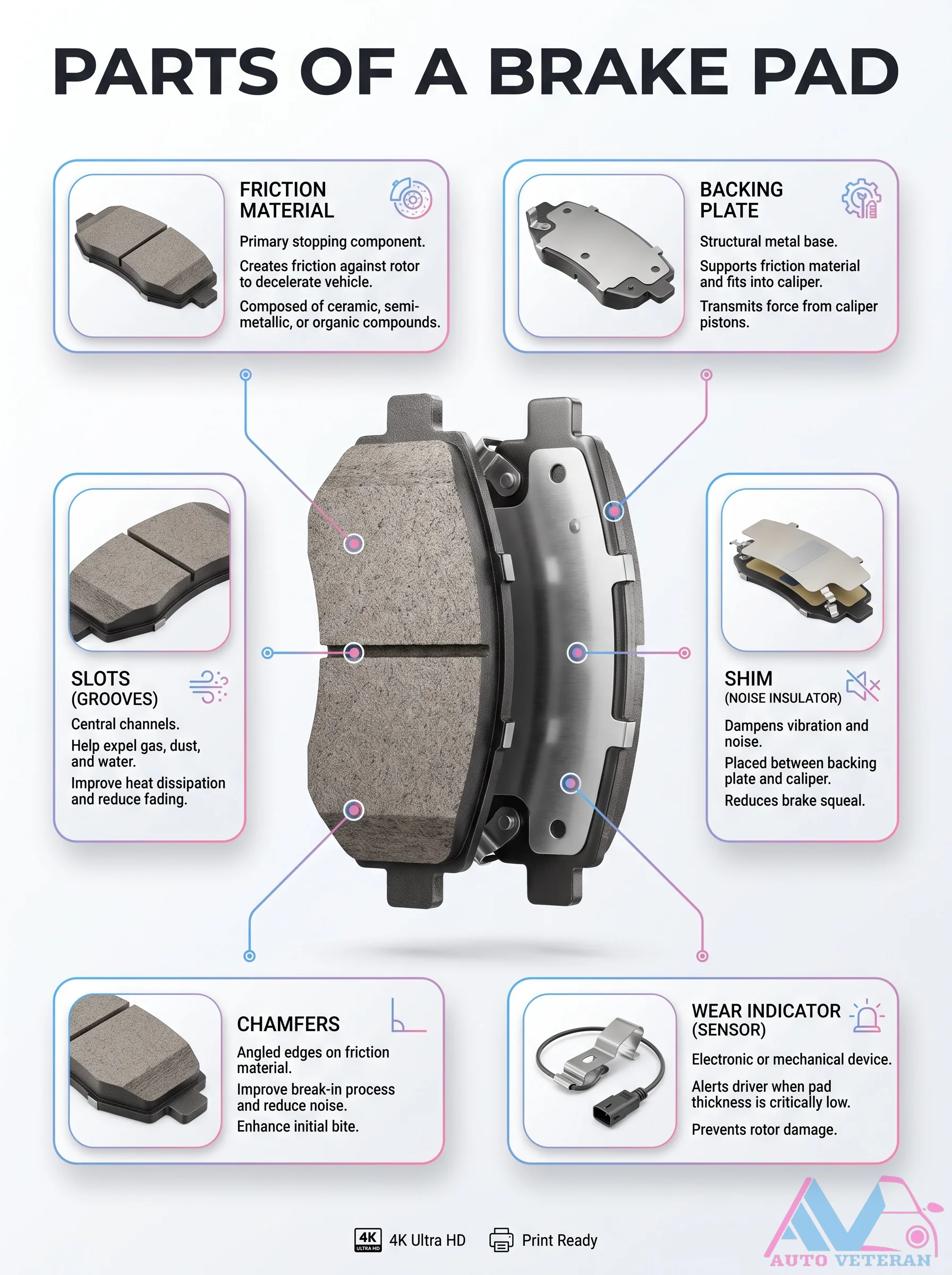
Every brake pad is a carefully engineered assembly. The friction material, made of ceramic, semi-metallic, or organic compounds, is the primary stopping component that creates friction against the rotor. It is bonded to a structural metal backing plate that supports the friction material, transmits force from the caliper pistons, and fits securely into the caliper. Slots or grooves in the friction material help expel gas, dust, and water while improving heat dissipation and reducing noise. Chamfered edges on the friction material improve the break-in process, reduce noise, and enhance initial bite. A shim or noise insulator placed between the backing plate and caliper dampens vibration and reduces brake squeal. Finally, a wear indicator, either electronic or mechanical, alerts the driver when pad thickness is critically low, preventing rotor damage.
Anti-Roll Bar (Stabilizer Bar)
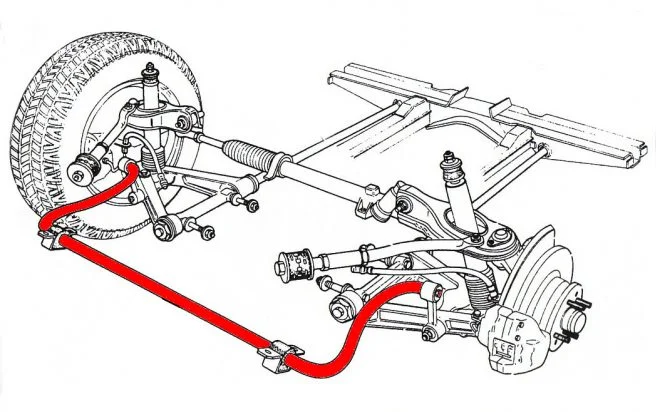
A metal bar that connects the left and right wheels of the same axle to reduce body roll during cornering. When one wheel encounters a bump or the vehicle turns, the bar transfers some of the force to the opposite wheel, helping maintain vehicle stability and improving handling characteristics. It can be found on front suspension, rear suspension, or both.
Anti-Roll Bar Dynamics During Cornering Force Transfer
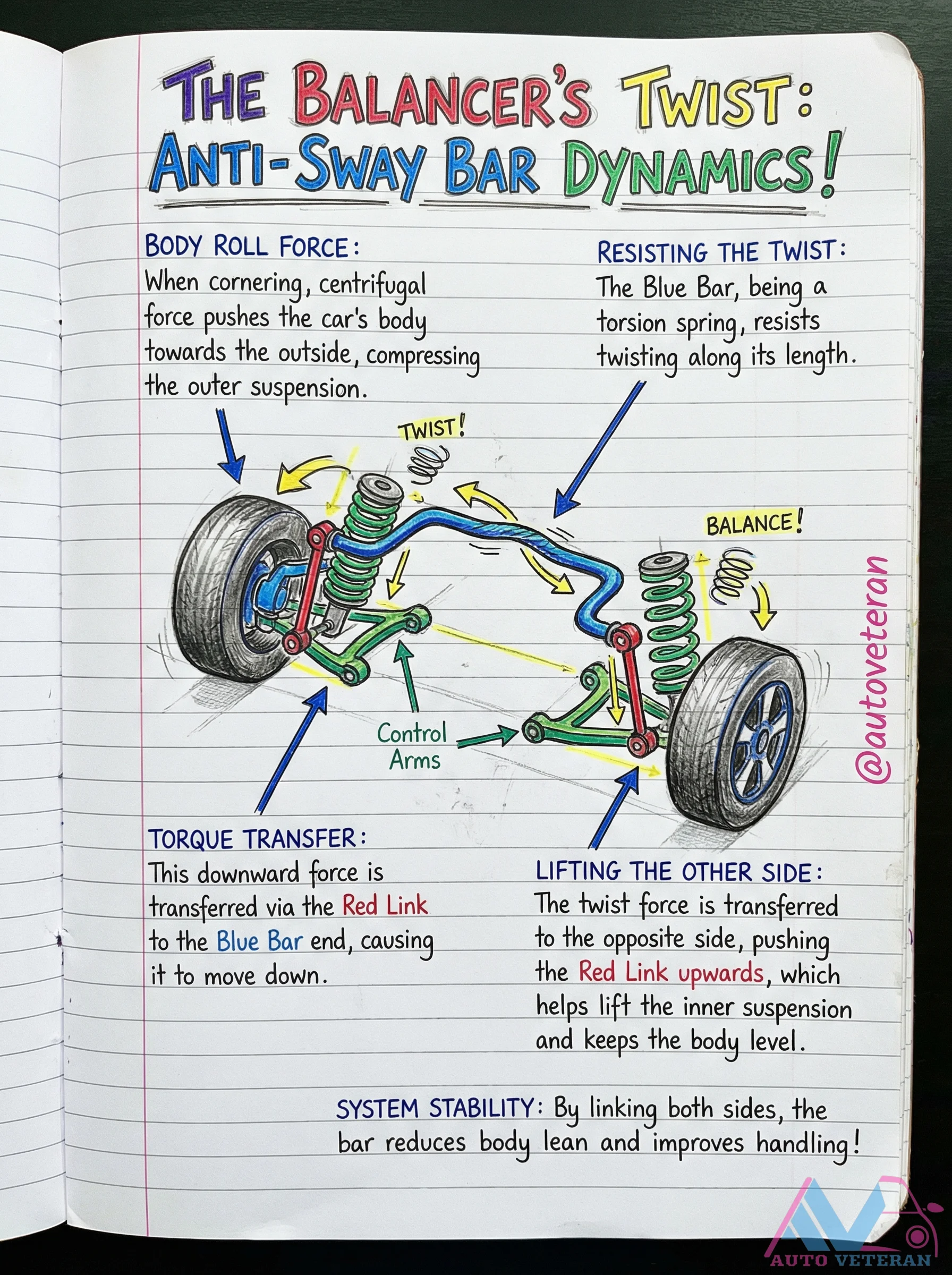
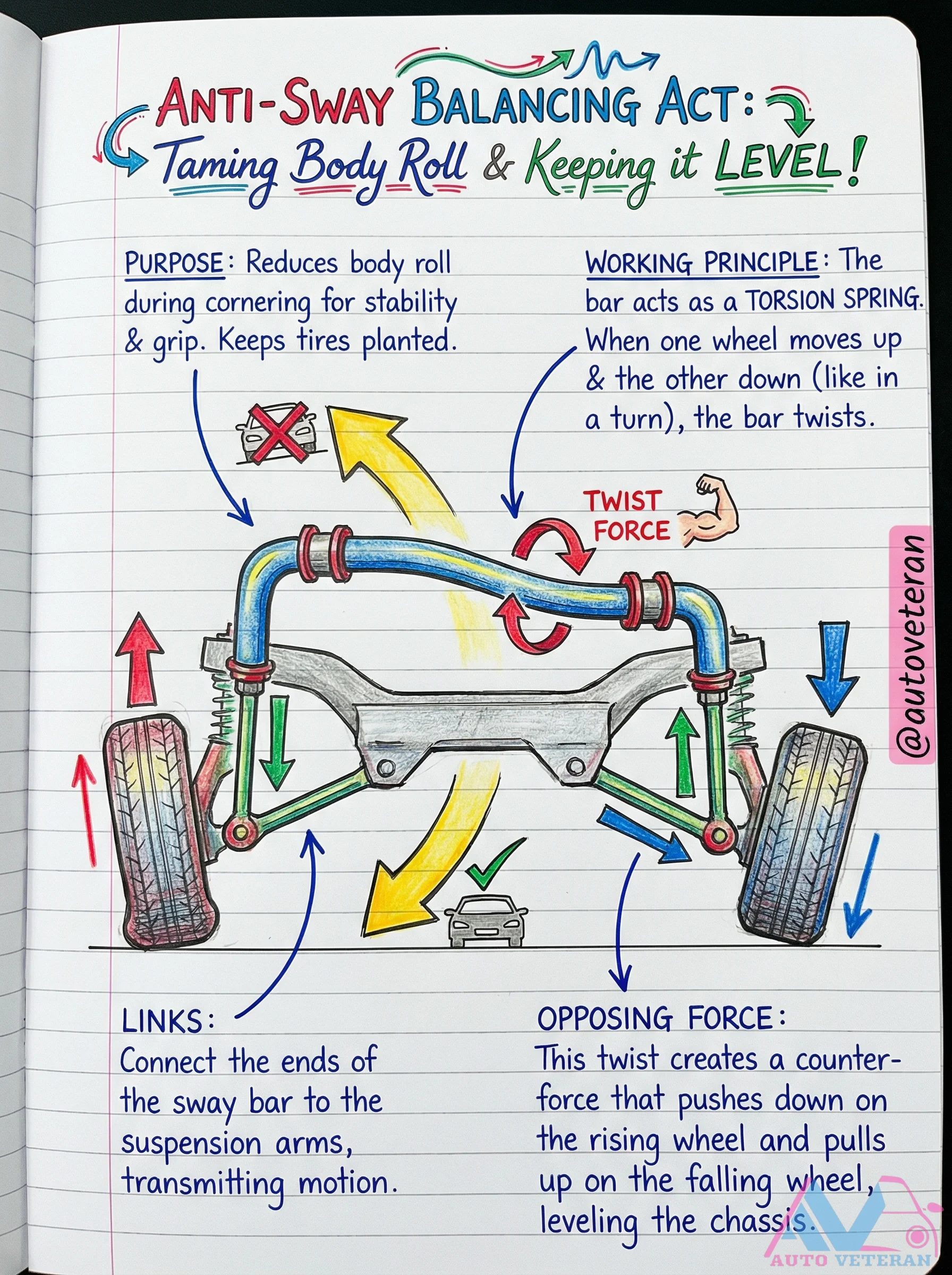
During cornering maneuvers, the anti-roll bar system actively resists body roll through a sophisticated mechanical interaction; the blue bar component compresses the outer suspension while transferring torque to lift the inner suspension via the red linkage, creating a balanced force distribution that stabilizes the vehicle and enhances handling performance by minimizing body lean.
Anti-Sway Bar Body Roll Reduction Principle
The anti-sway bar functions as a torsion spring to counteract body roll during cornering, keeping the vehicle level and maintaining tire grip. When one wheel moves up and the other down in a turn, the bar twists, creating an opposing force that pushes down on the rising wheel and pulls up on the falling wheel, transmitting stability to the chassis.
Antifreeze (Coolant)
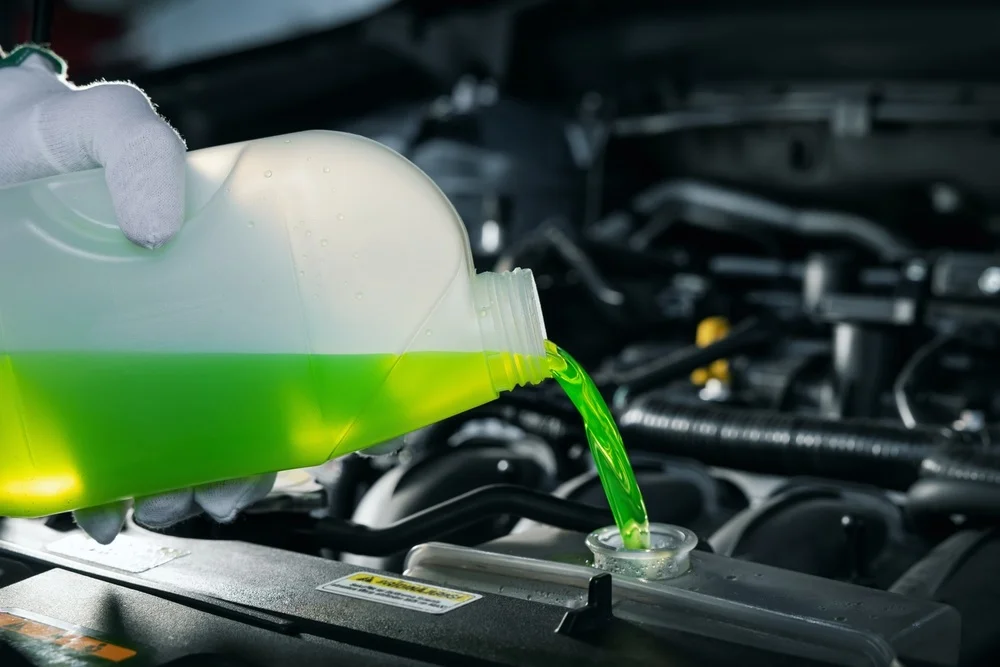
A chemical mixture, typically containing ethylene glycol or propylene glycol, added to the engine's cooling system to prevent freezing in cold temperatures and overheating in hot conditions. It also contains corrosion inhibitors to protect metal components in the cooling system. Modern antifreeze often comes pre-mixed with water in a 50/50 ratio.
Automatic Transmission
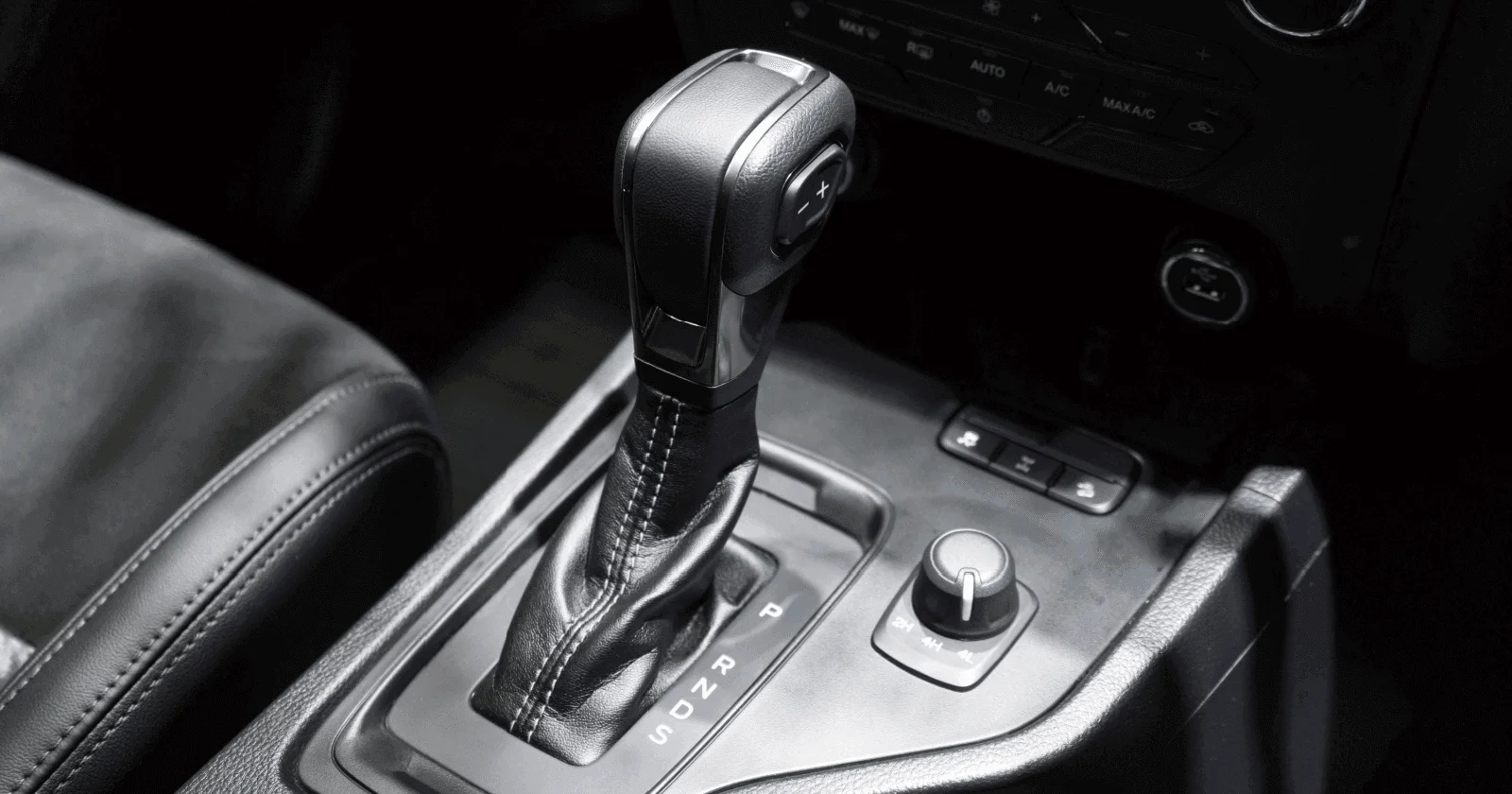
A type of transmission that automatically changes gear ratios as the vehicle moves, freeing the driver from manually shifting gears. It uses a torque converter, planetary gears, and hydraulic controls to select the appropriate gear based on vehicle speed, engine load, and throttle position. This provides smoother acceleration and easier driving compared to manual transmissions.
Automotive AC Refrigerant Cycle Components
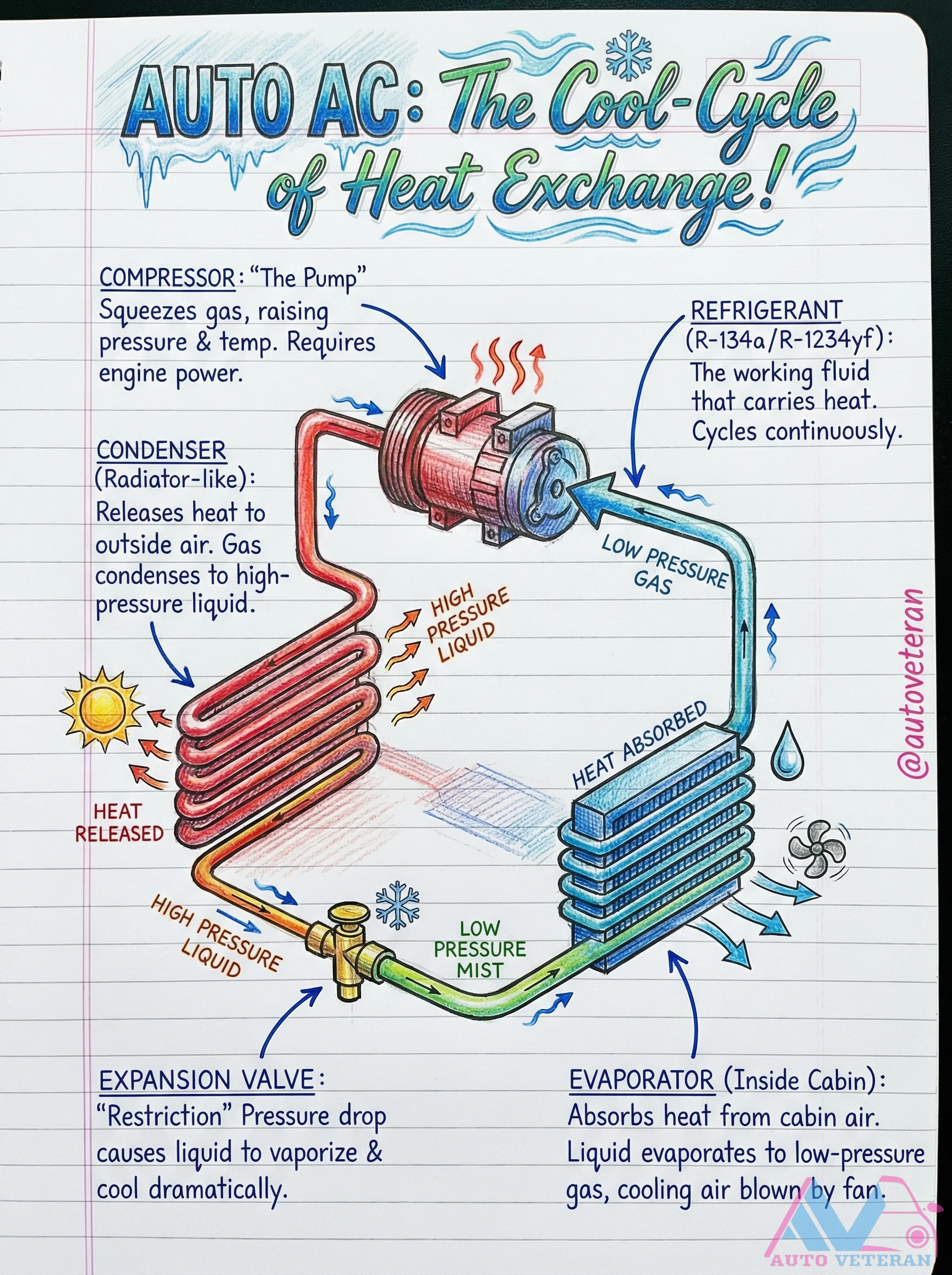
The automotive air conditioning system operates through a continuous refrigerant cycle, where the compressor acts as the pump, squeezing gas to raise pressure and requiring engine power. Refrigerants like R-134a or R-1234yf serve as the working fluid that carries heat. The condenser releases heat to outside air, causing gas to condense into high pressure liquid. The expansion valve creates a restriction that causes pressure drop, allowing liquid to vaporize in the evaporator, which absorbs heat from cabin air and dramatically cools it as air is blown by the fan. This cycle transforms low pressure mist into high pressure liquid and back, facilitating efficient heat exchange.
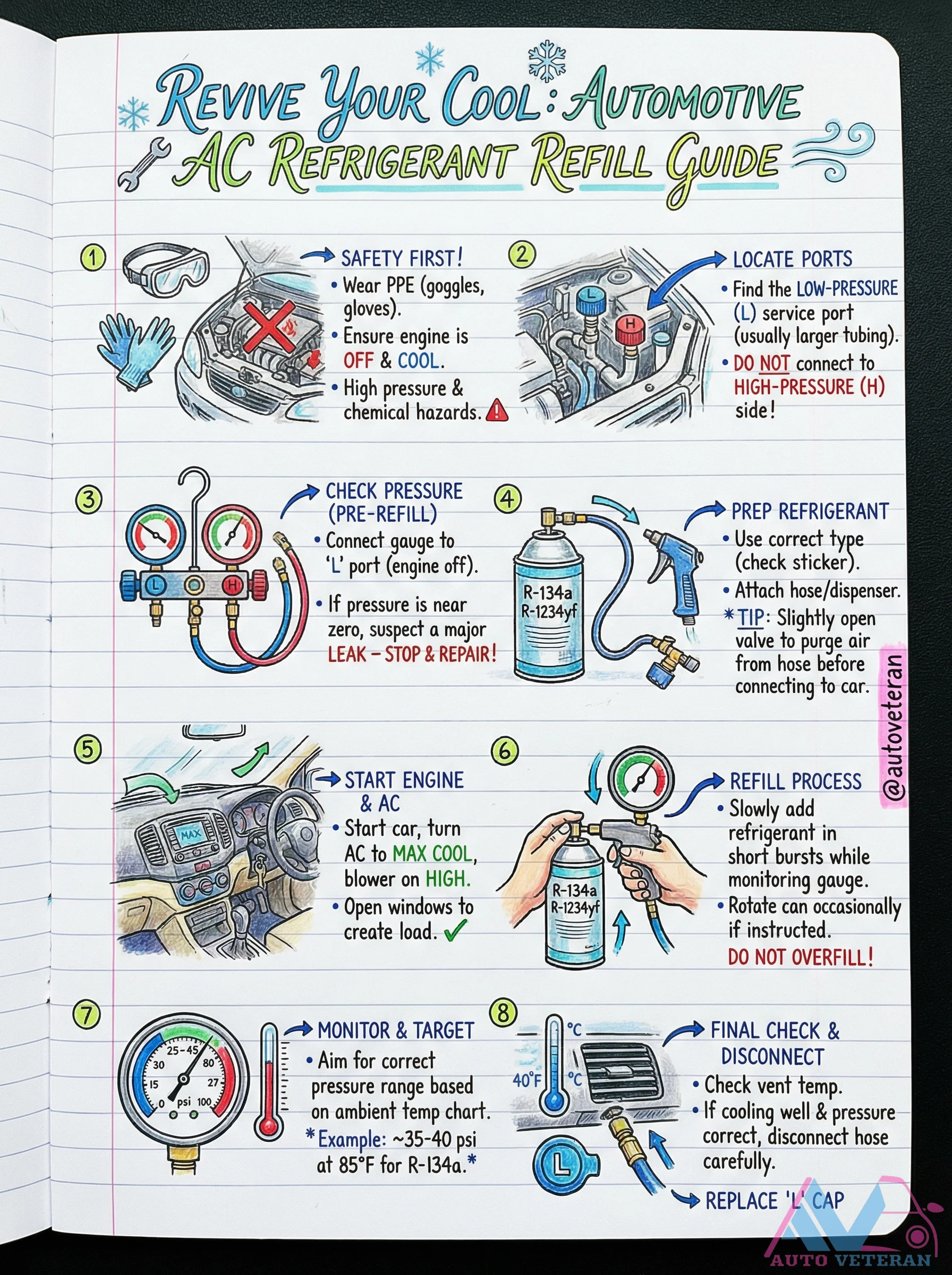
Automotive AC Refrigerant Refill Safety and Procedure
This guide details the essential steps for safely refilling your vehicle's air conditioning refrigerant, emphasizing critical safety precautions like wearing PPE and identifying the correct low-pressure service port. It covers pre-refill pressure checks to detect major leaks, proper connection techniques to purge air from hoses, and the refill process involving starting the engine with AC on max cool while adding refrigerant in short bursts. The procedure includes monitoring pressure against ambient temperature charts, aiming for specific ranges like 35-40 psi for R-134a at 85°F, and final checks for proper cooling before disconnecting and capping ports.
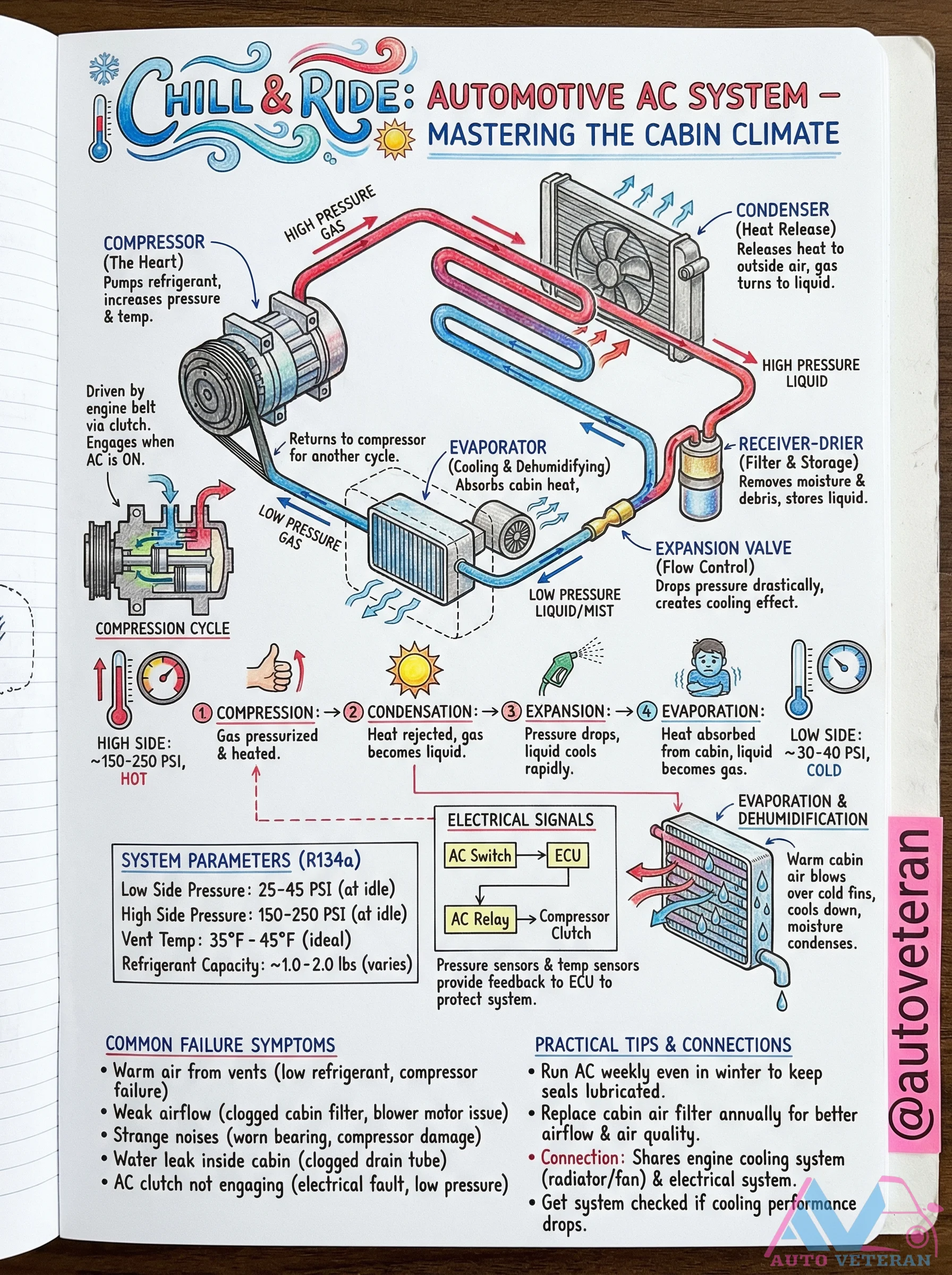
Automotive AC System Compression Cycle and Failure Symptoms
The automotive air conditioning system operates through a precise compression cycle where refrigerant transitions between high and low pressure states to cool the cabin. Key parameters include low side pressure of 25-45 PSI and high side pressure of 150-250 PSI at idle with R134a refrigerant. Common failure symptoms include warm air from vents due to low refrigerant or compressor failure, weak airflow from clogged filters, unusual compressor noises, water leaks from clogged drain tubes, and AC clutch disengagement from electrical faults. Practical maintenance involves running the AC periodically to lubricate seals and replacing cabin air filters annually for optimal performance.
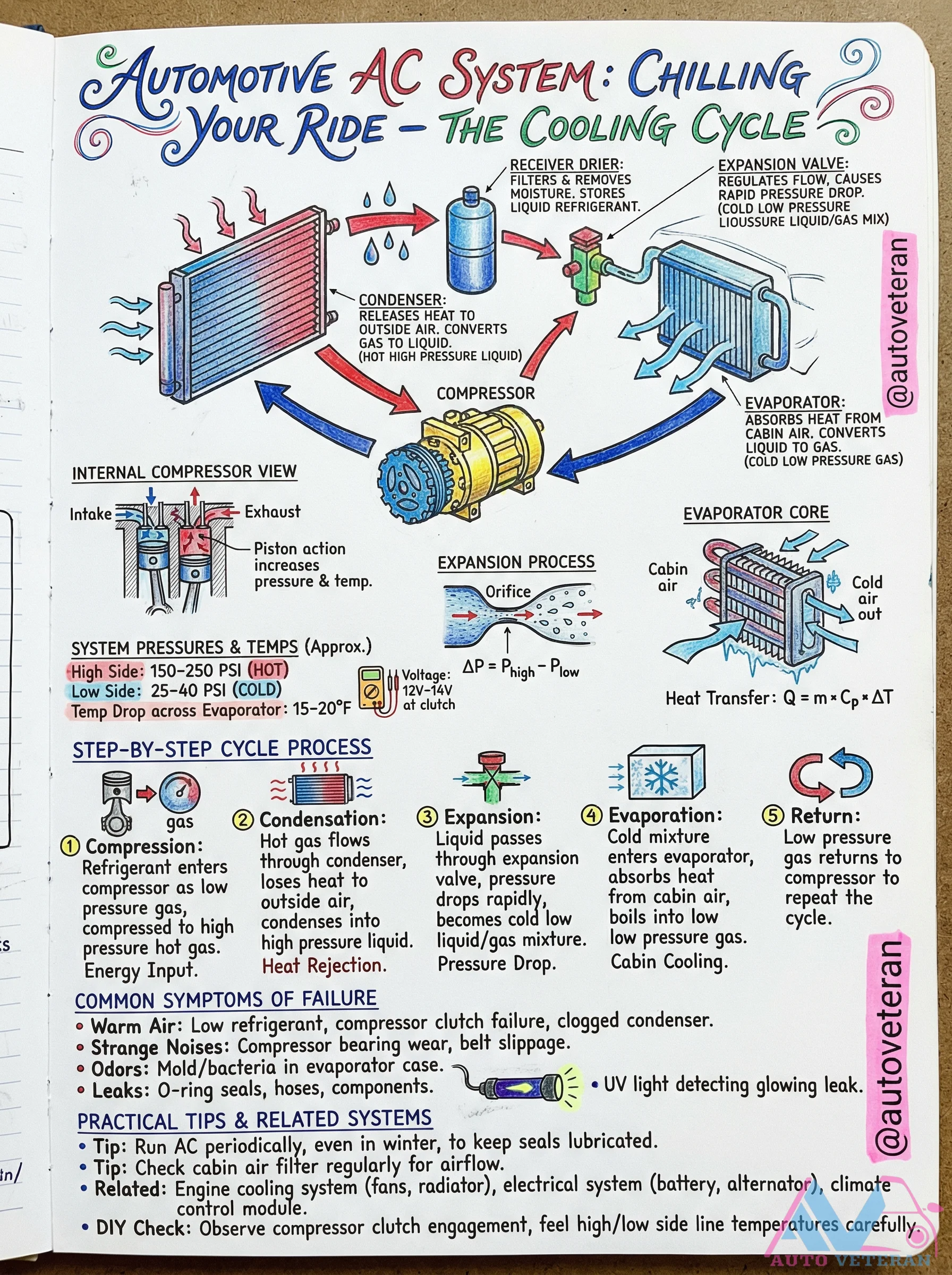
Automotive AC System Cooling Cycle Diagram
This diagram details the chilling process of an automotive AC system, illustrating the cooling cycle from compression to evaporation. It highlights key components like the receiver drier, which filters moisture, and the expansion valve, which regulates refrigerant flow to cause a rapid pressure drop. The cycle involves the compressor increasing pressure, the condenser converting hot gas to liquid, and the evaporator absorbing heat from cabin air to provide cooling. Approximate system pressures are noted, with the high side at 150-250 PSI and the low side at 25-40 PSI, alongside voltage requirements of 12V-14V for clutch engagement. Common failure symptoms such as warm air from low refrigerant or compressor clutch issues, and practical tips like periodic AC operation to keep seals lubricated, are also covered.
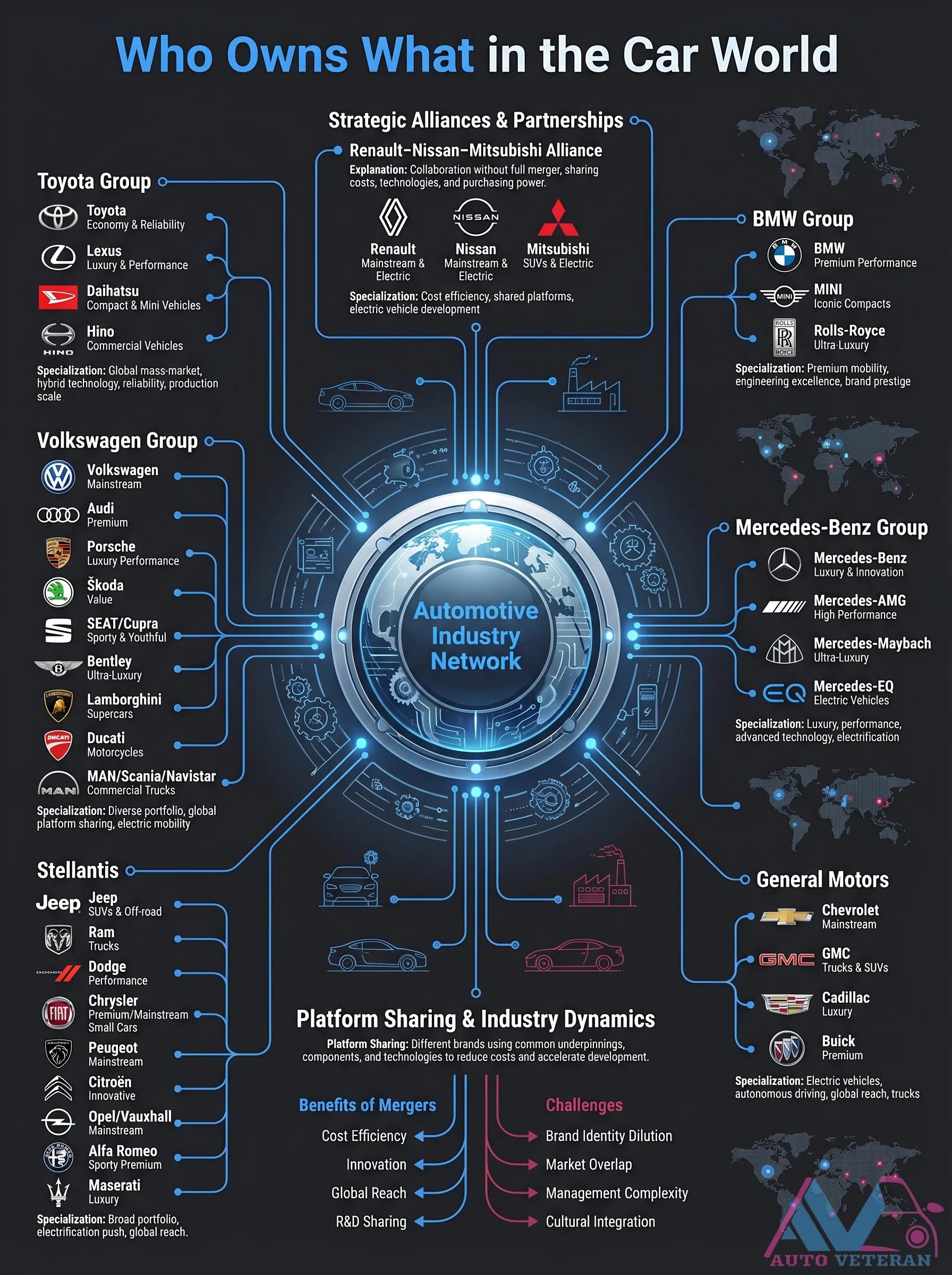
Automotive Alliances and Strategic Partnerships Map
This detailed overview illustrates the complex web of strategic alliances and partnerships shaping today's automotive industry, highlighting key collaborations like the Renault-Nissan-Mitsubishi Alliance, Toyota Group's technology sharing, and Volkswagen Group's portfolio diversification. It explains how different brands leverage shared platforms, components, and technologies to achieve cost efficiency, accelerate development, and specialize in areas such as electric vehicles, premium performance, or global market reach. The map also outlines the benefits of these mergers, including innovation and global expansion, while acknowledging challenges like brand identity dilution and management complexity, providing insight into the dynamic structure of modern automotive networks.